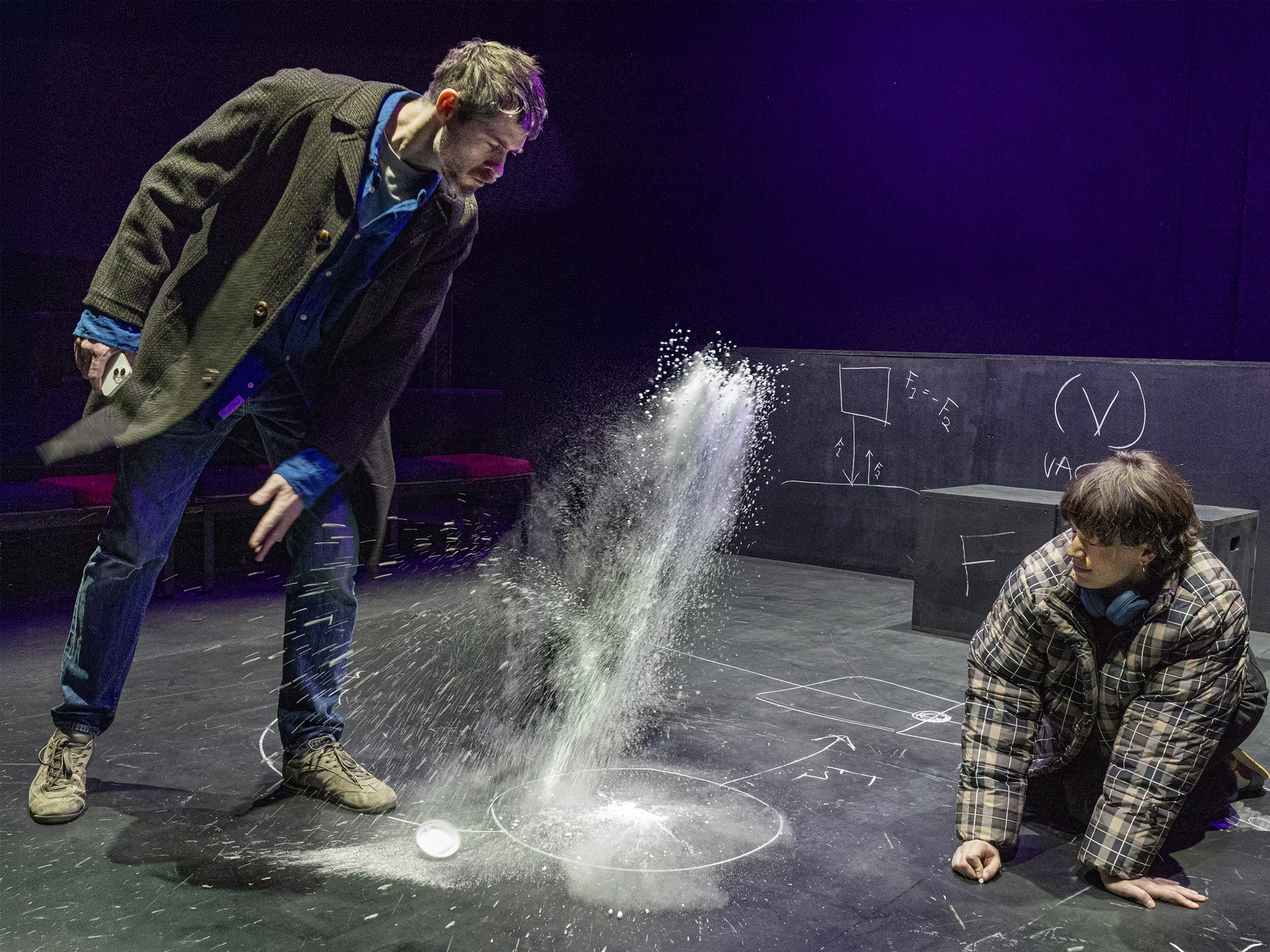
A play that uses, and takes its title from, Sir Isaac Newton’s scientific study sounds, at first glance, completely inaccessible to a science novice. Yet Stephanie Greenwood’s ambitious new work strives hard to use the scientist’s theories on movement and endless motion as an anchor to study a volatile, abusive relationship in this unsettling and deliberately uneasy piece.
Over 75 minutes, a chance encounter on a packed train between Paul (Sean Hart) and Sam (Greenwood) hints at a sweetly chaotic, burgeoning romance. The pair’s whirlwind connection seems, to begin with, a blend of charm and sweetness, yet Greenwood’s writing throws in offhand remarks from Paul about Sam’s behaviour and appearance, alongside an increasingly uncomfortable sense of love-bombing that casts the relationship in a much darker light. As the play unfolds, Greenwood uses physicist Sam’s monologues about physics, gravity, and the forces that bind us together and pull us apart as a neat comparison to the increasingly controlling influence Paul has over Sam’s life.
Largely, the combination of science and human relationships works well here. The presentation of the pair’s emerging relationship is deliberately disorienting as Paul’s charm gradually erodes. Sam’s initial eagerness and slight stubbornness are an intentional choice, helping to mask some of her boyfriend’s more dangerous qualities early on. Relative Motion’s writing style, obvious and immediate, can feel a little jarring until the reality between the couple becomes clear, though there is still something deeply odd about Paul right from our first encounter, where everything feels just too good to be true. Indeed, what works well is that the connection between the two never quite feels right, with the chemistry cold and insecure. In this sense, it is a work that you have to let bring the story to you, rather than one where the beats are quickly signposted. As a result, the script and staging combine neatly to build a sense of tension and dread about how this troubling relationship will resolve.
Like most abusers, Paul’s control starts subtly. Hart’s presentation of the character’s interrogation of Sam is calculated and cold. While the play is a sharp two-hander, it incorporates references to other characters, predominantly Sam’s family and male friend Dan, who arouses Paul’s manipulative suspicions. This propels Paul, like the forces Sam describes, to pull her away from those around her. Greenwood writes him as an author putting together a new novel on the impacts of egoism in the dating world. The warning signs are there, yet the way Paul shapeshifts from being too keen to being downright dangerous is cleverly crafted. While some directorial choices from Wiebke Green, such as having Paul moodily puff on a vape, feel a little too obvious in pointing the finger at the villain, the play thrives when Green’s intimate staging allows Paul’s facial expressions and sudden acts of violence to strike hard.
Where Relative Motion succeeds so well is in its subtlety. For much of it, Sam is swept up in Paul’s love-bombing, carried away by his charm and mercurial writer personality, quickly snapping back the ‘I love you’ just as rapidly as her partner. Yet as reality emerges, Greenwood’s deft portrayal draws out the psychological impact of Paul’s treatment on Sam, illuminated acutely by quiet, effective lighting choices from Ciarán Cunningham. Although this feels slightly short-changed by the play’s brief runtime, the contrast between Sam’s confidence as a physicist and the tongue-tied, scared girlfriend is impactful. Throughout the play, Sam moves more frantically around the space than Paul, a subtle nod to the dynamics of control here. Meanwhile, the genuinely awful way Paul treats Sam’s mother’s illness, emerging in one darkly sharp joke, is quietly yet disturbingly absorbed by Greenwood’s protagonist.
Almost a decade in the making, Relative Motion cleverly uses the ‘boy meets girl on a train’ romance trope and spins it into something much starker. While the last few moments threaten a tease that could completely derail the work, Greenwood’s resistance to tonally shifting the piece to the extreme is the sensible choice. Sam, earlier in the play, reflects on the laws of motion: while it can appear that someone is moving, to them, they are stagnantly still, a stagnancy from which Sam herself tries desperately to emerge.
A sharply unflinching new play.