I sat down with Scapegoat Theatre Company to find out more about Blue Hour coming to Theatro Technis this November as part of Voila! Festival.
Can you tell me a little about your show and what audiences can expect?
Audiences can expect to see something that challenges their expectations. To be surprised, to laugh, to feel unsettled, and hopefully to identify with some of the traits of the characters in the play.
They can expect to be immersed in the two worlds of the play: the first being the lives of seamstress Sanja, who has moved from Germany to be with her husband, shipbuilder Owen, and their charismatic neighbour Celeste, who starts to feel more than friendship for Sanja. The second world of the play reveals a window into the turbulent relationship of chaotic Marie, who doesn’t know what she wants in life, and her girlfriend Kara, a Greek photographer who can’t seem to fully commit, and Marie’s sister Iris, who appears to always have everything together.
Blue Hour blurs the boundaries between the subconscious and conscious, and hopefully leaves the audience feeling the urge to question what their dreams might be telling them.
What drew you to this specific story?
Blue Hour began as our final thesis project at East 15 Acting School. Believing in the potential of the story us creatives Kim Rechsteiner, Nasia Dalla, and Giverny Masso decided to take the project further and delve more into the lives of the six characters.
Originally, we were all drawn to dreams and sleep disorders, and we set out to explore them properly. We kept sleep journals and read widely about how dreams work, and over time we noticed a pattern: vivid dreams and nightmares often seemed to carry trauma that had been passed down through families and previous generations. That observation became the heart of the show. Blue Hour follows two couples, each carrying their own inherited wounds and dreams, and traces how those stories become tangled together, so that one family’s fears start to shape the other’s nightmares.
With a cast of six – Giverny Masso as Marie, Nasia Dalla as Kara, Kim Rechsteiner as Sanja, Arne van der Esch as Owen, Suha Ali as Celeste, and Myrtó Katsoulidou as Iris – we explore intricate relationship dynamics affected by family histories. Further creatives include the multi-award-winning director, actor, and writer Anca Vaida, movement consultant and intimacy coordinator Rebecca Goh, set and costume designer Agatha Vornicu, and tech and sound designer Allie Yu Hu.
What has been the biggest challenge in bringing this production to life?
As a self-produced play, one of our biggest challenges has been working with limited resources. We dream big and have so many wonderful ideas, but we also need to be realistic about what we can afford when it comes to set, costumes and the people who support us in bringing the production to life.
That said, we’ve managed to bring so many different elements together, and we’re really proud of what we’ve created. We’re incredibly grateful to have such a talented team of creatives supporting us throughout this process.
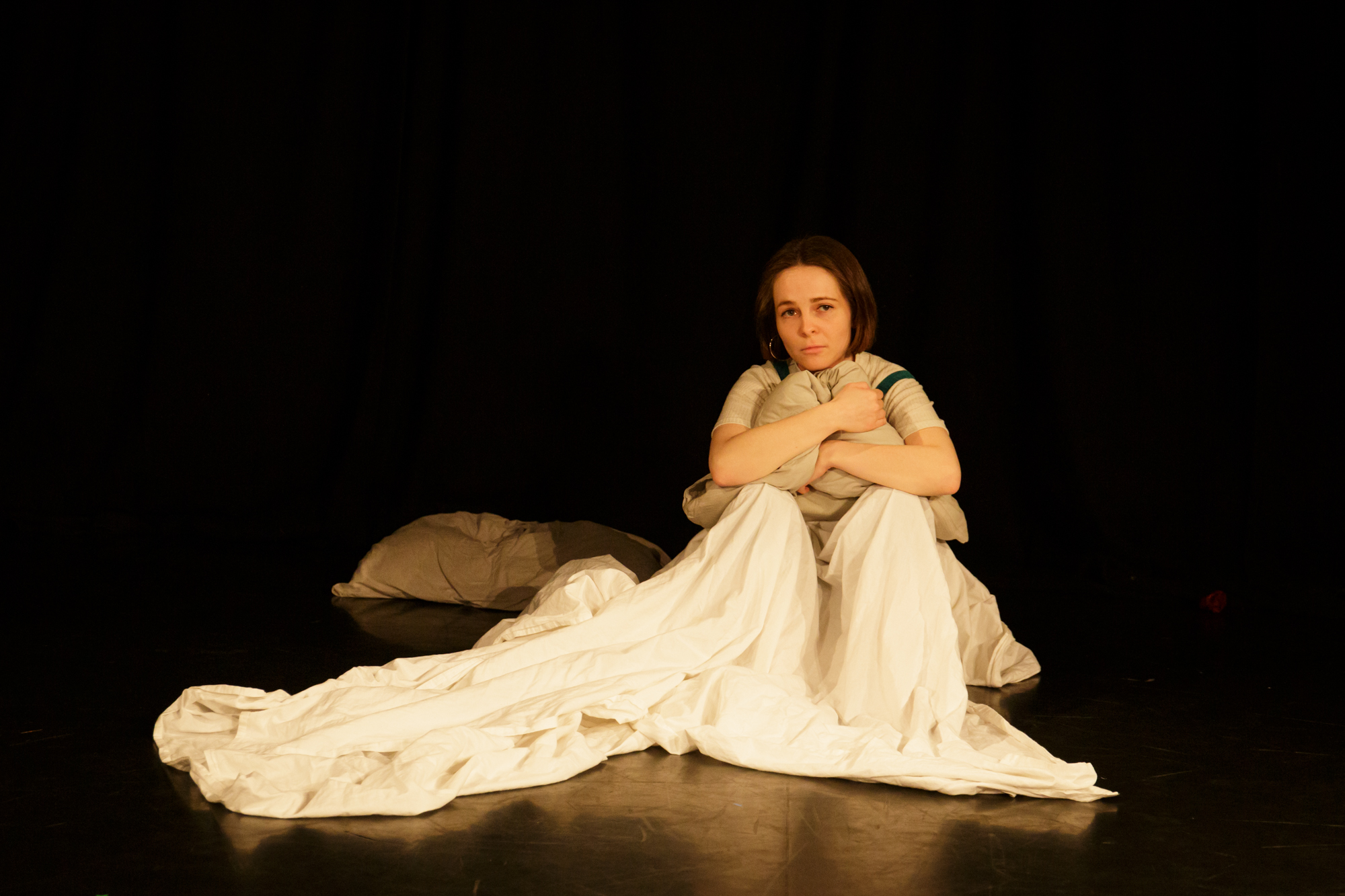
Just to give you a little glimpse: our set is divided between two different timelines, we have a bed on stage, and we also explore a number of abstract scenes featuring dreams and nightmares. Finding ways to bring all these different worlds together in a way that feels both visually compelling and dreamlike has been a wonderful challenge, and we feel we’ve managed to achieve something really special!
How does the design of your show (set, sound, or lighting) impact the presentation of your story?
Blue Hour is a play about dreams, transitions and liminality. The blue hour itself is the shift between day and night, the moments before sunrise and after sunset. Design is therefore integral to guiding the audience through the characters’ journeys in time and between their conscious and subconscious states.
Agatha Vornicu’s intricate set and costume design breathes life into the characters and the two worlds of the play. We see shipbuilder Owen and seamstress Sanja move in together in Portsmouth as a recently-wed couple, and witness their relationship unfold. Vornicu firmly anchors this storyline in the 80s – think shoulder pads and colourful tableware! – and moves the story across different seasons.
Meanwhile, in 2015, we witness the turbulent entanglement between chaotic fashion designer Marie and Kara, a photographer from Greece who is meticulous and practical. Vornicu’s creative and expressive design for Marie puts her in stark contrast with Kara, who has many variations of the same shirt!
Design is also integral to the dreams in Blue Hour. Dreams are a multi-sensory, surreal experience, where we are haunted by echoes of the deepest parts of ourselves, and where faces, time and settings blur. We therefore use sound, lighting and costume design to conjure the atmosphere of these subconscious spaces, as well as movement, to express the feelings we have in dreams that cannot be articulated with words.
If you could sum up the show in one word or phrase, what would it be and why?
A mix between self-awareness and self-destruction. Our generation has become really good at being self-aware of the trauma that has been passed down to us from our parents and their previous generations. To then act upon that self-awareness to change those patterns is quite difficult, though, which is why we find ourselves repeating the same cycles over and over again, while realising that what we do is not actually serving us.
There is a quote by Bonnie Burstow that sums this up perfectly and will give you a little taster of our play: “Often father and daughter look down on mother (woman) together. They exchange meaningful glances when she misses a point. They agree that she is not as bright as they are, and cannot reason as they do. This collusion does not save the daughter from the mother’s fate.” While it sometimes feels easier to blame our parents and especially our mothers for having to fix those patterns, it is on us to change them.
Blue Hour runs at the Theatro Technis, London, on 16 – 17 November. Tickets available at https://www.voilafestival.co.uk/events/blue-hour/