I sat down with writer Leaf Wang and director Yanlin Zhang to find out more about Aftercare coming to the Etcetera Theatre this December.
Can you tell me a little about your show and what audiences can expect?
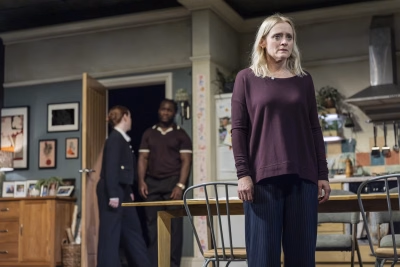
Leaf: As a writer, Aftercare is my first full-length play: an hour in a Battersea nail salon with three East Asian women, in English and a little bit of Cantonese.
Eliot is twenty-one, charming, funny, about to graduate as a games designer, and head over heels for Chloe, a banker eight years older. Eliot’s mum, Yanan, built the salon with her own two hands and thinks the worst secret her child could have is being gay. Then Chloe walks into the salon with something on her phone, and one night turns everything inside out.
Expect to laugh, especially in the first half. Expect some game logic too: pauses, rewinds, choices. And then expect the floor to drop. It’s a play about love, family and the things we learn at home without anyone meaning to teach us. It deals with abuse, so please check the content guidance before booking.
What drew you to this specific story?
Leaf: It all started with gender, or more precisely, with the rules of what a man is and what a woman is. I’ve been sensitive to those rules since I was a child. Probably too sensitive. Maybe that’s because I grew up without a father figure. Nobody showed me what a man was supposed to be, or what a woman was supposed to be.
But as I grew up, the world couldn’t wait to hand me the rules anyway. Men are strong, but also fragile, so women must handle them gently! Women are fragile, but also endlessly maternal. The same old clichés. Every time I heard them, I thought: what the fuck is going on?
So I imagined a girl who doesn’t admire strength in other people. She makes herself strong instead. She takes the wrong road, but the road has its own logic. She notices that the most dangerous men are always surrounded by women who can’t let them go. So she thinks: why can’t I learn how they do it? And she does. She learns all of it, including how to look vulnerable at exactly the right moment.
We talk a lot about victims, and rightly so. We talk much less about how harm gets passed down, and how charming it can look when it does. I wanted to write a queer East Asian character who is lovable, pitiable and genuinely hard to watch, sometimes all in the same minute, because queer characters deserve that complexity too. Eliot (she/they) is that character. I didn’t want to explain her away, and I didn’t want to condemn her. I wanted the audience to sit with her.
What has been the biggest challenge in bringing this production to life?
Yanlin: The biggest challenge is how to make the most of all the artistic ideas and authentic expression within our limited time and budget. The script is quite clear, and everyone has a sharp creative mind, which somehow makes it even harder to sort through all the ideas everyone has and bring them together into one artistic language.
Most of our creative team graduated within the last two years, and we’re all working part-time jobs to survive in London. As early-career theatre makers, it’s just hard to find enough brain space and energy to focus on creating. As a director, I’ve learned from my previous experiences how important it is to have a clear vision before stepping into the rehearsal room. I need my own time to think and plan, but unless I sacrifice some of my sleep, I genuinely don’t have the time.
Also, I think the most difficult part of directing new writing, for me personally, is working with the writer. Directors always want something strong and clear, but writers often want something deeper and more complicated. It takes a lot of wisdom and restraint to figure out how to handle such a delicate relationship. Leaf is a very talented writer, and Aftercare is like her child. Whenever I suggest anything, I have to think about how to say it without bringing in personal judgements that might not be helpful and could just cause confusion.
But working with the writer is also the part I enjoy the most. There’s so much to discover! Once we reach a shared understanding of the whole play, rehearsals and working with actors just feel like water flowing into the sea. And the fact that we’ve managed to put Aftercare together in such a short time feels like a miracle.
How does the design of your show (set, sound, or lighting) impact the presentation of your story?
Yanlin: I like this question because I do agree that all the design elements have to serve the language of the whole play. I’ve always been kind of obsessed with the concept of “language” on stage. Set, lighting and sound are undoubtedly forms of non-verbal language, so I’m trying to figure out how to give the designers clear directions while still leaving them enough space to create within that concept.
Our design work is still in progress. However, I’d say everything is built around one concept: a cheap, colourful, game-like world that eventually falls apart. From my point of view, this play is about the trauma of immigration between a mother and daughter. Fear creates a cycle of violence, and some patterns of trauma are really hard to break, like a cage that keeps Yanan, Chloe and Eliot trapped inside.
At the beginning, everything seems okay, even energetic and cute. But gradually, it becomes a little weird and unrealistic, until eventually everything goes dim. Yanan forces Eliot out of the game-like world Eliot has created for herself, a world that both protects and destroys her. Only then can Eliot begin to see a new world and new possibilities.
And as for the rest, you’ll have to come and see the show in early December!
If you could sum up the show in one word or phrase, what would it be and why?
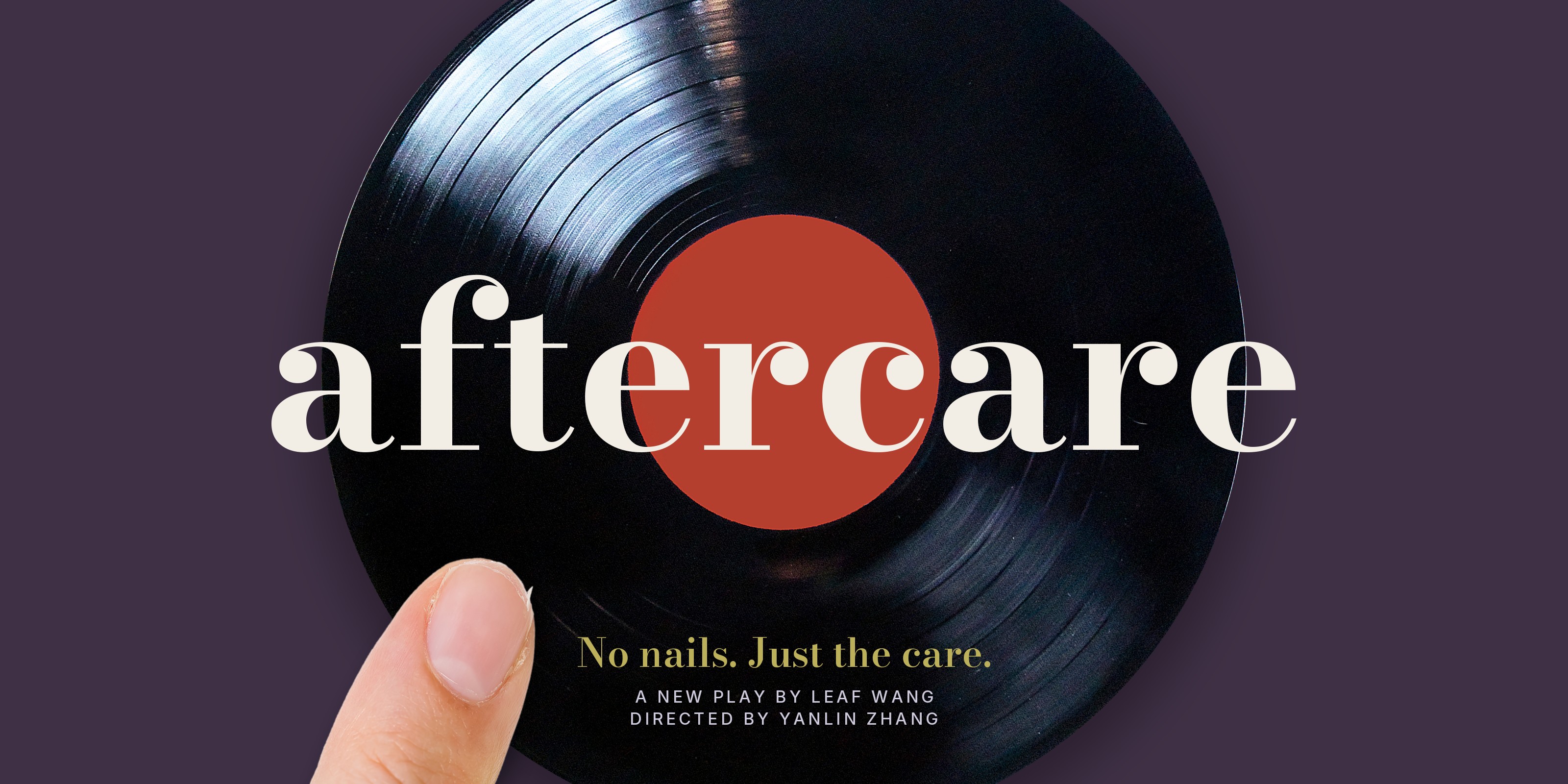
Leaf: “No nails. Just the care.”
It’s the last thing Yanan says to her child, and it’s also our poster line. Out of context, it sounds tender, like something a nail technician might say on a slow afternoon. By the end of the play, I hope it means something very different. That gap, between what care looks like and what it can cover up, is what Aftercare is about.
Aftercare runs at the Etcetera Theatre, London, on 3 – 6 December. Tickets available at https://events.humanitix.com/aftercare-r8p9ztsj