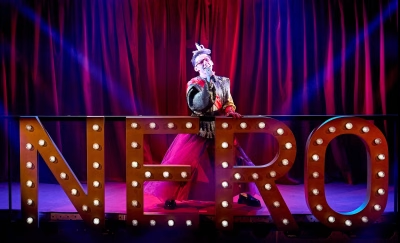
With the golden frame of the Lyttelton’s stage broken into two, scattered across the stage and with audience members casually striding through the play, one could be forgiven for thinking that Cloud Nine is as daring and as provocative as it once was when it debuted almost half a century ago. But amid the bluster and gimmick of the staging, Caryl Churchill’s swipe at colonialism and fierce exploration of modern sexuality feels a little less impactful in this ambitious but uneven revival.
It is an unusual play in that it is split into two distinctly different acts, the first being one satirising colonial behaviours in Africa during the Victorian era, and the latter set during the late seventies, though oddly just a quarter of a century has passed for the characters, as Churchill’s central message about acceptance and the rejection of social conformity bubbles to the fore.
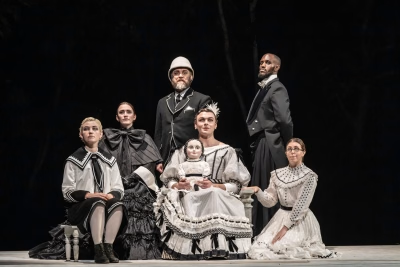
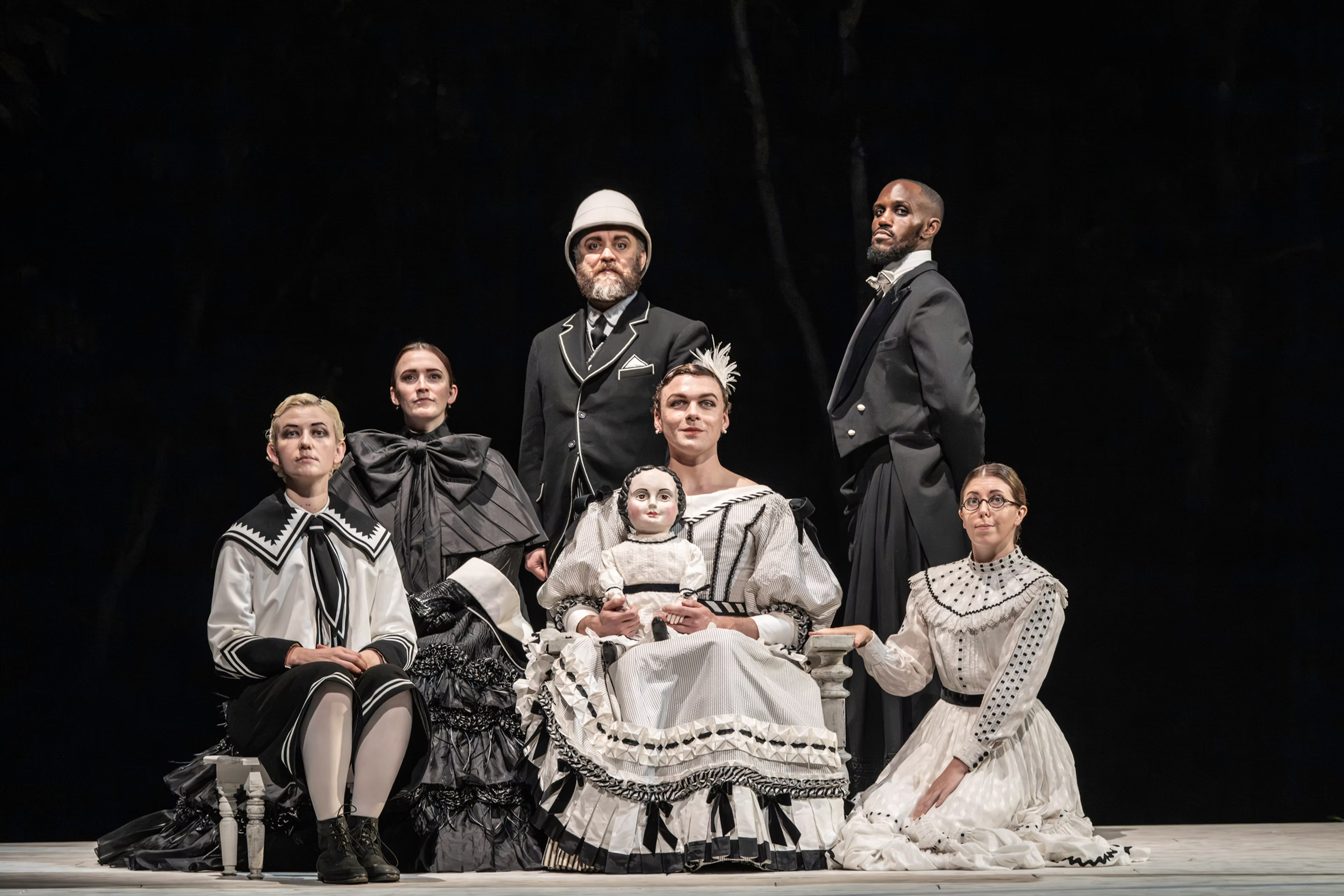
Undoubtedly, Churchill’s script, and Dominic Cooke’s direction here, is an ambitious one. The play’s first half, a satirical parody of Victorian society, deriding contemporary sensibilities and turning the family, representatives of Queen Victoria in Africa, into a sex-mad, riotous clan, is enormous fun. Led by patriarch Clive (a sharp Sam Troughton), the characters burst into melodramatic, lustful, and problematic speeches and acts that reveal their urges and contrast with their expected upright Victorian values.
Stuart Thompson’s hysterical Betty is flighty and erratic, while the dashing explorer Harry Bagley (Tom Mothersdale) causes Betty to swoon while also becoming entangled in the desires of Clive’s son Edward (Ellen Robertson). Indeed, the gender swapping of the characters is a deft touch in drawing out some of the absurdity of the values and traits being parodied here, while Eloka Ivo’s portrayal of Joshua, an African serving Clive’s family, flies in and out with an acerbic wit that serves as a brutal retort to the stereotypical colonial arrogance of the family. The buffoonish nature of the British here is neatly skewered in a fast-paced first half that lands many of its comedic aims with full force.
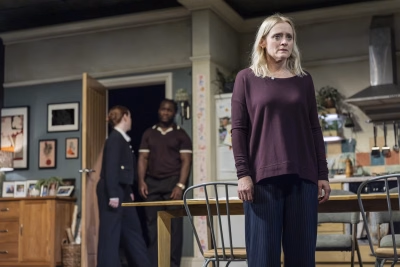
Yet it is in the second half where the work falters a little. Here, the spotlight is firmly on sexual awakening, largely centred around Victoria (Charlotte Ritchie), who in the first half was performed by a ventriloquist’s dummy, and who after the interval is attempting to find her own voice both in and out of the bedroom. Ritchie’s portrayal of Victoria, unsure yet keen to experiment, is engaging, yet the piece suffers from taking just too long to get to when Victoria and Lin (Rebecca Humphries) get together, less of a will-they-won’t-they and more of a well, we knew that was coming.
It is not the telegraphing necessarily that is the problem, but, oddly, a play with such a textured first half that relies on satire and wit becomes so painfully obvious and clear-cut after the interval. The play’s response to sex and sexuality feels a little outdated here, and so perhaps the decision to bring the audience on stage to roam freely in the second half, in a move that feels more like a gimmick than anything that adds any value to the piece, is an attempt to add some revolution into the work.
Cloud Nine encourages audiences to reconcile with Britain’s historical place in the world, and its contemporary position too. Interestingly, it is the critique of colonialism and the narrow-minded views of the past that feels more relevant today than the sexual revolution the play championed in 1979. It is a noble effort, but one that feels more celebratory of a work of its time rather than one that is going to provoke social change today.