When looming over gladiatorial battles, Roman Emperor Nero is commonly believed, albeit unconfirmed, to signify the death or survival of a competitor with a simple thumbs-up or thumbs-down. In this new, chaotic, long-awaited musical imagining of the tyrant’s life, it is this Emperor who looks fated to be doomed.
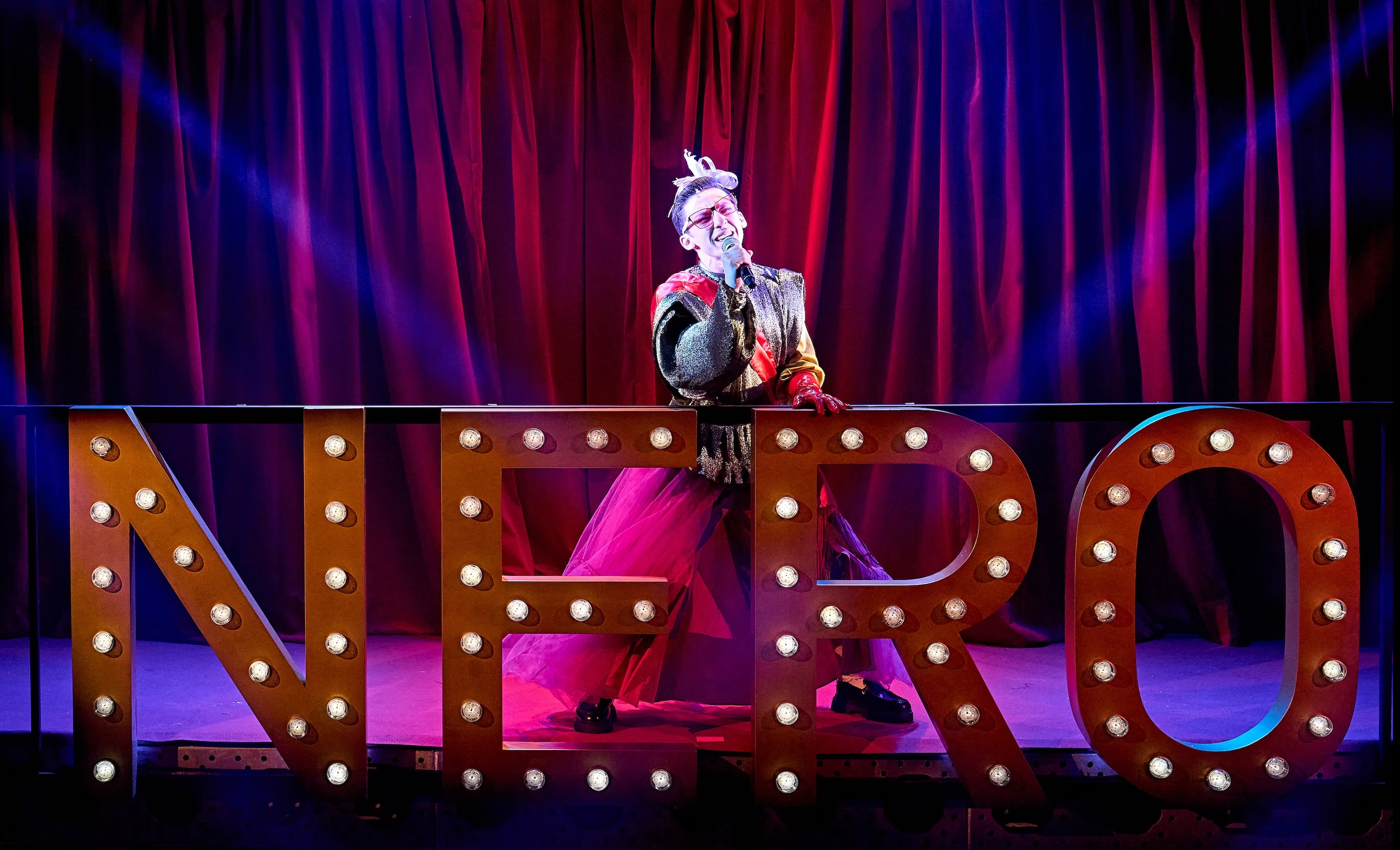
Nero, a new musical that brings together once again the creators of Spring Awakening (Steven Sater and the late Duncan Sheik), throws us into the chaos of succession in Ancient Rome, where the flamboyant eponymous new leader (Andrew Barth Feldman), ill-suited to power, is corrupted by violence, gold, and an unhealthy relationship with his domineering mother, Agrippina (Sally Dexter). Over a tonally conflicting two hours, Nero, like the play itself, swings wildly from violent monster to lovestruck goof, moulded in the image of others, before eventually settling on a crazed and monstrous existence.
As Nero, Feldman’s overtly expressive portrayal of the brash, bold man thrust into leadership by those around him is enjoyable and energetic. As leading musical performances go, Feldman’s presence oozes a charisma apt for the tyrant, demonstrated no better than when covered in an enormously lavish golden drape. Here, director Lindsay Posner’s styling of Feldman works best when Nero is strutting and singing, and less so when kicking pregnant Poppea (a terrifically poised Rhianne-Louise McCaulsky) to her death, clashing with the loud, exuberant style much of the musical goes for, and ultimately failing to capture why Nero is so infamous in the first place.
Meanwhile, Dexter’s poisonous Agrippina is acerbic and desperate, throwing herself at any power opportunities, or man, that comes her way. Dexter’s delivery of Agrippina’s conniving character is entertaining, but the character’s bitterness at her isolation, lamenting and throwing tantrums over the balcony, feels overdone, with Posner’s direction and the musical’s book creating a pantomime villain. This might work if the musical did not then lean so heavily on the rumours of incest between Nero and Agrippina, culminating in a bafflingly romantic duet between the pair.
Stephen Carlile’s Seneca, the philosopher whose words propel Nero to initial greatness, is good fun and works well with the ensemble to satirise the gossiping and meddling of the Roman forum. Moreover, Nabi Brown’s sweetly quiet performance as Octavia, Nero’s tortured wife whose family is gradually massacred by the Emperor, is the play’s standout performance.
It is remarkable that a production that has had so many workshop iterations is still in such a state of insecurity. The musical is in no short supply of hardworking performances, yet it struggles to lift itself out of its own self-inflicted chaos, much like the leader whose story it tells. As well as the aforementioned incest ballad, the musical never truly settles on what angle it wants to take. Characters fly in and out in traditional dress and togas before pulling out guns. Much of the play stays light and satirical, and then Poppea meets her violent end in a way that contradicts the reasonably likeable manner in which Nero has been crafted up until that point.
While Nero watches Rome burn, one cannot help but wonder whether we too are watching this musical dream go up in flames.