There is something deeply poetic in this quiet, unassuming, yet moving revival of Samuel Beckett’s work, deftly delivered by Gary Oldman.
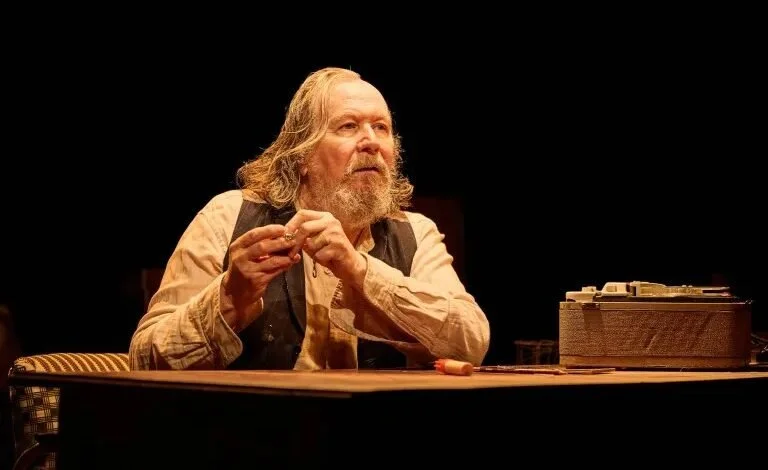
Clocking in at less than an hour, the production moves at a deliberately slow pace from the moment it begins, with Krapp (Oldman) gradually climbing the stairs into a chaotically cluttered attic where, it seems, his entire life is spread across the room. As Krapp settles into his chair, the piece becomes an intimate spotlight on a man and his reconciliation with his past, its pains and its lost opportunities, all captured on recording spools. These are old tapes that the mercurial figure replays, reliving and re-suffering his past.
Oldman’s direction here, at face value, appears simplistic, with Krapp sat almost exclusively at a desk. Yet, the layering of Krapp’s movements, his anguish, and his fragilities provides a deft, appropriately subtle reaction to the intimacy of the tapes. In this sense, the piece feels completely voyeuristic; we, as the audience, are sitting and listening to a man’s isolated, private life, clearly tucked away from society and intended for his ears only.
Krapp’s behaviour appears ritualistic, much like that of other protagonists in Beckett’s writing, yet here the rationale feels a little too obvious. This is a man ravaged by the passing of time and lost opportunities, emphasised by Oldman’s design. The bleak mountain of tapes, books, and banana skins (which feature in a fittingly absurd opening) create a sense of baggage and detritus that the protagonist has collected over the years, and now both literally and metaphorically holds onto. Nevertheless, Oldman’s portrayal is sharp and absorbing, holding the audience’s attention, albeit with very little spoken material, across the short yet poignant piece.

Krapp’s Last Tape, however, is preceded by Godot’s To Do List, a new work from Leo Simpe-Asante in the style of Beckett, which uses the writer’s most famous creation to pass comment on the chaos and absurdity of modern life.
Directed by Aneesha Srinivasan, in this piece Godot (Shakeel Haakim) is the protagonist. Before he can go and meet his friends (presumably those ‘Waiting’ for him…), he must complete increasingly frustrating tasks delivered by an all-seeing, all-knowing voice (Flora Ashton). It is a neat setup and one that, lasting only twenty minutes, is effective in looking at the way modern life is condensed into small, banal tasks reminiscent of social media inspirational captions (‘Task: Learn something new about yourself’). The instant gratification Godot gets soon fades, and he finds himself trapped in a never-ending race to complete a relentless list of tasks. Haakim’s characterisation works well here, and his exasperation is both desperately sad and desperately funny, especially in the way his entrapment in the chaos of modern life resonates.
That said, while Simpe-Asante’s writing is clearly inspired by Beckett, it is far more obvious in its execution, relying on slapstick humour and goofy gimmicks (an imaginative use of a crunched carrot) for effect in a piece. It would be interesting to see what difference to the evening it would make if Oldman’s Krapp came before Godot’s list, rather than after it.
As individual pieces, neither production takes flight on its own; yet, intriguingly, the pair support each other well in this short yet captivating double-header. What is clear is that a modern Beckett is far more palatable for the masses than the man himself, so perhaps this is what 21st-century theatre is waiting for?