A bookshop is designed to propel you into a myriad of exciting stories, yet in this shop, the people who work and live there suffocate in a life of dusty missed opportunities in this impressively poignant debut work from Oliver Judd.
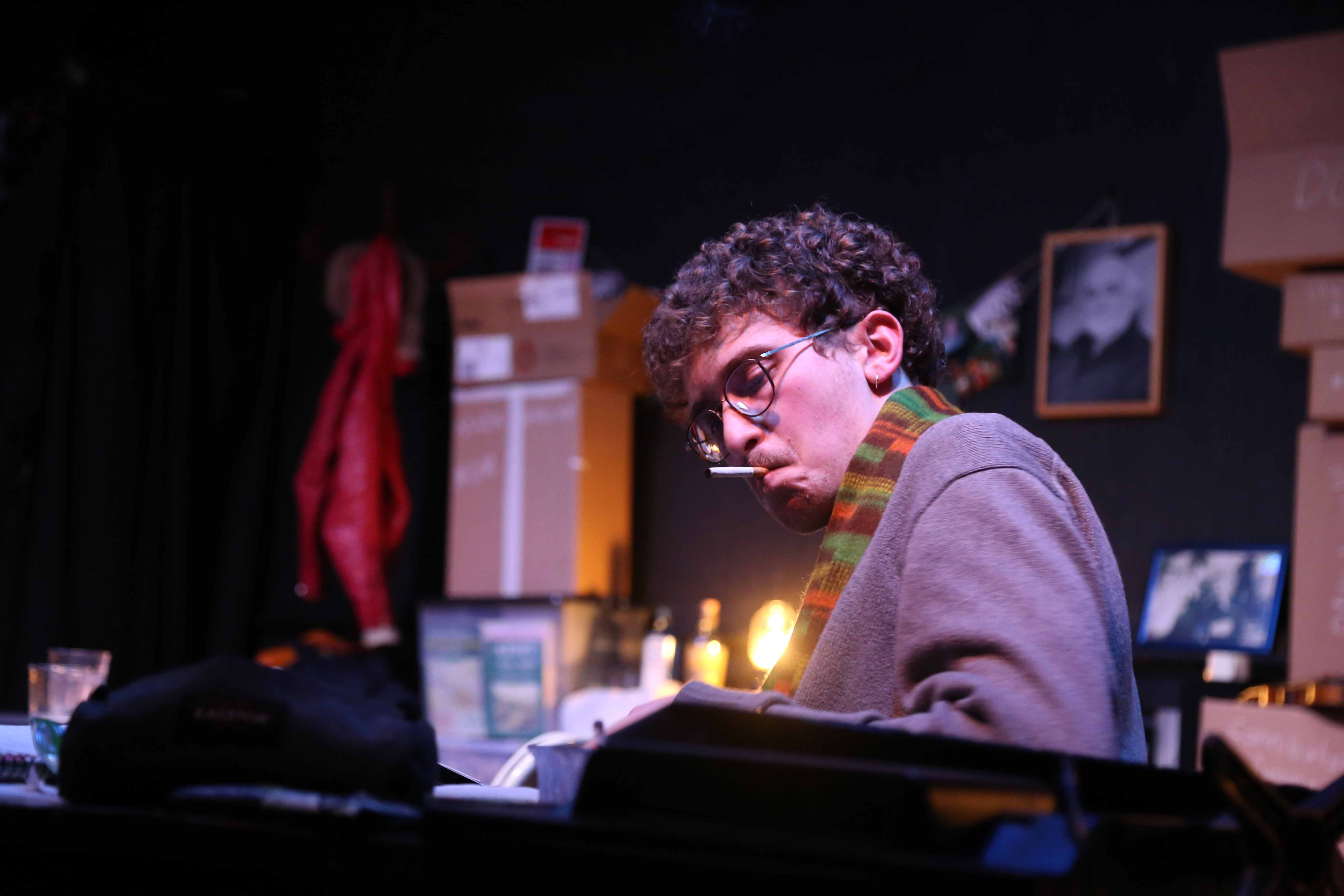
Judd’s play centres upon bookshop owner Oscar (Will Walford), a once-aspiring novelist who inherits the rundown bookshop relic from the long-deceased Eddie, himself a relic of the past whose antiquated views on literature have guided Oscar ever since. Surrounded by dusty books, scattered boxes, and no customers, chain-smoking Oscar cuts a mercurial, forlorn figure, despite the best efforts of partner Alice (an excellent Gia Imo), who both tolerates and is exasperated by Oscar’s difficult behaviour and the changes in him since their youth. Yet the return of Oscar’s former best friend Patrick (Charlie James-Howard) derails Oscar’s settled, if static, existence, leading all three to reconcile with their past choices and the impact these have had years later upon the stagnant present.
Almost two hours long without an interval, the production is an ambitious three-hander, absorbingly placed within a gloriously designed set that immediately evokes Oscar’s embittered existence. At first glance, Oscar’s refusal to move with the times appears to be a stubborn quirk. There is no website for the bookshop; Oscar has no smartphone, and the shop only stocks recommendations from the proprietor rather than national bestsellers. Flashbacks take us back to the trio’s youthful university lives, where all three enjoyed big dreams and much laughter, yet in the present the laughter has been replaced with drinking, smoking, and scattered Polaroid photos, which serve as fading memories of a collection of hope that no longer seems to exist. But with Patrick’s arrival from New York, the London bookseller and his partner are forced to confront a timeless betrayal, one that threatens to blow the three apart once again, building to a tremendously well-crafted, moving chapter.
As Oscar, Walford shines in creating a protagonist hell-bent on self-preservation, a defensive tactic that unknowingly pushes everyone else away from him. Walford’s characterisation is unusual, with Oscar both reserved and impulsive, displaying a protagonist insecure in himself following years of suppressing Patrick’s betrayal. The contrast between Walford’s Oscar and James-Howard’s Patrick is stark, with the latter arriving smartly dressed and suspiciously armed with a dictaphone as he scans the bookshop. Patrick’s success as a writer is the envy of Oscar, even if the latter refuses to accept it, and both performers work well here not only to craft the contradictions between the pair, but also the complexities within each character. In essence, Judd’s writing positions Patrick as the play’s closest thing to a villain, but the motivation for this villainy, a desire to better oneself, is a noble one, even if it comes at such a cost.
Yet it is Gia Imo’s depiction of Oscar’s partner, Alice, that soars the highest here. Imo shapeshifts from a bright-eyed student to a mature, slightly beaten-down adult, holding the bookshop and Oscar together despite the world crumbling around them. Imo’s deft portrayal, right down to the minute detail of her bleak eating of a sandwich, captures a woman who is continuously questioning the choices she has made and whether the life these choices have given her was the one she wanted. While the production centres largely on Oscar and his crippling refusal to move on, it is Imo’s Alice who suffers the most collateral damage here, and this is beautifully delivered by the performer under Isis Clunie’s slick direction.
That said, the production is a little too bloated in places. Much of the drama and intrigue exists in the characters’ present, and while the piece makes use of flashbacks in an attempt to contextualise their former friendship before Patrick’s betrayal, the flashbacks are too few and far between to really make an impact. There is enough drama and clarity in the relationships within the present-day interactions, aided by a clever use of photographs, and the piece would benefit from slight trimming to maximise the tension throughout.
Nevertheless, while much of what happens is a little too telegraphed, the final moments of the play are wonderfully stark, serving as a brutal reminder of how trauma, in its many forms, can linger in an individual and manifest itself in a plethora of ways.
It is hard not to resonate with Oscar’s desire to stay in a secure sense of the past, afraid of change and discomforted by modernity, yet the stifling dust that smothers everyone here results in a captivating, claustrophobic piece of theatre that succeeds in its interrogation of a painful past.