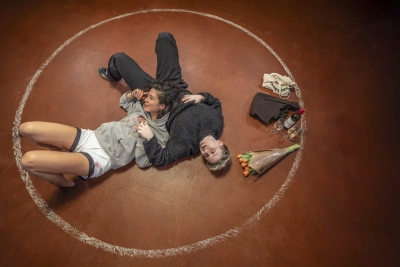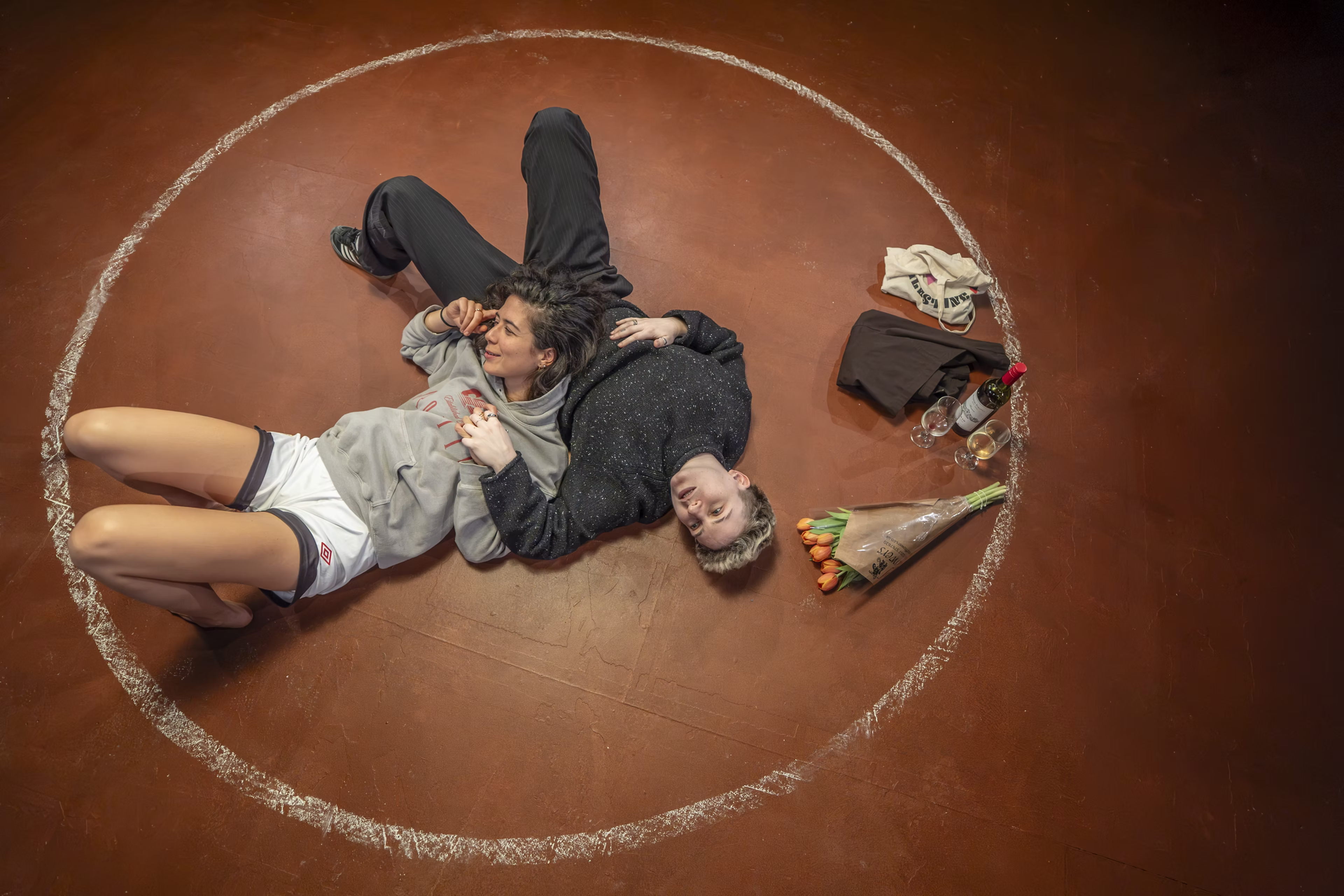
With a white circle drawn on the bare, intimate, studio-space stage, mimicking a judo or wrestling ring, the scene is set quickly for sparring. Yet while no punches are thrown, what follows is an ever-changing production that allows the performers and the creative team to react and respond live to the volatility of a queer relationship on the verge of collapse in Georgia Bruce’s unique new work.
Before the piece begins, Attention gets off to an auspicious start, setting up the notion that this is not going to be a typical play about two people being together. Instead of the performers opening the play, we get Martha Knight, the production’s sound designer, who, from the sound booth, reveals to the audience how this work is going to pan out. While most plays, Knight reveals, repeat the same rehearsed pattern with each performance, this one is more like a game with endless possibilities, where the performers will enter the circle and act out elements of Bruce’s script before choosing, at any given moment, to step out of the ring and pivot the play, selecting from script extracts stacked on the wall and changing the direction of the work and A and B’s relationship at any given moment.
The game, Knight says, has a strict runtime, and at the end, performers will choose whether to stay in the circle or break it apart. As a result, the production immediately becomes a live, ever-evolving piece, and while the script maintains a core spine, each performance offers different scenes in different sequences, allowing performers Bláithín Mac Gabhann and Norah Lopez Holden to live and develop in the moment.
It is an undoubtedly ambitious and inventive premise, and one impressively put together under Jules Head’s direction. The notion that the performers can twist and form the outcome of the relationship nightly, rather than let it play out as expected, offers intrigue and supports the central conflict between the two characters here. It results in a ‘will-they, won’t-they’ narrative, but one that feels fraught with tension and emotional anxiety, disarming audiences with the naive charm of its opening scene as the play becomes something more desperate. Over 65 minutes, we see flashbacks to the beginning of A (Norah Lopez Holden) and B’s (Bláithín Mac Gabhann) relationship, sparked by a sweet exchange where successful actor A charms youth worker B with a playful drama game. Yet with each selected scene, glimmers are offered about why, years later, this relationship is on the rocks, with the revelation that B may love another woman, a result of the couple’s polyamory, threatening to tear the couple apart.
Amid the intrigue of how the story might play out, both Bláithín Mac Gabhann and Norah Lopez Holden are electric in crafting their respective characters. Mac Gabhann’s deft portrayal of B, unsure of what they want and whom they want to be with, feels authentic and raw. Mac Gabhann’s delivery brings Bruce’s dialogue to life here, well paced to replicate the sense that B is desperately trying to untangle their conflicted feelings. Meanwhile, Lopez Holden draws out the character’s tenderness acutely, while also being impactful in the play’s more painful moments, as the character reconciles with the consequences of her pushing to open up the pair’s relationship.
Indeed, while the relationship appears at times irreversibly damaged, both performers are strong in still crafting a compelling love story, where, amid each of the characters’ mistakes, there is still a desperate hope that, as the rules of this game establish, the pair will carry on.
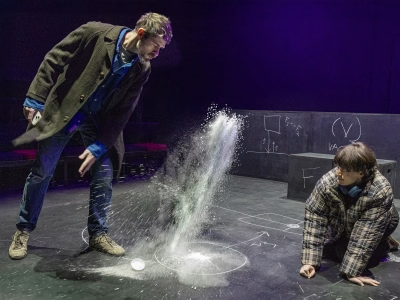
What makes Attention so captivating is also what makes it so absorbingly difficult too. The production is at the mercy of the performers’ choices, leaving Knight and lighting designer Suze Cummins to react instantaneously, but as a result, many of the script’s episodes go unsaid. Gaps appear in the narrative, with conversations referencing moments we are not privy to, or dialogue overlapping and repeated in contrasting ways with a slightly disorienting impact. Ideas about polyamory and queer identity are discussed and quickly pulled away from, with A’s critique of B regarding the latter not fully explored and feeling a little too large for a play that has no settled rhythm.
Despite this, it is a testament to the cast and creative team, especially Bruce’s writing, that the ending still reaches a poignant climax, with both performers, or perhaps competitors, at the final whistle standing across from each other ready to make one last play. Propelled by the voyeuristic in-the-round staging, Attention is a raw, creative, unpredictable interrogation of how relationships spark and erode, culminating in an intimate, moving final choice.