Generational trauma, the bonds that tie families together, and a violent reconciliation with the past are all explored with full force in Joy Nesbitt’s powerfully engrossing new work Blood of My Blood, debuting as part of the Royal Court’s 70th Anniversary season.
Nesbitt’s script sets us in Bullock Creek, South Carolina, but straddles two different time periods, centring upon the brutal experiences of enslaved Black woman Ginnie (Ronkẹ Adékọluẹ́jọ) and, over 160 years later, Talulah (Jodie Campbell), whose unplanned pregnancy draws her to the former slave plantation now, macabrely, a trendy Airbnb, in an attempt to connect with and seek guidance from her ancestors.
It is a play both rooted in reality and spirituality, with the latter seen in the form of ‘conjuring’, acts done by Talulah to try and connect directly with her ancestry. The play handles this both deftly and devastatingly, with tender touches between the pair growing into full, poignant embraces. Meanwhile, Talulah’s bloodletting is viscerally compelling, and, intriguingly, the main scenes of physical violence occur within the present rather than the past, hinting at the long-lasting impact of stories like Ginnie’s on Black women today.
Talulah’s arrival at the cabin immediately arouses curiosity in host Nora (Hannah Morrish), intrigued by why her guest has requested to stay in a cabin formerly occupied by enslaved people (as it turns out, this is also Ginnie’s), although it does not take too long for her Londoner visitor to reveal, in part, her intentions for the visit. This is not a play that aims to be a history lesson, but one that instead spotlights a Black woman’s attempt to reconnect with her heritage and ancestry after finding herself alone in the present day.
Nesbitt’s writing gives equal exposure to both Ginnie and Talulah’s stories. In the past, Adékọluẹ́jọ’s sublime and moving depiction captures Ginnie’s anguished life enslaved by the site’s owner, John ‘Doc’ Good (Patrick Vaill). Doc’s nightly visitations have led to five children, but what is so odd and unnerving here is Doc’s treatment of Ginnie. The violence lies not in its physicality, but in Doc’s emotional control and oppression of Ginnie’s character, intriguingly love-bombing the desperate woman into bed while taking their children into his mansion in a way that compels Ginnie to heartbreakingly comply. Adékọluẹ́jọ is impressive in never fully allowing Ginnie to break, using deft expressions and vocal trembles to capture her desperation before building to a shockingly composed finale.
As the Civil War ravages around Ginnie and Doc, in the present a different kind of societal clash revolves around Talulah. Her unwanted pregnancy led her to the cabin, but it is her interactions with Nora and Nora’s husband James, a slightly too melodramatic descendant of John and an academic unwilling to face his family’s actions, that become prickly and strained, reiterating the play’s focus on the ever-lasting, generation-spanning impact of trauma.
Campbell’s Talulah is both desperate and bullish, with the character far more interesting in the first half as she attempts to reconnect, and in the latter moments of the piece as this reconnection lands. Indeed, the conversations between Talulah and James (also played by Vaill) are provocative but surprisingly on the nose for a play that handles much else of its content with subtlety. It is perhaps in these scenes where a conversion of this work into a one-act play might keep the momentum going. Nevertheless, Campbell’s delivery of one of the play’s two protagonists is engrossing, especially as her desperation to re-examine the past pushes her closer to the edge, covered in blood and wide-eyed as she relives the horrors of her ancestors.
The production’s use of multi-rolling is an excellent touch. While Adékọluẹ́jọ and Campbell remain as Ginnie and Talulah throughout, Morrish and Vaill’s switching between slave owners and Airbnb hosts is a creative hand played here that draws parallels between the exploitation of the past and present. Meanwhile, Karene Peter’s doubling as Ginnie’s friend Bertha and scholar Niecey in the present works successfully to form two characters, centuries apart but both equally perceptive about the direction in which society is heading.
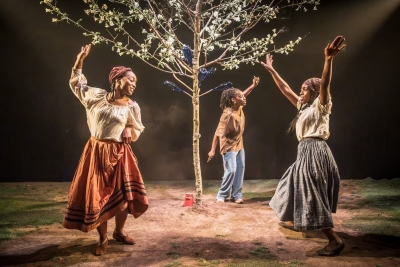
Despite continuous time shifts, Nesbitt’s writing and Tatenda Shamiso’s direction are remarkably clear in threading the lives of the two women together. Scenes jump seamlessly from past to present, but it is in the striking moments where the pair collide, brought together by Talulah’s use of Hoodoo, presented with maturity as a practice of ancestral worship, that the play shines brightest. Equally engrossing is Natalie Pryce’s exposing set design. The cabin where both women reside is hollowed out, using its wooden frame structure to loom enormously within the Royal Court’s smaller upstairs space, evoking a sense of entrapment for both Ginnie and Talulah. The traverse staging allows audiences to peer into the cabin in a voyeuristic manner, unable to stop the events playing out, while the open grassland areas downstage are dominated by a single tree used by Talulah to connect with the dead, neatly representing the shared ground and emotions of the two women.
Blood of My Blood is an intriguing watch that resists the temptation to fall into the trap of stereotypical stories from this period of American history, focusing instead on something much more sinister. Visions of past and present explode into the women’s lives with violent velocity, yet what lingers is the continuously strained understanding of how events from the past remain pertinent today, marking Nesbitt out as a writer to keep an eye on.