Leaving home and gaining independence brings its own excitement and challenges, yet for one young British Chinese woman, this comes in the form of a haunting ghost in this inventive and impressive debut play from Mei Leng Yew.
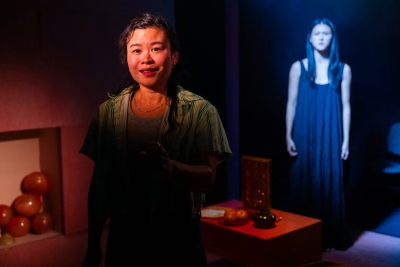
The Hungry Ghost centres upon Girl (an extraordinary Mei Mac), who is in the secret process of gradually moving out of her parents’ home without them knowing and into a new flat with her girlfriend Naomi. For Girl, it is a move that promises freedom, both personal and sexual, after living under fair but continuous scrutiny from her well-meaning, domineering mother. Yet ominous signs hover around Girl’s moving day, which coincides with the first day of the lunar month, known in Chinese culture as the start of the Festival of the Hungry Ghosts. It is one of these ghosts (a brilliant Isabella Wei) who latches onto Girl, threatening to pull her into a world of hunger-driven delirium.
Billed as a ‘sexy rom-com’, much of the opening of Yew’s impressively slick script focuses on the newfound freedom and excitement for Girl, whose relationship with Naomi is firmly in its honeymoon period. Yet as Wei’s Ghost begins to gain further influence over Girl, controlling her into shocking acts of culinary indulgence and feasting on the energy of kind-hearted therapist Naomi (also played by Mac), The Hungry Ghost blends into a psychological thriller. Here, the mania of the Ghost’s presence takes its toll on Girl’s physical and mental well-being and her blossoming romance, with increasingly catastrophic impact. Yew leans heavily into Chinese culture without making it inaccessible, using just enough exposition during Girl and her mother’s initial interactions to establish the premise before allowing the relationship between Girl and Ghost to organically, and destructively, grow.
Over the play’s two hours (with a brief interval), Girl increasingly finds herself wrought with violent hunger pains. It is clear from the outset that it is the Hungry Ghost evoking this, but as Yew’s piece progresses, the two twist and combine in a production that blends sensuality with shock, where Girl’s sexual and culinary desires transcend to reach both hilarious and horrifying consequences. Food flies everywhere, bodies contort, and minds unravel in a piece that knows, maturely, both how to shock and when to dial it back to offer something more profound. It becomes anarchic, but the piece also resists the urge to overindulge in these mad sequences, picking its moments with precision, such as a stark snapshot where Girl’s tongue infinitely extends, to shock and unnerve before snapping back to realism.
For a debut play, Yew’s script is sharply written and fiercely engrossing. The joy and enthusiasm of a sneaking-out Girl is neatly contrasted with the lingering, looming presence of the Ghost. Yew’s dialogue is well directed and choreographed by director Ailin Conant, who allows Wei to drift and float around the intimate studio space, always at Girl’s shoulder and increasingly in control of her words and movements. Indeed, writer and director seem to be in complete sync, with moments of comedy, whether witty gags or deftly delivered physicality, combined superbly with strikingly visceral moments of horror and violence that unnerve. This is propelled by Cheng Keng’s lighting design, which utilises blackouts sparingly but menacingly, with quick strobe flashes allowing a lithe Wei to bend and contort in unsettling moments that capture the growing mania in starving Girl’s mind.
It is those moments of mania that Mac delivers so absorbingly as the play’s protagonist. Mac’s relentless energy keeps the play’s momentum frantic, mirroring Girl’s breakdown. This is a complete leading performance, with Mac’s well-crafted moments of subtlety and anguish brilliantly contrasted by shocking fits of madness, such as a binge-eating sequence in Sainsbury’s that is captivatingly comedic and chaotic. Much of the play’s first half is spent demonstrating Girl’s breakdown, which Mac thrives in, but it is Girl’s quieter, more spiritual moments in the play’s second half, where Yew’s script leans more into the roots of The Festival of the Hungry Ghosts, that the production can breathe, finding terrific poignancy in its undercurrent of loss, desire, and acceptance. Mac also multi-roles as all other characters in Girl’s life, with a standout being her acid-tongued but loving mother, in a breathless performance that reiterates Mac’s sublime stage presence.
This is furthered by Wei’s extraordinary performance as the Ghost. It is a complex portrayal, with Wei’s brash, booming presence neatly juxtaposed with a sense of horror explored towards the play’s climax, which reveals the Ghost’s true motivations and connection to Girl. Wei drifts and glides across the stage, with Conant’s direction precise in picking its moments to signpost the Ghost’s terrifying potential, succeeding enormously because of its sparing nature, such as the glorious jump-scare prior to the interval. While the play centres around Girl’s descent into hungry hysteria, it is the stoic, mercurial poise of Wei’s Ghost that provides a dangerous, gripping contrast, helping lift the piece from a conventional goofy rom-com into something more profound.
While The Hungry Ghost becomes splattered with gory off-cuts, half-chewed fruit, and a delightfully horrifying extended tongue, the production itself is far from a mess. There is meaning to the madness, focusing on desire, independence, and the trauma that can come with moving on. As the two characters’ stories intertwine, it is the similarities of their wants and aspirations that pull neatly into the play’s final, heartfelt moments.
This is an eye-popping, delightfully delirious debut work. Blisteringly funny but also deeply moving, there is a lot to like on The Hungry Ghost’s menu, with the play, like a meal for Girl, not to be missed.