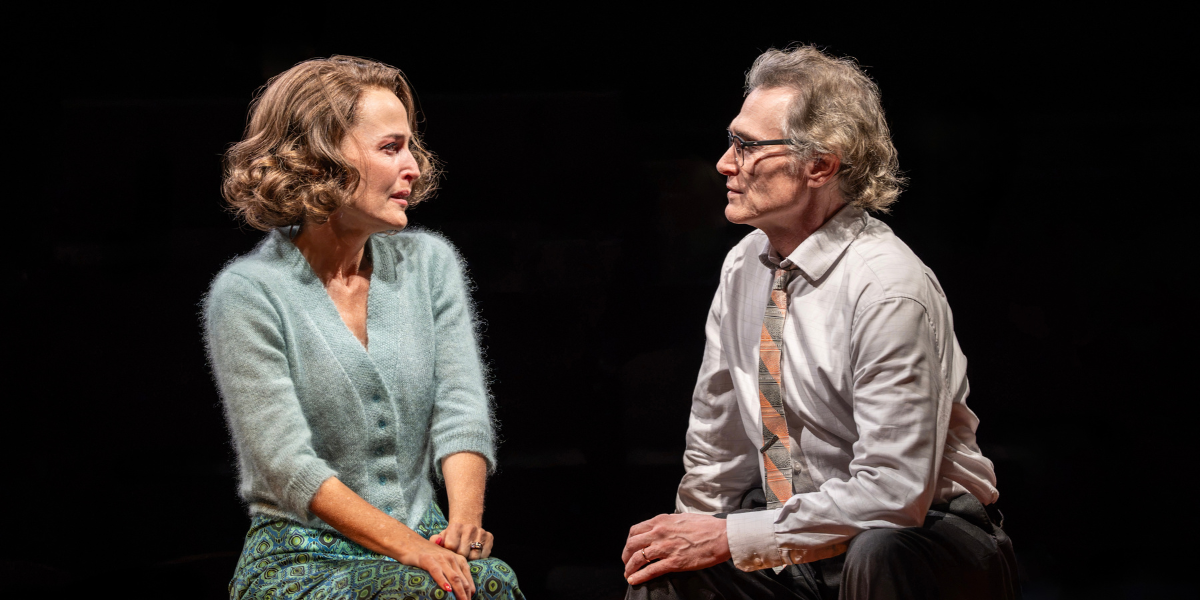
Within the very essence of Edward Albee’s Who’s Afraid of Virginia Woolf? sits a philosophical witch hunt, representing a Cold War America holding onto its historical past while being swept forward by an excitingly scientific future. Yet quite who, or what, is on trial simmers wonderfully amid the undercurrent of this gloriously staged revival of the American playwright’s work, propelled by incredible leads Gillian Anderson and Billy Crudup.
It is the early hours in George (Crudup) and Martha’s (Anderson) home, back from a soirée at New Carthage, the college where George teaches History and whose president is Martha’s father. At first glance, it is a relationship intoxicated by the alcohol of the night and the passions between them. Martha’s domineering presence is indulged by George, eager to get her another drink as the married couple swoop and swoon around each other in a deft blend of frivolity and dominance. However, Martha’s invitation of a suave biologist, the youthful Nick (Josh Dylan), and his mousy wife, Honey (Phoebe Horn), is an attempt to keep the party going and, as the play unfolds, the catalyst for an increasingly chaotic and vitriolic battle between the hosts, which ensnares their guests too.
Across Albee’s three-hour play, the piece moves seamlessly through its trio of acts as the hysteria and aggression between Martha and George, dangerous and deceptive, threaten to spin violently out of control. Barbed comments fling across the stage with terrific vigour and great gusto from Anderson and Crudup, who look remarkably at ease slinging insults at each other around Miriam Buether’s superbly designed stage. Neatly configured into the play’s in-the-round setting, it hints at a primal boxing bout with two predators encircling each other, and Nick and Honey their unfortunate prey. While many of George and Martha’s quips, especially George’s, belittle the other, director Marianne Elliott, as well as Anderson and Crudup, succeed in drawing out the absurdity of the vitriol too. With the cruelty comes a great sense of humour that pulls you further into this impending domestic catastrophe.
There was great anticipation in the build-up to this revival about the lead pair, and categorically Anderson and Crudup live up to the hype. Anderson’s poise snaps to mania in a heartbeat as Martha fires from desperate to delirious, rageful to raunchy, all to get a rise out of her husband, who, due to his work, she exclaims is being lost to time. Whether sprawled on the set’s leather sofa or crawling on hands and knees around the stage’s perimeter, Anderson is in complete control in a piece that is as intoxicating to watch as Martha is intoxicated. It is a venomous portrayal, but one that also captures the vulnerability of the character, particularly during the play’s closing act.
Moreover, Crudup proves more than a match in the verbal jousting. Crudup’s dialogue delivery is violent and assertive, quick-witted but, like Anderson’s, undercut by a sense that amid the games, tricks, and projected anger, there is a husband set on trying to keep hold of his marriage and way of life within a changing world. The absurdity of the pair’s relationship and its chaos comes out during a particularly striking moment with a shotgun in Act One, which Crudup delivers with aplomb, capturing the madness of a night at George and Martha’s appropriately. While both Anderson and Crudup thrive individually, it is together that they are most impactful, in a combination that could run for even longer without the piece faltering.
While Nick and Honey become pawns in George and Martha’s provocative games, Elliott’s direction gives both characters moments to shine too. Dylan’s bullish young biologist turns his nose up at George’s willing cuckoldry, and it is here in his clash of values where the script, and this production in particular, most exposes the sense of ideological clashes within contemporary America. Horn’s Honey is collateral damage in the games all three other characters play, yet Horn does a great job of not allowing the character to be reduced to drunken slurring and wails, with a real sense of abject horror coming out during some of the play’s most stark revelations.
This is engrossing, thrilling theatre. The combination of Elliott’s subtle direction and Buether’s quietly rotating set is excellent in reiterating the madness of the four’s night together, combining an urgent sense of claustrophobia while allowing the most tender moments and intimate revelations to be heard with breath and clarity. Where Hollywood had Burton and Taylor, the West End has Anderson and Crudup in a phenomenal, psychologically exhausting revival that leaves you feeling beaten up by George and Martha too.
An unmissable piece of theatre.