A play about John Maynard Keynes and economics does not immediately scream exhilaration and excitement. Despite some witty inclusions from acclaimed writer James Graham’s script, along with a creative blend of dance and dialogue, The Standard of Living struggles to get its sums right in this biographical work.
Graham’s work whizzes through the final thirty years of the renowned economist’s life, from Keynes’s desperation to stop fine French art from falling into World War One enemy hands through to his final, noble efforts to set up the Arts Council, still in force today. It is a production that tries to bring creative interest to Keynes’s life, exploring his relationships with men and women, his friendships with acclaimed painters and writers such as Virginia Woolf, and his efforts to end the war and use financial philosophy to preserve world peace.
What is clear in Graham’s well-researched script is the nobility and rigid principles, both economic and moral, that guided Keynes throughout his life. Yet the piece is ultimately hindered by its whistle-stop tour of his final three decades and its lack of jeopardy, where failures mean a retreat to academia rather than anything too severe.
As Keynes, Rory Kinnear is strong in crafting a man unrelenting in his scruples, yet desperate to please and support those around him. Kinnear’s stubborn portrayal of Keynes is resolute, but his refusal to adapt or change his ways does not bend into something constricting or insufferable. With Graham’s script and Kinnear’s performance, directed by the excellent Nicholas Hytner, the production keeps the economist firmly in position as the play’s closest thing to a hero. Keynes’s numerous homosexual relationships and trysts are explored, though it is his unexpected marriage to charismatic ballerina Lydia (Natalia Osipova) that sets tongues wagging. Indeed, despite Kinnear’s best efforts, in truth there is little to really get into in this piece. While both performer and creator attempt to find the human element and humour amid the economics, there is very little substance in the story itself to hold attention.
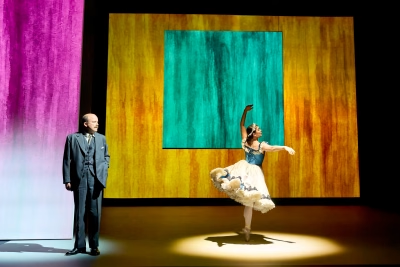
That said, it is Osipova who brings much-needed energy and flair to the piece. Lithely gracing the stage prior to meeting Keynes, Lydia is kept to scene transitions, elegantly dancing routines that capture the spark and vigour of the character. Lydia’s spirited nature is well introduced by Osipova’s instantly likeable performance, but the script neutralises her character a little too early, moving from outspoken Russian dancer to doting housewife, sanitising her a little too urgently.
Indeed, in a world full of revolutionary creativity, it is the sterile sense of characterisation in this work that feels so unusual. Keynes’s brilliant mind is surrounded by equally brilliant figures, such as Woolf (Naomi Frederick) and modernist painters Vanessa Bell (Claire Price) and Duncan Grant (Thomas Flynn), with the latter once a lover of interest to Keynes. In this production, these creative geniuses are reduced to judgemental sound bites, criticising Lydia’s character and cooping themselves up, at Keynes’s expense, painting and writing almost aimlessly. Perhaps the aim here is to try to cast Keynes as the true revolutionary, building his economic policies on speculating to accumulate, but it is an odd setup and one that feels a little shallow. Pip Carter’s forlorn Lytton Strachey, also in love with Keynes, wallows and sulks too, compounding the unusually prostrate nature of a Bloomsbury Group typically heralded for its relentless creativity.
Meanwhile, Keynes’s economic prowess is challenged by Austrian Friedrich Hayek (Laurie Kynaston), whose odd blend of belittling and idolising behaviour towards Keynes establishes the character as the closest thing the play has to a villain. Kynaston’s wit is effective in the second half, where Graham’s script leans more heavily on comedy to inject energy into the piece.
Where the production does make the numbers work, however, is in its clever set design. Bob Crowley’s projection-heavy set cleverly integrates screens with angular shapes to replicate the modern art and values Keynes surrounds himself with, providing illuminating moments of colour in an otherwise black-and-white play.
Despite its enormous promise, hard-working cast, and acclaimed creative team, this biographical play struggles to become as exciting as Keynes gets excited by mathematics. It is unquestionably well performed, but why it is being performed remains the larger question.
The long-lasting impact of Keynes in the world of economics lingers eighty years later, but this impact struggles to translate into interesting, engaging theatre.