Georg Büchner’sWoyzeck is a tricky play to stage. The German playwright’s expressionist tragedy, arguably the birth of the abstract theatre style that went on to inspire Bertolt Brecht, is a collection of unfinished episodic scenes loosely woven together with a thread hinging on traumatic flashbacks and supposed infidelity. Its bleak outlook on life for the working class and its exploitation by those above them does not necessarily point towards rich material for a musical, but this new work exceeds expectations in a complex and provocative production.
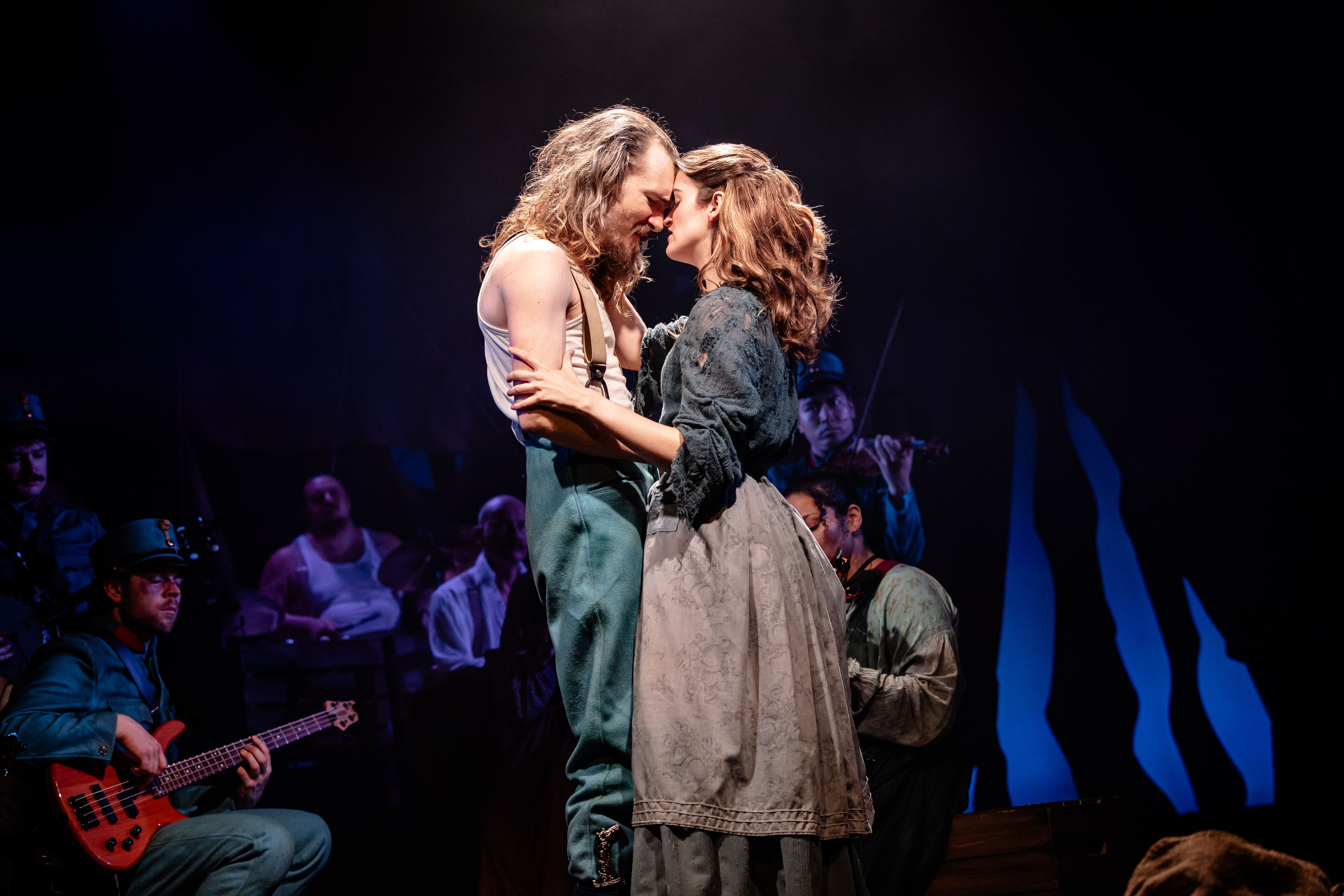
Largely faithful to Büchner’s source material, this new adaptation from Teresa Howard, set in a 19th-century rural community, centres upon the downtrodden proletariat couple Franz Woyzeck (Brenock O’Connor) and wife Marie (Jade Oswald). The pair dream of a life outside working-class oppression, with Franz subjected to malicious bullying in his military barracks and sinister experimentation by deranged Doctor Simian (Richard Emerson Gould) to earn extra money. Franz is haunted by traumatic flashbacks of his wartime experiences, yet the real horror is to come for the couple when egotistical misogynist Drum Major Varg (Matthew Heywood) sets his sights on Marie.
It is unequivocally an ambitious piece, but one that relies on an appreciation of the German expressionist theatrical style from which the original stems. Both Howard and director Michael Oakley lean into this significantly, weaving humour, crass language, and an unnerving quirkiness into the production that succeeds in forcing the audience to question what is taking place. This largely works, with Oakley’s direction of the play’s substantial amount of humour, typically dry and aimed at skewering the elite, unrelenting even in moments that feel crass or banal, such as the brilliantly barmy, cake-scoffing Captain Peccary (Mark Meadows).
Consequently, the production takes a little while to settle, with audiences clearly unsure how to react to a politically charged first half that relents into a slightly more conventional, albeit depressing, musical after the interval. In this sense, it is a captivating watch, but also one that, unlike some musicals, requires a great deal of thought and concentration.
O’Connor’s tortured Franz is frantic, bursting with anguish and energy as his life unravels around him. O’Connor cuts a gaunt figure, particularly in the second half, but does well not to overindulge in the painful devastation each rumour and revelation brings to Franz. Moreover, Oakley’s direction of O’Connor through his haunting flashbacks, presented beautifully with Christopher Nairne’s murky green lighting choices, evokes a deep sense of trauma and furthers Franz’s neurasthenic depiction. Mistreated by everyone, Franz’s relentless desire to provide for his family is starkly profound, furthered by his awful experiences as Simian’s test subject, restricted to a diet of peas and invasive examinations, which O’Connor captures with effective horror and desperation.
While Oswald’s Marie is a little too rough and ready at times, there is also a great sense of tenderness in appropriate moments. Marie’s character, like most of those in the play, swears incessantly, and while Howard’s script could be a little lighter on this, it is the raw, gritty presentation of proletariat life that makes the couple’s downfall so evocative. Oswald’s terrific portrayal of Marie’s horrifying interaction with Varg is well pitched and provides a useful moment of subtlety, yet it is the deft chemistry between Oswald and O’Connor that builds to a poignant and deliberately understated finale, swift and violent.
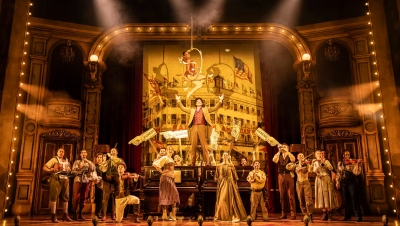
Hojin Yun, artistic director of Korean company Acom, co-producing the musical with Charing Cross Theatre, states in the programme a desire to stage this folk tale with actor-musicians. The outcome is a deeply talented cast transitioning seamlessly from delivering dialogue to performing Rob Shepherd and Chris Broderick’s music with aplomb. Büchner’s original uses Hessian folk music to bring the proletariat struggle to the fore, and the decision to maintain the folk genre works successfully here too. An almost sung-through musical, Franz & Marie bucks the trend by not seeking out a catchy earworm within its numbers, using awkward lyrics and dry humour instead to reiterate its tragic message about class struggle.
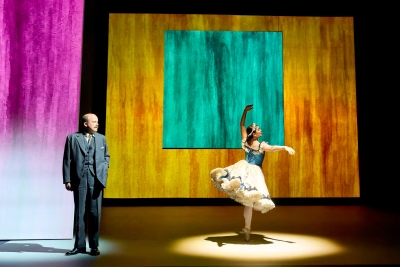
Meanwhile, Bretta Gerecke’s drape-heavy set is covered in beige and browns, mirroring the increasing colourlessness of Franz’s existence. The set is deliberately dropped and hung on stage by the performers, with transitions visible to reflect the musical’s fourth wall-breaking influences. This also symbolically works nicely to sharply contrast the vivid colours of the Drum Major’s turquoise uniform, illuminating his ill-deserved sense of grandeur that looms aggressively over a weakening Franz.
This is not your typical musical, and it will inevitably polarise. While the plot itself is kept simple, the motivations for the creative choices are so tightly woven with early 20th-century German abstract theatre that it requires a little homework to really get to grips with it. That said, the result is a clever and distinctly unique new musical that, despite the source’s age, feels relevant today with its nods to class divides and the inherent marginalisation of the working class.