I sat down with Theatre Re’s Artistic Director Guillaume Pigé to find out more about the deeply poignant The Nature of Forgetting, which opened in London this October before a landmark 10th anniversary UK and International Tour.
Can you tell me a little about your show and what audiences can expect?
The Nature of Forgetting deals with the inability of a man to recollect his life. Featuring specially composed live music and skillfully executed physicality, it explores what happens in the brain when we forget.
Our main character is Tom; a middle-aged father living with early-onset dementia, being cared for by his daughter Sophie. We present him on the day of his 55th birthday. As he struggles to get dressed for his party, the feel of his clothes sparks him into life and unravels a tale of friendship, love and guilt. Ultimately, the piece is not about dementia but the fragility of life and that eternal ‘something’ we all share which is left when memory is gone.
What drew you to this specific story?
There wasn’t just one source of inspiration for the development of the piece, but it all emerged from one question, which was: what is eternal?
To find answers we were very inspired by the work of Polish writer Bruno Schulz and Polish theatre director Tadeusz Kantor, with pieces such as The Dead Class and Wielopole, Wielopole. Both shows deal with the world of childhood memories and the impossibility of returning to one’s past – which is what happens to people living with dementia. They are unable to reconstruct past memories. We were also really inspired by the atmosphere, the apparent simplicity and the inherent theatricality of Thornton Wilder’s Our Town.
The show celebrates its 10th anniversary; what changes have you seen over the period in the approaches in society to Alzheimer’s?
I feel there is a greater willingness to talk openly about dementia. In conversations after performances, people often share very personal experiences, and those exchanges have become an important part of the show’s life.
What has been the biggest challenge in bringing this production to life?
Money! Our process takes time: time to play, to explore, and to discover what we want to make as we are making it. We don’t begin with a finished script or a clear idea of where we will end up. We find our way through working together in the rehearsal room.
That makes our development processes long and, therefore, expensive. It also makes finding financial support challenging: we are asking people to back an adventure before we can tell them exactly where it will lead.
The biggest challenge is securing the time and resources to allow that discovery to happen. That space is essential to how we make our work, and to the unexpected things that emerge along the way.
How does the design of your show (set, sound, or lighting) impact the presentation of your story?
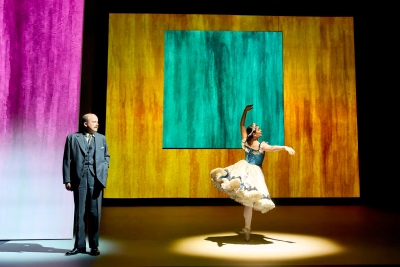
For us, design is an active partner in the rehearsal room and a storyteller on stage. Movement, music, lighting and set develop together, each bringing ideas and opening up possibilities that shape the piece. Each has its own part to play in telling Tom’s story. Much of our process is about discovering what each element can bring, and how they work together to create something none of them could achieve alone.
Why was it essential to include live, original, music into this production?
Live, original music is part of Theatre Re’s DNA. It is how we create our pieces: music and movement develop together in the rehearsal room, each shaping the other. That relationship naturally carries through to the performance.
Having the musicians on stage also reinforces what makes theatre so special: everything is happening live, here and now. We listen, breathe and respond to one another, and that exact performance will never happen again.
For me, that gives the work its value and enhances its emotional power. There is something precious about sharing a moment that only exists between these performers and this audience, on this
If you could sum up the show in one word or phrase, what would it be and why?
“Magic.” I am biased, of course, but it is the word that comes up most often when we chat with audiences after the show.
There is something extraordinary about seeing movement, music and light come together to bring a memory to life—and feeling it connect with your own. Those moments of connection are, for me, where the magic happens.
The Nature of Forgetting runs on the following dates:
Autumn 2026 UK Tour
Jersey
Dates: 13th – 15th October 2026
Venue: Jersey Opera House, Gloucester Street, St Helier, Jersey JE2 3QR
Book Tickets at Jersey Opera House
Leicester
Dates: 9th – 10th November 2026
Venue: Curve Leicester, Rutland Street, Leicester LE1 1SB
Book Tickets at Curve Leicester
Hertford
Dates: 11th – 12th November 2026
Venue: BEAM Hertford, The Wash, Hertford SG14 1PS
International Dates
Seoul, South Korea
Dates: 18th September – 29th November 2026
Venue: Sejong Center for Performing Arts, S Theater
Shanghai, China
Dates: 25th – 26th November 2026
Venue: Shanghai Jasmine Theatre
Nantong, China
Dates: 28th – 29th November 2026
Venue: Nantong Grand Theatre
Spring 2027 UK Tour
Hornchurch
Dates: 11th – 12th February 2027
Venue: Queen’s Theatre, Billet Lane, Hornchurch RM11 1QT
Leeds
Dates: 24th – 25th February 2027
Venue: Leeds Playhouse, Playhouse Square, Quarry Hill, Leeds LS2 7UP
Chester
Dates: 3rd – 4th March 2027
Venue: The Storyhouse, Hunter Street, Chester CH1 2AR