The depth and detail of Charles Dickens’s writing make it an ambitious target for theatrical adaptation. It is probably, then, the comparative brevity of ‘A Tale of Two Cities’, being the second-shortest of the writer’s novels, that in part made it appeal as potential for the theatre to adaptors, the acclaimed duo Terence Rattigan and John Gielgud, whose creative and inventive exploration of this epic story is brought to the fore in the Marlowe Theatre’s stylish and compelling new in-house production.
Tackling a work penned by two of theatre’s giants is an unenviable task, yet under Michael Fentiman’s stylised direction, this new production of A Tale of Two Cities soars. Set against the backdrop of the French Revolution and its impacts on either side of the channel, the piece centres upon mercurial lawyer Sydney Carton (Samuel Collings), who becomes entwined in the blossoming marriage between Lucie Manette (Jordan Loughran) and Charles Darnay (Ed Sayer), who both carry the scars of brutal French aristocratic rule. With two acts of only an hour each, it would be reasonable to have suspected that the piece may have needed to speed through moments, or rely on heavy-handed storytelling to plug gaps. Yet, it is a tightly formed script, enabling story beats to breathe with poignancy, and characters to feel fully formed despite its pace. From Darnay’s trial, suspected of being a French spy, through to the piece’s final, thrilling climax, it is a production which finds a good blend of creative choices while also simply enabling the performers to fully dive into the individuals they are portraying, with dialogue, some in English and some in French with surtitles, feeling authentic and believable, and never languishing in unnecessary fluff.
While much of the jeopardy revolves around Darnay and his volatile relationship with his French heritage, it is through the complex Carton that the piece channels its story. As the straight-talking, dour lawyer, Collings is superb in combining an initial blasé attitude with a much more well-rounded figure as the play reaches its climax, representing a man worn down by selfish and detached choices, and seekign retribution and a legacy that he can never quite achieve. Collings’s presence is felt throughout, either in his dominant dialogue delivery or in the poised manner in which he stands and observes, constantly proving a figure hard to make out but, by the end, desperate to do good, despite the consequences. It is interesting, therefore, that in a play which utilises doubling both in its script and in its delivery, Collings should play Carton, the piece’s unlikely hero, and also the Marquis De St. Evrémore, a brutally violent and manipulative French nobleman who, before meeting one of the most explosive and gory endings I’ve seen on a stage, is fiercely menacing. Collings shapeshifts here remarkably, but the decision to have him play both roles is a neat nod to the ideas about duplicity and duality which run throughout this adaptation and Dickens’s original.
Meanwhile, Loughran’s naive Lucie shines, a gentle soul in a violent world who desires love and affection, and moral goodness in a world increasingly losing it. There is immediate chemistry sparked between the character and Sayer’s Charles, told in a typically stoic 18th-century manner, but one which nevertheless is believable. Sayer’s Charles is upstanding and, much like Carton, leaves little to the imagination, but it is the inner conflict that the character wrestles with, reconciling the callous acts of his bloodline towards the French lower classes, which Sayer holds close in his portrayal. Fentiman’s direction of both Sayer and Carton is clever in reiterating the pair’s necessary similarities, but this is not leaned into too forcefully, allowing both men to settle and both characters to grow at the same time.
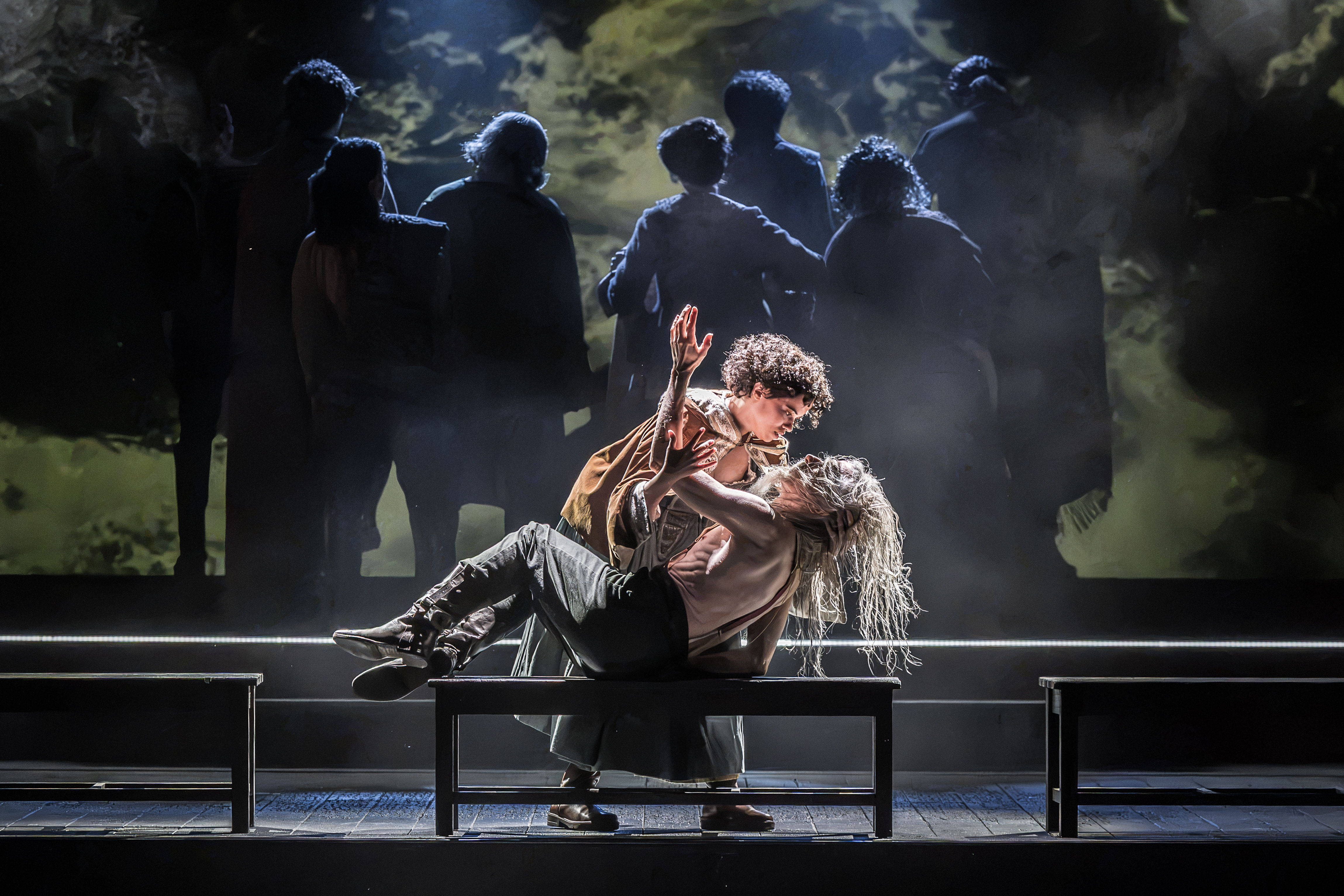
Indeed, while it is the lead trio who pull the story together, it is under Fentiman’s sharp direction that the brilliant ensemble, combined with gorgeous creative designs, also elevates this piece. Max Jones’s gloriously minimalist yet effective set design gives room for the relationships and tensions to grow here, but the decision for a moving set to pull up and down from the rafters works superbly to reiterate a sense of entrapment. Moreover, the lavish, blurred projections of clouds and abstract colours, framed by bright white lighting strips, evoke ideas of the dramatic paintings of the era, where ensemble characters such as Lucie’s haunted father (François Testory), aide Miss Pross (Scarlett Brookes) and family friend Lorry (Roger Ringrose) are often found slowly moving in front of, observing the action but forming a brilliant still image that emphasises the emotional drama of the piece. The combination of Fentiman’s direction and the creative set design here works remarkably well, and it blends inventive artistic merit with a theatricality that is utterly absorbing.
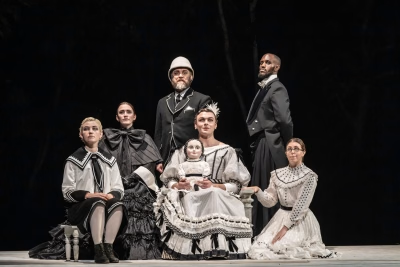
Ben Jacobs’s stark lighting choices, from the harsh white to bursts of extreme strobe to capture Lucie’s father’s distress, work well, but it also enhances some of the stark movement direction here too, with the piece utilising physical theatre routines and tightly choreographed sequences to capture the mania and intensity of such a bleak time in French history. The quietness of London is contrasted by the hysteria of Paris, and this is represented with full force in the jagged and violent jolting of the ensemble. It is a neat, violent paradox to the lavish costumes of the period, and reminds us of the ferocious volatility of the period too.
The second Marlowe Theatre in-house production, following last year’s successful The Party Girls, A Tale of Two Cities succeeds in firmly establishing the theatre as an emerging powerhouse for new and revived work. This is a fresh reimagining of the story, boosted by a sharp script and engrossing visual storytelling, and resulting in a work that offers the best of times, rather than the worst.