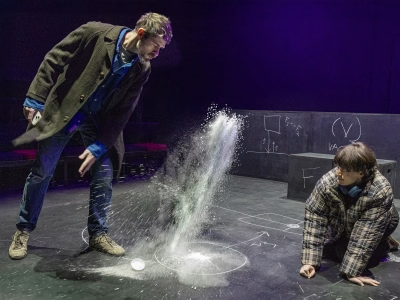
The trauma for a Welsh miner’s son looms large in this devastating production, which celebrates and commemorates a rural mining community ravaged by pit closures.
Although the date of the play is not explicitly given, Cyn takes place towards the end of the 20th century, in a small, dilapidated Welsh village pub where signs of stagnation are clear. This is captured by the play’s title: ‘Cyn’ translates from Welsh as ‘before’, and the sense that the piece interrogates a place, a people, stuck in time is instantly established. Sat with a beer and in tattered clothing, Emyr (an outstanding Sam Rees, who also writes) festers, with only guitar plucking, mumbling Alun (Jed Kain) and busying wife Mary (Dionne James) for company.
The quiet, the desperate quiet, is broken with the arrival of Simon (Charlie Muskett), a young Englishman, son of a business owner and marooned in the Valleys after his car breaks down. As Simon asks for help, the piece twists and turns with Emyr’s frustration about the English, and the evaporated Welsh mining culture comes to the fore.
It is a patriotic story but an unconventional one, a raw depiction not of the miners themselves, but of those left in the wake of the closures where opportunities sealed up. Emyr’s sense of defiance is admirable, but is it sustainable, a question which bubbles underneath the surface in this maturely crafted piece.
As Emyr, Sam Rees gives one of the best performances at this year’s Fringe. Having penned Cyn, this is clearly a project which means a great deal to Rees, represented in the extraordinary individual performance that marks him out as one to watch out for in the future. Emyr is grief-stricken. The impending death of his father to the ‘black lung’, caused by years of mining, represents something bigger as time, and the world, is moving on from this once thriving mining town. The wounds of Thatcher’s mining crackdown are still open here, and it is through Emyr’s volatile, angry and anxious character that this comes across so powerfully.
Meanwhile, Muskett’s Simon is clumsy and unintentionally antagonistic for the quick-to-explode Emyr. It is what Simon represents rather than who he is which irks so intensely, and Muskett leans into this well with his polished, middle-class delivery. Crucially, his haplessness is not overused here. Rees’s layering of the script and Freya Bradshaw’s deft direction means that Muskett moves on and off, enabling Emyr and those around him some on-stage breathing space.
Yet what really shines through in this gorgeously refined piece is the heart and heartbreak of these Welsh communities. Rees’s script includes Welsh mining songs, sung by Emyr and his dad in powerful flashbacks, which further reiterate the emotional power of the play. Indeed, what is so intelligent about the script here is that initially the songs are used in celebration, marking Welsh rugby’s battering of the English at Twickenham in 1974, before representing something more devastatingly defiant as time passes. The play’s script includes the lyrics, with audiences invited to sing along, evoking an immersive communal spirit. The raw emotion is palpable and beautifully captured by Kain’s onstage playing and James’s remarkably understated portrayal of Mary and of Emyr’s mother, where her fiery landlady character is contrasted by the mother’s gentle sobs. In this, James’s multi-rolling hints at some being able to move on, while others like Emyr remain static, paralysed by rage, injustice and a sense of loss.
While Cyn has mining communities at its heart, it is also a piece about generational trauma, and a relationship between father and son impacted by a seismic shift between generations. The pain and fury of these communities is evident here, but Rees’s exceptional script lets moments sit too, building to a stunning and unforgettable finale.