The Edinburgh Fringe is almost upon us and to get prepared for another Scottish summer Read About Stuff is running a ‘Five From The Fringe’ interview series, where creative teams answer five questions about their upcoming Festival shows.
In this interview, I chat to Dominic Whitefield-Holbrook, director of Bare Productions, who discusses the company’s upcoming production of Next To Normal, which Whitefield-Holbrook also directs.
Can you tell me a little about your show and what audiences can expect?
Next to Normal is a rock musical about a family trying to hold itself together while living with grief, trauma, mental illness, and the things they don’t quite know how to say to each other. At its centre is Diana, a mother navigating bipolar disorder, but the show is really about the whole family and how each person is affected by love, loss, memory and survival.
Audiences can expect something emotionally intense, but not bleak for the sake of it. It is funny at points, uncomfortable at points, and deeply human throughout. The score is extraordinary, full of rock, tenderness, anger and release. We’re not interested in presenting mental health as a neat issue with a neat answer. We want audiences to feel like they’ve stepped inside a family home where everything looks normal from the outside, but underneath, everyone is carrying something.
What drew you to this specific story, and why does it belong at the Edinburgh Fringe?
I was drawn to Next to Normal because it refuses to simplify people. It doesn’t make Diana a symbol or a diagnosis. It lets her be brilliant, funny, difficult, loving, and complicated. That feels important. Theatre is at its best when it allows us to sit with contradiction, and this show does that beautifully.
It belongs at the Edinburgh Fringe because the Fringe should be a place for ambitious, brave, emotionally honest work. This is a musical, yes, but it has the intimacy and force of a play. It opens up conversations about mental health, grief, family dynamics and care in a way that feels urgent. Bringing the Scottish premiere to the Fringe also feels right because Edinburgh audiences are ready for work that challenges them, not just entertains them. We want people to leave moved, but also talking.
What has been the biggest challenge in bringing this production to life?
The biggest challenge has been finding the balance between emotional truth and emotional safety. This is not a show where you can just ask performers to “go there” every night and hope for the best. The material is too heavy and too personal for that. So we’ve had to build a rehearsal process that is detailed, careful and responsible.
That means being really clear about intention before emotion, making sure actors understand the story structurally and not just emotionally, and creating space to decompress. It also means not mining anyone’s personal trauma for performance. The challenge is to make the show feel raw and truthful while making sure the room remains safe, professional and sustainable. That has been a huge responsibility, but also one of the most meaningful parts of the process.
How does the design of your show impact the presentation of your story?
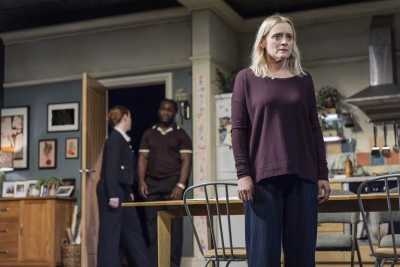
The design is built around the idea of a family home that is never quite stable. We’re not trying to create a perfect naturalistic house. Instead, the set gives us fragments of domestic life: pieces of rooms, furniture, windows, spaces that can shift and re-form. It reflects the way memory works in the show. Things appear, disappear, repeat, distort.
Lighting is a huge part of that. It helps us move between reality, memory, medical spaces, family life and Diana’s inner world without needing to over-explain anything. Sound is equally important because the score is relentless in the best way. It carries the heartbeat of the show. The design has to let the musical feel immediate and intimate, while still giving us those moments where the world fractures open.
If you could sum up the show in one word or phrase, what would it be and why?
I’d sum it up as “the cost of holding on.”
Every character in the show is holding on to something. A person, a version of the past, an idea of family, an identity, a hope that things can go back to how they were. But the show asks what happens when holding on becomes the thing that hurts you, and whether letting go can be an act of love rather than abandonment.
That, to me, is why Next to Normal is so powerful. It isn’t really about being “fixed.” It’s about learning how to live honestly with what has happened, and finding a way forward when normal was never really the point.
Next to Normal runs from 7–15 August at 18:40 at Paradise in Augustine’s, The Sanctuary. Tickets can be bought here: https://www.edfringe.com/tickets/whats-on/next-to-normal