It is a theatrical attempt as ambitious and as noble as the actions of desperate Marshall Will Kane in this powerful adaptation of the western High Noon.
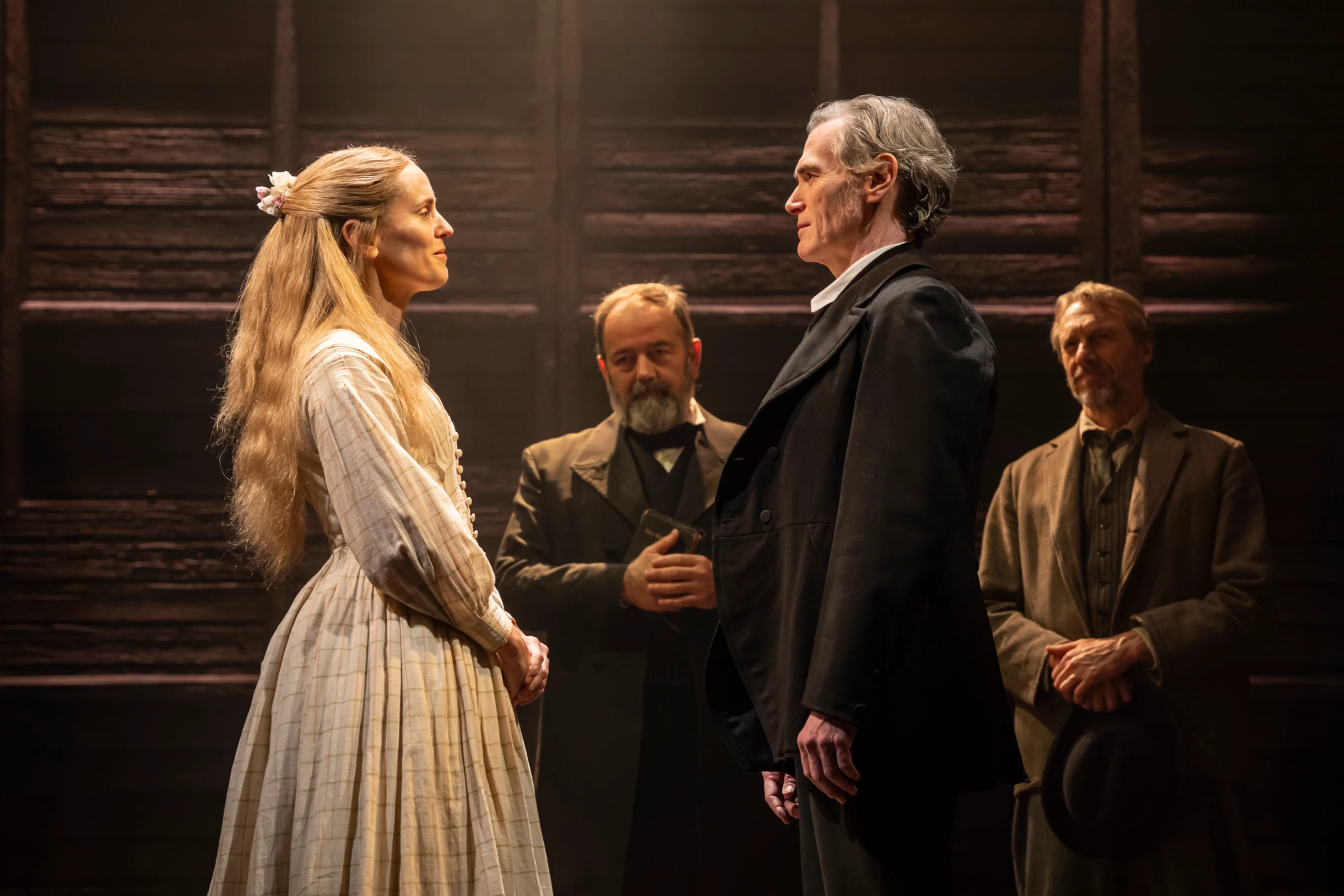
In a small backwater in America’s Wild West, Kane (Billy Crudup) is celebrating his new marriage to Quaker Amy Fowler (Denise Gough), and is ready to hang up his badge when news breaks that deadly outlaw Frank Miller (James Doherty) is on his way back to town, swearing vengeance on the Marshall who put him behind bars.
At face value, it is a typical Western story, where the good of the law faces the brutish outlaw, with an inevitable shootout on the cards. Yet this story, adapted for the stage by Eric Roth, is more than that. It is a thought-provoking battle between courage and cowardice. Initially serving as an allegory for Hollywood’s blacklist and McCarthyism, its wider comments on morality and standing up for one’s beliefs feel even more pertinent against today’s political stakes.
As Marshall Kane, Crudup works hard to quickly establish Kane’s stubborn moral compass. It is almost completely frustrating how Kane continues to fight and defend a community that seems happy to take an easy way out and sacrifice Kane to the outlaws, and Crudup is excellent in crafting a quiet defiance in his characterisation, only erupting during a terrific final act. Like most McCarthyism-inspired plays, the male protagonist, like Arthur Miller’s John Proctor in The Crucible, is unswayed in defending himself and his sense of honour, and this is the same in Roth’s adaptation of Kane’s character. Crudup is poised during the final showdown, yet it is in his pleas to the community that he defended for so long, and who have now left him potentially to die, that is so poignant. It is a powerful display of courage and moral duty, despite adversity, and Crudup shoulders the weight of the play’s message with aplomb.
Alongside Crudup, Denise Gough’s Amy is fiery and stoic in her beliefs. Although her random bursts into song feel a little strange, Gough is typically brilliant in presenting a character fierce in her anti-violence attitude, desperate for her husband to run rather than defend himself, and his community. It is a shame that even in this adaptation, Amy feels a little sidelined until she isn’t, which is a slight waste of Gough’s unquestionable talents, and one wonders whether this troupe of a Western could have been tied up a little. Nevertheless, the moments between Crudup and Gough land well, yet it is just a shame that these are frustratingly scarce given the potential of the lead pair.
That said, the production remains ambitious in staging a Western, most impactfully through Tim Hatley’s inventive costume and set design. Visually, the production quickly immerses in the Wild West, with era-appropriate costumes effectively establishing the backwater Western town with ease. This is compounded by the set design, predominantly made of wooden beams and slats, which allow for quick transitions between saloon, church and train station, all hallmarks of a Western and all recognisable through Hatley’s configuration. This is especially impactful when Miller eventually turns up, arrival shrouded within an atmospheric plume of smoke and a neat use of an onstage train to herald the outlaw’s arrival. It captures the stereotypically dramatic entrance of a Western villain well, reiterating Doherty’s cruel depiction.
It is also a production supported by an effective ensemble cast. Rosa Salazar’s resourceful Helen serves as the scarlet woman effectively, while Billy Howle’s relentlessly angry Deputy Marshall Harvey Pell is a good contrast to Crudup’s poised superior. The characters fall into stereotypes without issue, again aiding the slick transition into a Western, but in a way that does not trivialise the production either.
There are not that many Westerns which make it to the stage, and it is easy to see why. You cannot quite capture the sprawling wilds of the American Wild West in a small proscenium arch theatre, yet despite restrictions High Noon does a stellar job at not just converting the big screen to the stage, but maintaining its message abut decency, compassion and identity that remains just as urgent today, particularly when ideologies are more and more essential components of a person’s character.