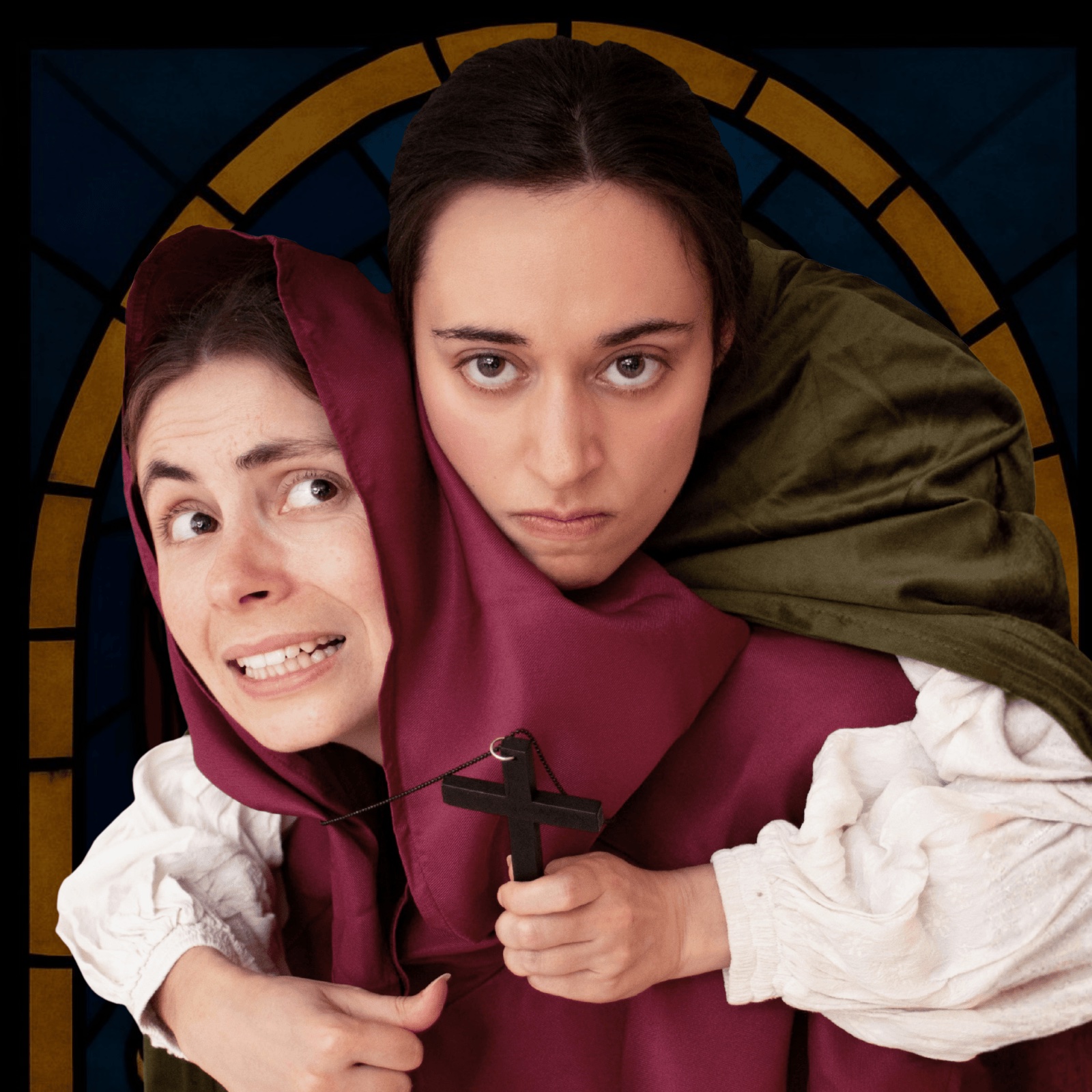
I sat down with writer and director Esalan Gates to find out more about God Save Us! coming to The Lion and Unicorn Theatre this October.
Can you tell me a little about your show and what audiences can expect?
God Save Us! is a medieval comedy set just after 1066, based on the true story of a woman who managed to divorce her husband and retain her land ownership despite the change in laws after the Norman invasion. Another woman wouldn’t get divorced for centuries.
The play follows Joan, an over-educated orphan who talks her local priest into letting her write and direct a new kind of morality play for the village. Between rumours of how the virgin birth really came about and the appearance of a suspicious stranger with nothing to lose, Joan gets a whole lot more than she bargained for on opening night…
It’s both a big, silly farce with small-town hijinks and slapstick physical comedy, and a sly provocation that it hasn’t always been a steady upwards trajectory for women’s rights. It’s so easy to say, “well, at least it’s better than it used to be”, but these days it feels as though the idea that we can’t slip backwards is becoming increasingly uncertain.
What drew you to this specific story?
I had the idea for a couple of years that there was a parallel between our relationship with money today, and the medieval cultural relationship with religion: the lower classes are excluded via elitism, gatekeeping of information, and a general attitude that if you don’t understand, it’s your own fault. I then read about the real historical figure of Asa in Normal Women by Philippa Gregory, which details the lives of women who were not aristocrats or royals throughout history. There is very little known about Asa other than what we can read in the Domesday Book: she was a Yorkshire woman who divorced her husband and maintained ownership of her lands, despite the change in law after the Norman invasion that restricted women from land ownership.
I founded Codex Theatre because I am a big fan of plays that take a complicated idea or series of events, and transform that into entertainment. Last year, I wrote and directed Pop Goes the Dollar, the company’s flagship show, which took the 2008 financial crash and turned it into an edge-of-your-seat drama. I find money and our systems for managing it dramatically exciting, because, at the end of the day, it’s all about power.
What has been the biggest challenge in bringing this production to life?
It’s a tricky balance to maintain the ridiculous, slapstick comedy while threading through the real story of a woman desperately trying to reclaim what she was rightfully owed by the law. I also have a tendency towards verbosity as a writer, as the casts who have performed my work can attest: it’s a hell of a lot of lines to learn! Once it all clicked, the comedy got sharper and the politics clearer, but it took time to pull out the important threads and figure out which of my darlings to kill.
And there’s always the issue of money and time. I work full time in Development at the Bush Theatre, and the cast and creative team are all managing their own jobs and other projects. I’m forever grateful to the people I get to work with, and directing a five-hander is such a joy – it’s rare to have such a large cast in today’s economic climate, and I’m thrilled we could make it work.
How does the design of your show (set, sound, or lighting) impact the presentation of your story?
I love working with designers, they have an incredible way of seeing the world that I don’t naturally have, and so working with Tom McVeigh (Set & Lighting) and Sarah Randall (Costume) has been a real dream. We’re keen to have the set and costume reflect the comedic nature of the show, and so we’re leaning into bright colours, visual jokes, and surprises hidden in the set and costumes that will hopefully delight audiences.
I love a stage that transforms over the course of the show, and I’m increasingly becoming an advocate for handmade props and busy, material sets as AI creeps into the creative landscape. We’re using the play-within-a-play element as a feature of the set, so there’s a strong sense that the characters have painted the drapery and crafted the flags and bunting themselves. The language of the script itself is influenced by modern sitcoms (The Office, Abbot Elementary, Parks & Rec) and so the costumes will be indicative of the characters’ personalities, rather than too caught up with historical accuracy.
If you could sum up the show in one word or phrase, what would it be and why?
It’s The Office set in 1066. Because it’s bureaucratic nonsense and interpersonal misunderstandings and herd-mentality-driven shenanigans, all set in a world where the French have just invaded, they’ve never had a King of the whole country before, and no one understands the new language of the state or the Latin church services the priests refuse to perform any other way. It’s chaos.
God Save Us! runs at The Lion and Unicorn Theatre, London, on 6 – 10 October. Tickets available at https://www.thelionandunicorntheatre.com/whats-on