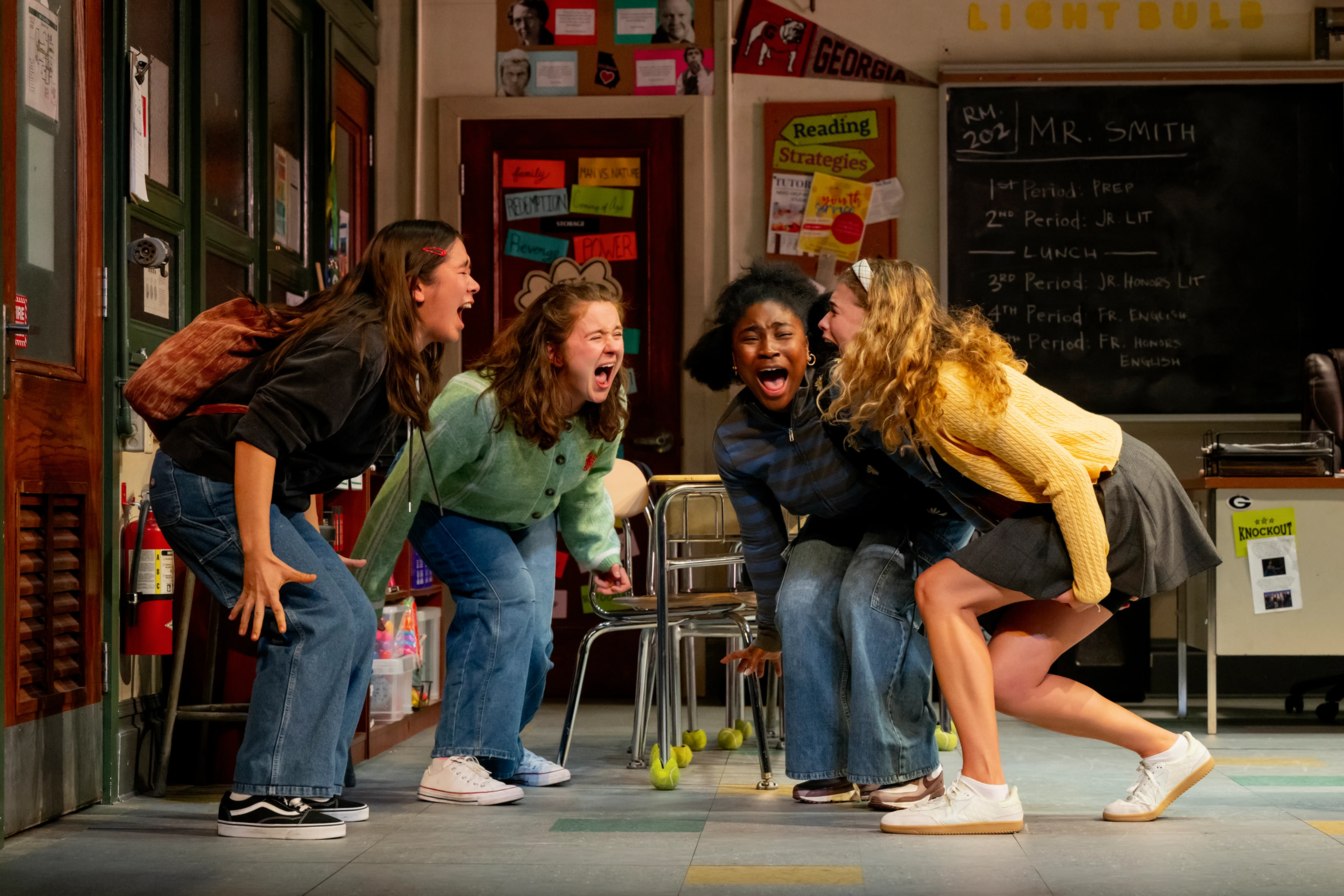
Some shows are captivating from the very first line, while others build to a memorable ending. In the instance of John Proctor Is The Villain, making its sold-out UK debut to help the Royal Court celebrate its 70th birthday, this thrilling Broadway transfer does both, leaving a lasting and moving impression.
It is 2018, the #MeToo era is in full swing, and conversations about feminism and literature are dominating the conversation among teenagers in a small Georgia town high school. At the forefront of this is English teacher Mr Smith (Dónal Finn), whose charismatic, easy-going style makes him popular among his students, especially the girls in his classroom. Under the leadership of bookworm Beth (Holly Howden Gilchrist), the girls, supported by Smith, launch a feminist club and navigate their places in the world, complicated by the return of absent student Shelby (Sadie Soverall). Yet while the girls initially use the club as a vessel to explore the growing feminist movement, it is when Shelby’s accusations towards Mr Smith, explaining her absence, that the piece really takes hold, forming a nice parallel to their exploration of Arthur Miller’s The Crucible, which becomes central to this play.
What results is a deeply impactful play, layered with the complexities of teenage life, yet one that feels distinctly fresh and current, too. References to Beyonce, Taylor Swift and Lorde all capture the pop culture for these girls, and the innocence of this is shockingly contrasted to the brutal life experiences each girl goes through here. The contrasts to The Crucible, particularly the notion of a witch hunt, are threaded through the piece, aptly pulling the audience in a direction, combined with the juxtaposing characteristics of Smith and Shelby, that make the play’s final twenty minutes all the more devastating. John Proctor Is The Villain is played at terrific speed, with an urgency that matches the anguish with aplomb.
Kimberly Belflower’s intelligent script bursts with energy, brought to the fore by the group of teens it centres around, a microcosm for American teenage life. Gilchrist’s portrayal of the sweet and ferociously smart Beth starts as the typical book nerd, eager to impress Smith, but eventually becomes the moral compass of the production, with her final decision, in the play’s last moment, a turning point in how the teens see their beloved teacher and their places not just in his classroom but in the world as teenage girls.
Meanwhile, Soverall’s Shelby is mercurial and impulsive. Returning to school after a mysterious absence, the revelations of why Shelby was gone for so long are raw and stark. It is an engrossing depiction of a teenage girl broken by abuse, and desperate to reclaim not just her best friend Raelynn (a tremendous Miya James) but also her sense of self-worth, eroded by her experiences. The pair are fractured by Shelby’s tryst with Raelynn’s long-time boyfriend, Charlie Borg’s obnoxious Lee, but it is in their reconciliation, and its culmination in the play’s final moments, an interpretative dance of The Crucible, that epitomises the heart, spirit and fire that burns in these young women, furious at the patriarchal world’s treatment of them. Lauryn Ajufo’s Nell, newly moved to the school from Atlanta, provides a fresh perspective, quick-witted and strong-willed. Her burgeoning relationship with goofy Mason (Reece Braddock), is a neat side-plot, but one also used by Belflower to navigate the innocence of teenage relationships in their proper form, rather than the abuse-laden ones explored elsewhere.
Yet the script is also deft in exploring the other side of the #MeToo movement, the wives and daughters of men accused, re-evaluating a world where their male role models are actually something darker. Clare Hughes’ Ivy is a neat representation of this. Her father is accused of an inappropriate relationship with a young employee, resulting not just in his societal expulsion but Ivy’s social isolation, too, which Danya Taymor’s direction reiterates successfully when Ivy is caught in the crossfire of Shelby’s accusations and torn between her beliefs of right and wrong.
It is through Finn’s Mr Smith that the play takes a darker turn. The piece is fascinating in this respect, with the tonal shift following Shelby’s outburst about her teacher not totally landing until his return to the classroom, evoking contempt and disgust in equal measure for a man who is so charming for large parts of the play. The impact is genuinely powerful, and all the more poignant when the girls fight back. Mr Smith, Carter, before the revelations, is teaching them Miller’s play, and the comparisons between him and John Proctor become stark, yet here there is truth to the accusations, leaving him a dishonourable man, curtly and brilliantly cut down by Molly McFadden’s guidance counsellor Bailey in an electric exchange. It is clear that Smith sees himself as John Proctor, but his misinterpretation of him, full of bravado and ego, only further reiterates the sinister undercurrents of Finn’s character, which becomes even more horrifying when the mask slips.
In a thrilling final moment, the girls dance, expressing their inner torments, frustrations and youthful, energetic rage in a visceral, striking conclusion that lifts directly from Miller’s tragedy, turning these acts, which were aligned with witchcraft and female hysteria, into something poignant and empowering. Combined with Lorde’s ‘Green Light’, the finale to Belflower’s work lands with full force, a triumphant representation of resilience and spirit that resonates.
The Crucible, and John Proctor, are seen as pillars of American Literature, yet in this new, igniting work, John Proctor Is The Villain, a modern classic emerges.


