At what point does the past stay in the past, and are some pasts more troubling than others? It is this question, and the conflict between reconciling with the past and re-punishing acts of the past, which is explored in this terrifically powerful and very funny new play.
Sarah Power’s script drops us into the quiet gift shop of Pemfort, a fort, not quite a castle, and a landmark that is being lost to time. Thankfully, its staff, owner Uma (Debra Gillett), nature-loving Ria (Lydia Larson) and a history buff Glenn (Ali Hadji-Heshmati) are seeking to breathe new life into the fort with a ‘Living History’ event to mark its place in the sleepy village.
Initially, it starts as a play about restoring history to its former glory, yet despite the trio’s initial retrospective focus on the fort’s past, it is a modern event, the arrival of released prisoner Kurtis (an exceptional, standout performance from Sean Delaney), where the production really comes into its own. What unfolds is a superb, brutal conversation about justice and time served, and whether anyone capable of heinous crimes can truly get, or deserve, a second chance.
It is Delaney’s Kurtis that the piece really centres upon. The revelation of what Kurtis’s crime actually is the play’s big twist, and Power’s script works hard to conjure a particular image of the character before the reveal comes. Delaney’s performance as Kurtis is exceptional, with deft murmurs, mumbles and stutters effective in creating a character struggling to open up and fit into life after prison. Ed Madden’s direction of Kurtis’s character, in particular, is effective, instantly establishing an air of vulnerability which immediately resonates, making the twist and moral conundrum of his past life with his present as difficult to come to terms with for the audience as it is for the characters. The play makes it clear that Kurtis is a changed man after prison, for the better, and while it does acknowledge the troubled upbringing that may in part have led to his crime, there is no attempt to deflect blame here. Delaney’s portrayal of Kurtis is raw and essential to making the production such a success.
Kurtis is also a neat contrast to the rest of the characters, swept up in their excitement for the festival. Gillett’s Uma is a little over the top to begin with, but settles down once her fierce defence of Kurtis kicks in. In addition, Larson’s Ria is sweet and sensible, epitomised by her desire to free a trapped deer, which sparks the connection between her and Kurtis that dominates the play’s latter half. Again, Madden’s direction is well-executed here. Ria’s unease around Kurtis is understandable, yet it feels natural and not overly confrontational, enabling the play’s central aims about restoration to become clear.
Alongside them, Hadji-Heshmati’s portrayal of neurodiverse Glenn is terrific, finding a neat blend of humorous pedantry when planning the historical re-enactments and a moving fragility when opening up about his mother’s struggles and his own place in the world. Glenn’s character is a treat, full of quick one-liners which largely drive the play’s well-pitched humour throughout, but with space for genuine character development too.
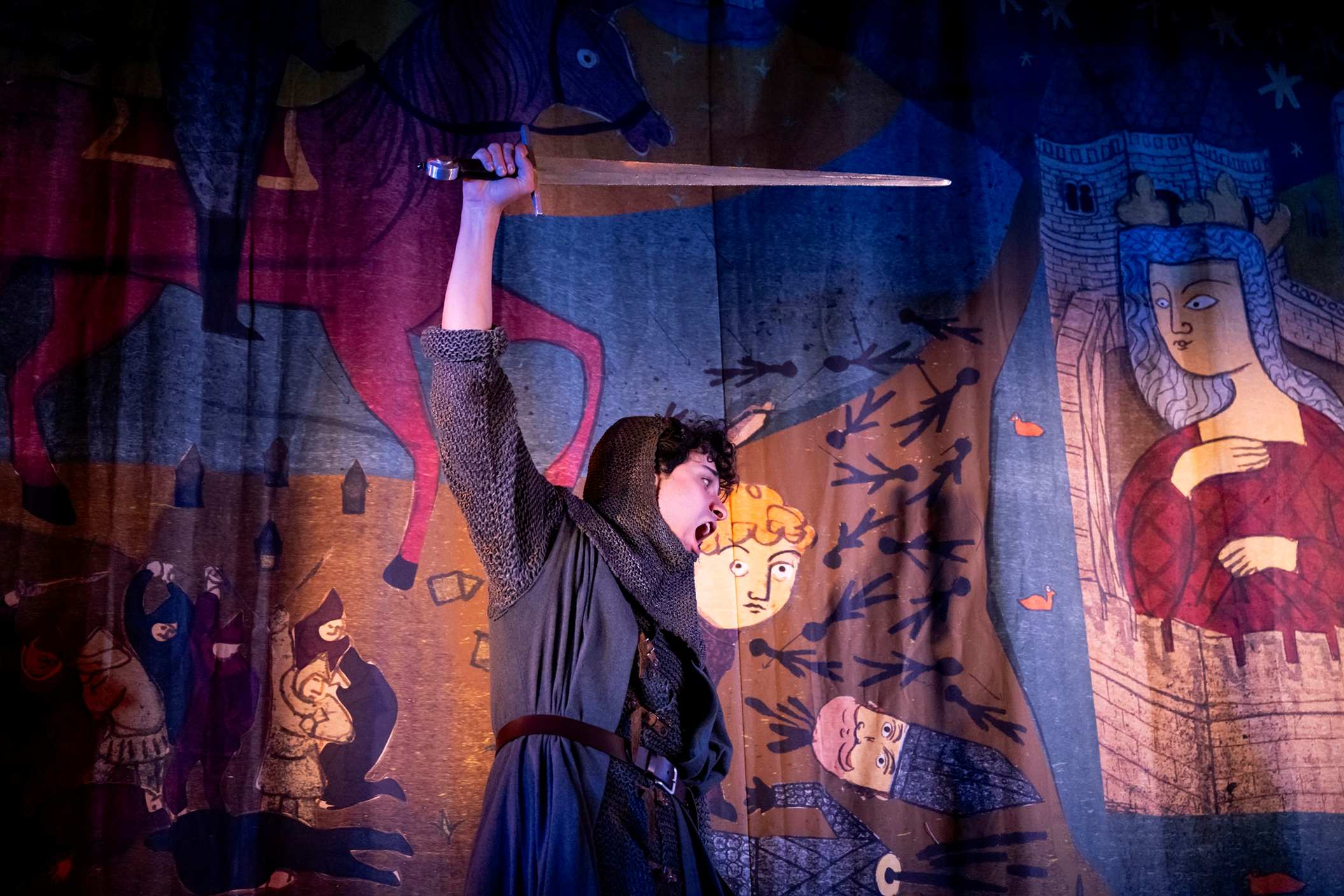
At the centre of Glenn’s festival is a fight between two noblemen vying to claim Pemfort, a neat metaphor for the clash of ideologies that plays out in this tightly formed piece, which forces a side to be taken, regardless of how brutal that may be. But it is the focus on a murder-ruled -suicide at the fort that throws the piece back into the current. Events in the 13th century feel fine to be re-enacted, but those from the 20th century? When does history become acceptable? These are big questions, and ones which are confronted at full force by the end.
Alys Whitehead’s set captures the whimsy, instantly recognisable, gift shop setting, with some brilliant fine details adding to the charm and humour of the piece. Small postcards suggesting activities and demonstrations for the history event, such as ‘medical leeching demonstrations’ and ‘public hanging?’, are never explicitly mentioned, but are there to earn a few chuckles, and also add to the rich fabric that layers this play. The setting, despite being quite close, never feels claustrophobic and allows even the most intense moments to breathe.
Welcome to Pemfort is a tremendous piece of theatre, and one that completely hits its intentions. The outcome for Ria and Kurtis swings like a pendulum right until the piece’s last moments, yet what makes the play so impactful is its authenticity. Combined with stunning individual performances, Power’s script has dialogue which naturally ebbs and flows, waiting for an opportune moment before landing a punch, with its 90-minute runtime fizzing by. It is terribly funny in places, and utterly heartbreaking in others; a perfect blend for combining such a small story with such a big message.
A thought-provoking, empathetic triumph.
This review was originally written for The Reviews Hub: https://www.thereviewshub.com/welcome-to-pemfort-soho-theatre-london/


