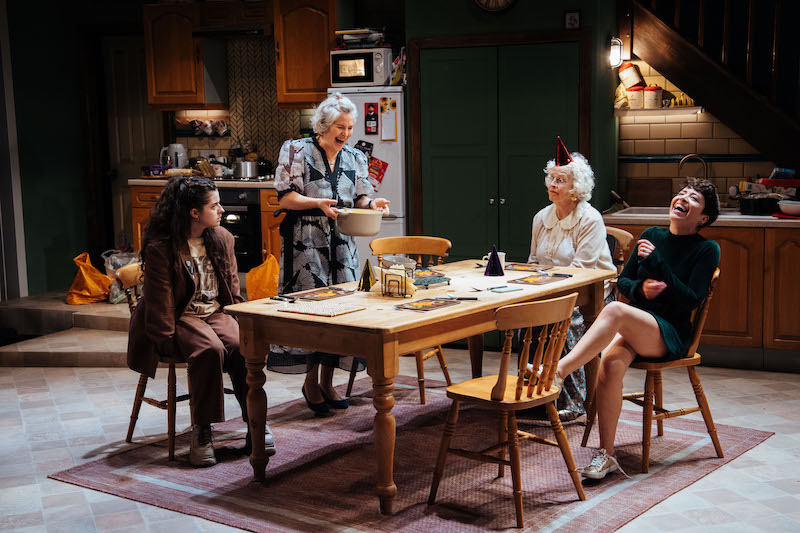
A dismal birthday party and a dreadful family secret take hold in Karis Kelly’s darkly gripping focus on female and familial trauma.
It is Granny Eileen’s (Julia Dearden) 90th birthday, and the acid-tongued nonagenarian is fiercely critical of all of those around her, especially daughter Gilly (Andrea Irvine), whose doting, caring ways appear to disguise something much darker. The relationship and the birthday celebrations are complicated with the arrival of Gilly’s daughter (Caoimhe Farren), quizzing her mother about her absent father, and Jenny’s daughter, Muireann (Muireann Ní Fhaogáin).
Consumed starts as a typically awkward birthday party between four generations of women who spend very little time in each other’s company, all harbouring grudges of some sort. But as Karis Kelly’s script unfolds, what is unveiled is the four generations of trauma the family is holding onto. Eileen’s horror of The Troubles runs deep, while Gilly’s deflection of her own trauma manifests itself in an out-of-control hoarding habit. Meanwhile, Jenny’s reflections on her poor childhood have soiled her relationships and driven her to the bottle, while Muireann, a complex teen worried about the world and battling an eating disorder, uses her relationship with food as a coping mechanism for her anxieties.
Despite its brevity (clocking just under 80 minutes), Kelly’s script tackles an enormous number of issues, but the piece is layered in such a way that each is given its own time to be explored, to varying degrees of depth. Dearden’s fiercely enjoyable portrayal of the bitter, great-grandmother is stark, reduced to begin with to acerbic putdowns of her family members, and furious tirades about Catholics and the state of Northern Ireland, before something much darker is later revealed.
Irvine’s Gilly, meanwhile, is mercurial. Irvine succeeds in the sharp turns of tone in Gilly’s character, with her continuous smile and forced laughter a weak defence for the troubles bubbling underneath. It is Gilly and Eileen who appear to be holding the play’s most troubling secret, and it is the revelation of what this secret is, in a powerful final 15 minutes, that the piece moves into much more sinister territory.
As the two more recent generations, Jenny and Muireann initially bond over their differences with the more traditional, quieter Ulster life, which contrasts with their more urgent London lifestyle. Jenny’s obsession with her work phone proves to be an addiction that is only replaced by something alcoholic, which Farren conveys with a rawness and vulnerability that takes hold during the piece’s conclusion. Meanwhile, Ní Fhaogáin’s Muireann, reconciling with her role as the fourth generation of this family, and her eating disorder, strikes a good balance between youthful defiance and activism and naive vulnerability. The pair is an interesting study of a mother-and-daughter relationship, fiercely defensive of each other at the start, but the passage of time, albeit brief in this play, sees this erode.
Kelly’s play won the Women’s Prize for Playwriting 2022, and Katie Posner’s direction of this production enables the complexities between these four women to shine through. While it is a play deep rooted in exploring trauma and experiences for women across generations, it is also a deeply funny piece, with the bleak, and in places absurdly dark, humour enabling the play to straddle its comedy and its horror in equal measure. This is supported by a gorgeously designed set, with Lily Arnold’s design of the home a neat blend between warm homeliness and, with scattered rubbish, used boxes and old newspapers thrown into the corner, the notion that something is not quite right.
It is a play that gradually sees all four’s facades break away, forced to face their traumas in increasingly darker and more devastating ways. The production makes a sharp turn in its last few moments, which is a little at odds with the rest of the piece, but nevertheless, it provides a meaningful and moving conclusion to these four women’s stories.
Muireann, earlier in the play, muses that rats have been proven to pass on traumatic thoughts from generation to generation, which becomes a metaphor for these four women, trapped in their cage, the family home, unable to escape the binds of time. By the end, the notion of trauma is stark for all four characters, and a horrified audience, to see.
This review was originally written for The Reviews Hub: https://www.thereviewshub.com/consumed-park-theatre-london/


