The concepts of faith, gender, and repressed sexuality all converge in this engrossingly stark, bilingual stage adaptation of Isaac Bashevis Singer’s 1962 short story.
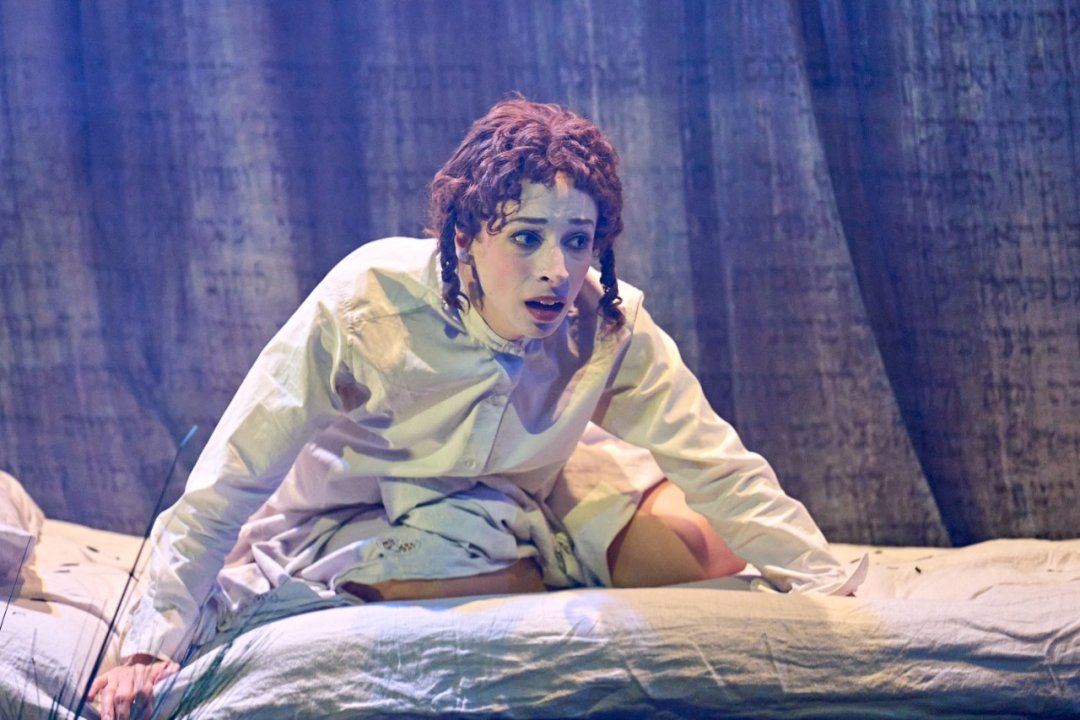
Those who may be familiar with Yentl may instead be expecting an adaptation of the 1983 musical version starring Barbara Streisand, but what this production offers instead is a much darker, much more stylised and much more captivating production, spearheaded by a terrific Amy Hack in the titular role, as a young Orthodox Jewish woman seeks to escape the confines of her gender, and of societal expectations, to fulfil her desires to study Jewish scripture.
Writers Gary Abrahams (who also directs), Elise Hearst, and Galit Klas have, instead, produced an intriguing and slowly unfolding story, looking instead at the intersection of faith, gender, sexuality and desire and the complications that arise when pushing their respective arbitrary boundaries. Abrahams, artistic director of Kadimah Yiddish Theatre, who produces the piece, directs the production with a strong blend of traditional Yiddish culture with an urgency that feels fresh and relevant, with Hack’s Yentl’s struggle with their gender identity a provocative and emotive construct.
The choice to make the piece bilingual is effective, with characters seamlessly shifting from English to Yiddish, often during times of emotional strife, to further the authenticity of the production. This is supported by unobtrusive surtitles, projected onto the set, with the production balancing this well, allowing the more dramatic, powerful moments to be in English, with more intimate, quieter, moments in pain in Yiddish to avoid deflecting audience attention.
Hack brings great clarity to Yentl’s complexity, using deft movements and a blend of subtlety with explosive angst to capture Yentl’s frustrations at her social situation first as an oppressed woman, and then one rapt with desire and longing while disguised as Anshl. The absurdity of the situation, in the script, initially leans on awkward moments with other men, particularly study partner Avigdor (Ashley Margolis), before becoming more severe in exploring the pain Yentl’s deceit evokes for those around her. By the piece’s moving and poignant conclusion, the play becomes a stark reminder of how society treats those deemed to be non-conformists, with Isabella Van Braeckel’s set design effective in its use of scrim to cast Yentl, in a state of self-imposed exile, aside.
Margolis’ Avigdor is rapt with sexual repression, frequently and openly talking about the desires that he grapples with, confused by the pleasure he gains and the sins these are felt to be. It is a neat performance, and one that, as Avigdor becomes torn between the affection for his long-time crush, the sweet yet naive and fiercely traditional Hodes (Genevieve Kingsford) and mercurial Yentl/Anshl, evokes ideas about queerness and sexual fluidity that Singer’s source material leans on, helping the production feel current and necessary sixty years later.
An addition to this production that would be unfamiliar to fans of Streisand would be the inclusion of ‘The Figure’ (Evelyn Krape), a conniving, menacing and defensive guardian angel, conscience figure that lingers around Yentl throughout. Krape’s character squawks and giggles, becoming almost a solo version of a Greek chorus, threading scenes together and explaining much of the Orthodox Jewish traditions.
Where the production also thrives is in its severe design. Yentl, The Figure and Hodes are all emblazoned with white face paint, immediately creating a sense of unease. Meanwhile, Van Braeckel’s set design is brutal in its starkness, relying on plain, rustic, shapes and colours, and a stage floor covered in black rubber that evokes a barren, lifeless, landscape, a neat contrast to the vividness of life Yentl craves and that society and its traditions withhold.
Before reaching Marylebone Theatre, the production enjoyed a 5-star run at the Sydney Opera House, and it is easy to see why. This is a captivating piece of theatre which is delicate and determined in its approach. While a little slow to get underway, the second half, in particular, flies, culminating in a devastating, impactful end.
For Yentl, the complexities of societal views leave her on the fringes, yet in this production her pains, her aspirations and her desires are spotlighted with sensitivity that handles the balance between Yiddish tradition and urgent individuality with tremendous care.
There is nothing quite like this on stage right now; an epic masterpiece.


