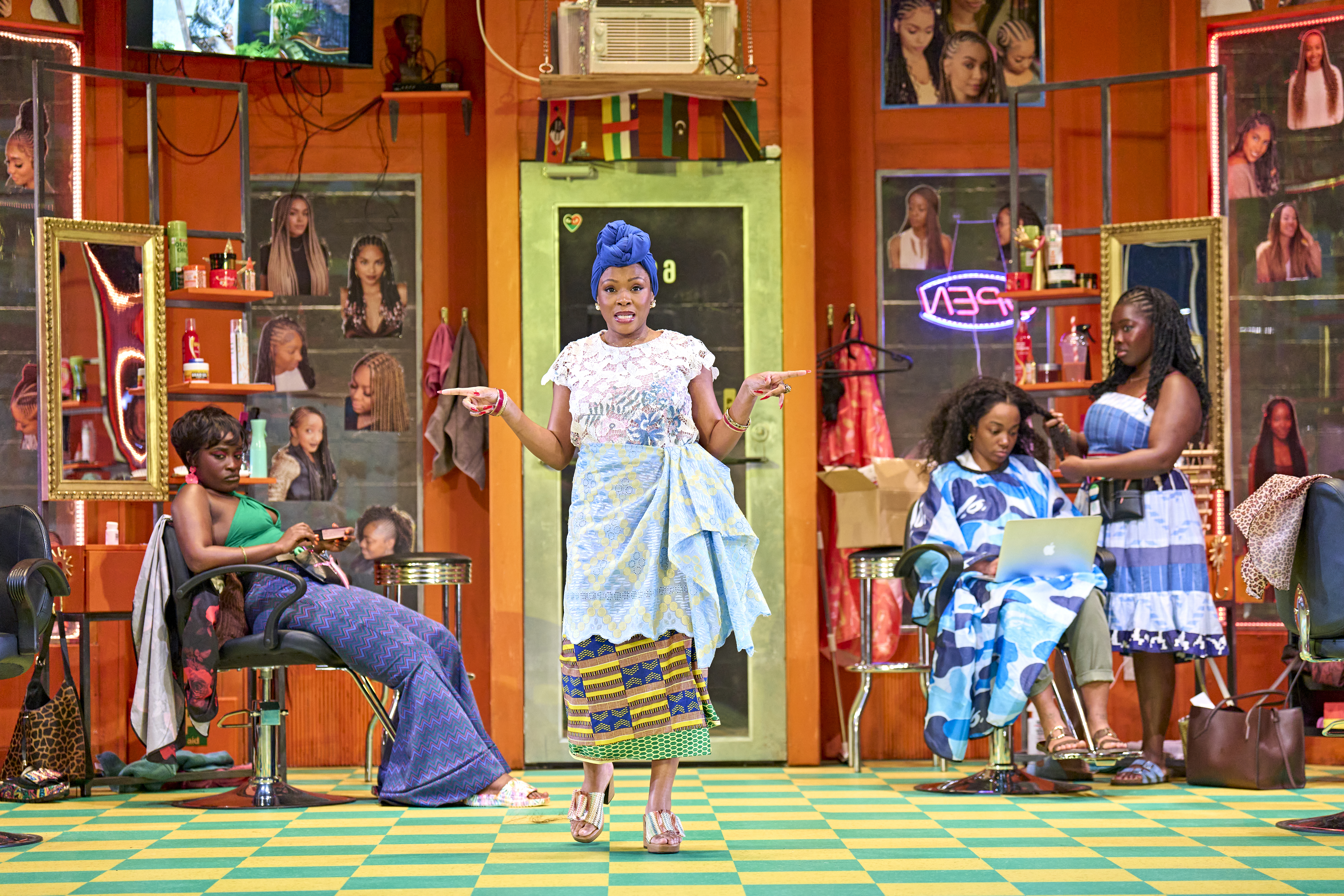
Micro-braiding, hair extensions and cornrows are the knots that hold these women together in this lively and engaging exploration of sisterhood and identity as Tony Award nominee Jocelyn Bioh’s Jaja’s African Hair Braiding makes its UK premiere at London’s Lyric Hammersmith.
Bioh’s play is reminiscent of Inua Ellams’ Barber Shop Chronicles. Where that play used barber shops in London and Africa to look at the similarities regarding masculinity among black men, Jaja’s African Hair Braiding uses a Harlem hair braiding shop as a setting to explore the female Black African and African-American experience. The result is a poignant and powerful blend of ferociously funny humour and a representation of the tight bonds of sisterhood between these five, each seeking their own versions of survival in a 21st-century America particularly challenging for immigrant women.
Jaja’s shop is looked after by her eighteen-year-old daughter Marie (a brilliantly subtle Sewa Zamba), who oversees the five women who work there, each vying for customers, tips and all with their own complex backstories. Bolshy, composed, Ndidi (Bola Akeju) balances a passion for Nollywood and aspirations of stardom with a spark for styling, while Jadesola Odunjo’s Miriam, three years in America after leaving a loveless marriage in Sierra Leone, finds comfort in pining for a musical lover while aspiring to bring her young daughter to New York. Contrasting the younger stylists are the cynical, gossiping pair of Aminata (babirye bukilwa) and Bea (Dolapo Oni), whose acid tongue provides much of the early humour and scathing remarks.
It is a good blend of characters, with Bioh’s script giving plenty of opportunities for each woman’s life to be explored, including their motivations and aspirations. The piece is layered with humorous remarks and interactions that are fiercely familiar for anyone who has been in such a shop, yet this is finely balanced with a tenderness within each woman too, ranging from the spark of romance to the loneliness divorce and separation can bring.
With the air conditioning in the salon conked out, the shop quickly becomes a hot and stifling environment for everyone there. Zamba’s portrayal of a daughter worried about her mother Jaja’s (Zainab Jah, who dazzles in a brief yet commanding cameo) marriage to white American Steven, as well as her fears about her legalty to be in the States, living on a fake ID of a distant cousin, is stark and pained, with Marie never quite settling or looking at ease.
Meanwhile, Akeju is bouncing and energetic as enthusiastic Ndidi, representing the fresh face of youthful innocence, though her sharp hands for braiding quickly put her at odds with elder Bea, with Oni fierce in her portrayal of Bea’s rebuking of the novice stylist. It is Bea whom we never quite get to the bottom of, hiding behind a deflective bravado which is only fleetingly unmasked during a vicious trade of insults with bukilwa’s Aminata, embarrassed by boyfriend James’s (a sparkly Demmy Ladipo) lothario ways. bukilwa is terrific here in these moments, disguising this moment of pain, while pain is also hidden in the relentlessly positive portrayal of Odunjo’s Miriam, aspiring for a better life for her daughter and herself, which feels both poignant and futile given her immigration status and the current climate.
Monique Touko’s direction of the piece largely lands, and the combination of the snappy dialogue and engaging characters blends well with the bright and colourful shop designed by Paul Wills. The wrap-around nature of the set resembles something protective, with the salon almost a defence for these women from the harsh reality of life outside the security of their hair-braiding lifestyles. Male characters come and go, yet it remains clear in its centring of these five women and their interrelated lives.
The production’s stark tonal shift in the final twenty minutes provides a whiplash of emotion, in a move that feels a little underdeveloped given the twist’s severity. Bioh’s inclusion of this moment is a clear connection to the domestic horrors immigrants are contending with in America right now, but it is also something that feels under-explored by the piece’s conclusion. Nevertheless, its addition does help to provide some closure, not just to the shop’s day, but to the infighting, bringing it back to the sense of sisterhood that underlines the piece as a whole.
Despite its uneven finish, Jaja’s African Hair Braiding is open for business with success. The piece consists of a good blend of heart and humour, which clearly resonates, but also does not take itself or its characters too seriously. The bonds between these women are as tight as the knots in the hair they style, and it is this spotlighting on sisterhood that feels so compelling by the finish.
Fun and fresh in equal measure, and feeling distinctly current, Jaja’s African Hair Braiding is packed with terrific punchlines and bold characters who all bring something unique to the salon.


