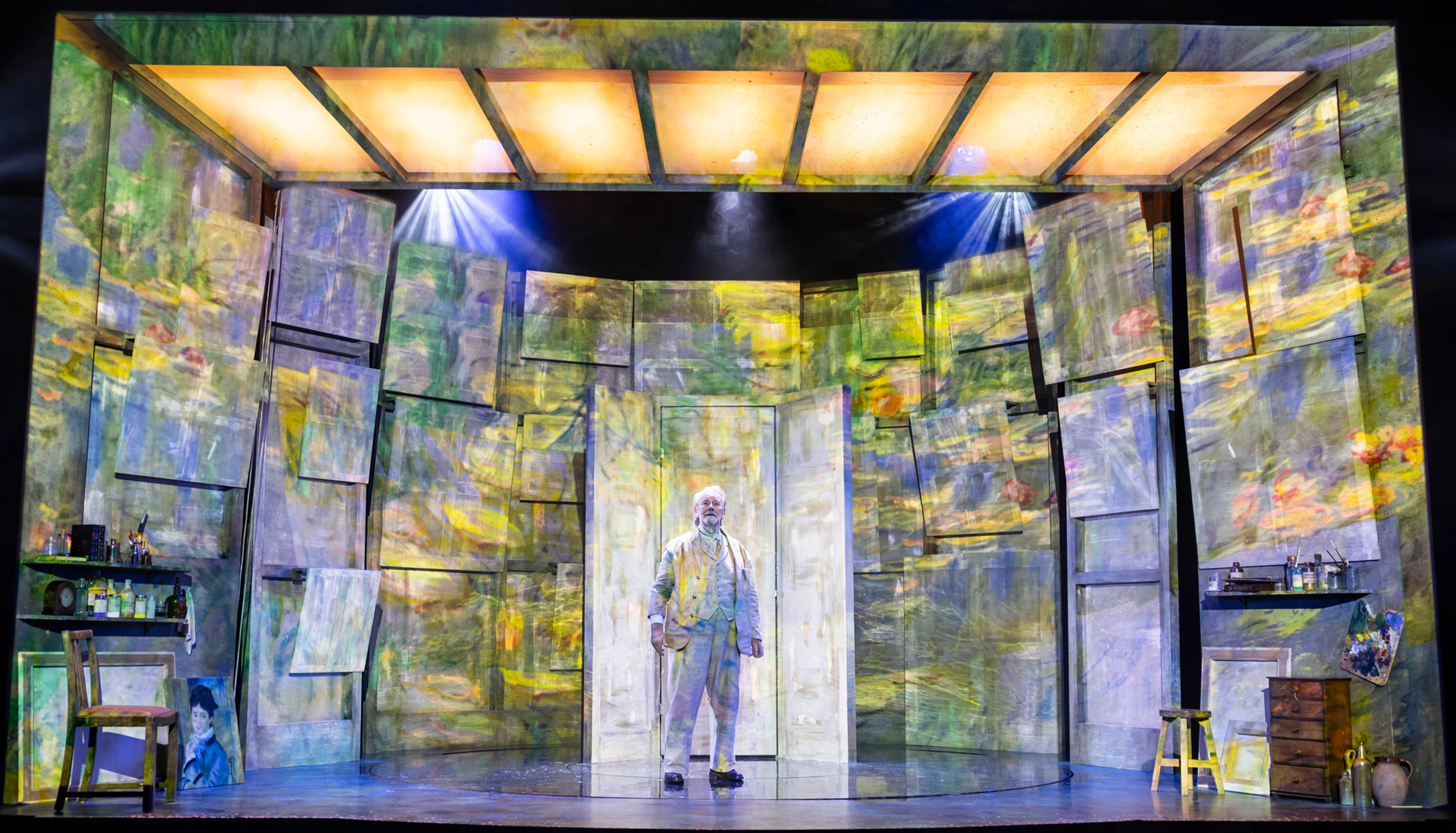
Claude Monet’s ‘The Water Lilies’ is one of the world’s most recognisable paintings, but it is his personal struggle to paint the iconic work, and the impact of the death of his long-term muse and wife, Camille, which takes centre stage in this new musical.
Carmel Owen’s book places us in Monet’s tired studio, absent of paintings apart from one portrait of Camille, and the sounds of World War One bombs dropping overhead. It is a bleak start, and one that is a contrast to the colour and illumination synonymous with the French Impressionist artwork. While we know that Monet will inevitably succeed in creating his finest work, the musical still manages to provoke intrigue regarding the process that led a miserable Monet to this moment of artistic genius.
Director Christian Durham uses an aged, bitter Monet (Jeff Shankley) to retrospectively guide us through the artist’s formative years, with Shankley’s gravelly depiction a neat contrast to Dean John-Wilson’s more ambitious, resolute, younger version. Shankley’s version of Monet is more layered, beaten down by time and by guilt, reflecting on his obsession with art and its toll taken upon Camille (a strong Brooke Bazarian), ever-present across the production as he drifts in and out of his past. This contrasts the younger Monet, with John-Wilson having less to work with here in a viewpoint that is far more simplistic, yet his colourful view of a life ahead of him works to contrast the impact of time’s passing on his older self. Owen’s book does not hold back in exploring Monet’s flaws, particularly his selfish treatment of Camille, but this does become a little too self-pitying by the end, symptomatic of a man aware of his flaws but not able to reconcile with them either.
Bazarian’s Camille, more educated and wealthier than Monet, is defiant and resilient despite Monet’s prolonged absences. The nature of their relationship means the script gets a little bogged down by the repetitive nature of their on-off status, yet Bazarian does succeed to drawing out Camille’s bitter frustration at her situation, right through to her sad fate. Meanwhile, Sam Peggs’ Renoir and Ritesh Manugula’s Bazille, two of Monet’s artistic contemporaries, provide neat sidelines to Monet’s story, representing the new and vibrant art world and style that Monet also represents, but which struggles to gain mainstream success. Aaron Pryce-Lewis’s depiction of Édouard Manet also lands well, forming a mentor-type figure for Monet, and also a constant reminder of how the French art scene is not necessarily ready for an artistic revolution, still scarred by its political upheavals.
This is, in part, because of the stubbornness of Steven Serlin’s Marquis, who gatekeeps the French Salon, deciding which art is, and is not, acceptable. Serlin’s Marquis is given a chance to linger on his own ostracism much later in the piece, a stark reminder of how quickly and brutally the artistic world can move on and embrace a new style.
Owen’s book, particularly the songs, do not immediately land neatly in the ear. Characters stumble into songs, and there is an unusual blend of more conventional-sounding numbers with ones that are more hurried and spoken. At first, this can be a little odd to reconcile with, but this soon becomes a metaphor for the manner with which Monet himself reinvented artistic genres and forms, never quite fitting in or ‘performing’ to type. It takes a while to get used to, but the effect helps to evoke ideas about the painter’s artistic approach with success.
While undone on occasion with a bloated set of songs and a few on-the-nose dialogue exchanges, the beauty of this piece lies, aptly, in its design. Libby Todd’s set and its combination with Matt Powell’s gorgeous video design are vivid and extraordinary, blasting the theatre in colour and Monet’s work in a way that immerses both characters and audiences into the artwork. Powell’s design is projected with precision across the set, mapped to show an array of paintings not just of Monet’s but of his contemporaries, which bring the art to life across the stage. By the end of the piece, these take hold with Monet, the company and the set all awash with colour as Monet’s most famous work fills the room in a moving moment which could be lingered upon for slightly longer.
A Mirrored Monet is not the catchiest musical to grace a London stage, but it is one of the most colourful. It is an interesting look at one of the art world’s most renowned figures, and also ambitious in its own aims to blend theatrical styles into its own form of art. While a little overdone in parts, its hardworking cast and imaginative creative team bring Monet’s work, and his flaws, to the fore with eye-catching vibrancy.


