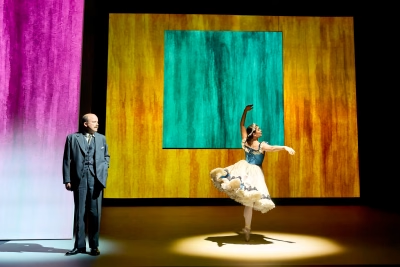
Actress Maud Allan is on trial for her provocative depiction of Oscar Wilde’s Salomé, yet it is the playwright’s former lover and literary executor, Robert Ross, who finds himself defending the disgraced writer one last time in this slickly performed new work.
Penned by Lily Zhang, 1918: The Final Salomé uses the legal case, but instead sheds light on Ross, Wilde’s first ‘boy’, a devoted lover who, in the years following the writer’s death, has committed to preserving his legacy, and the legacy of Salomé. Wilde’s play focuses on the seduction of John the Baptist by the titular Salomé, and perhaps it is the playwright himself who is the corrupting seducer here, leaving behind the besotted Ross and the inflammatory Lord Alfred Douglas, with whom his relationship landed Wilde in jail.
Yet while Wilde looms large over this piece, he makes only one fleeting appearance, with instead Zhang’s script focusing on the emotional torment of Ross, who dedicated his life, perhaps wastefully, to preserving Wilde’s legacy. At its core, then, the show is a form of love story, but one full of pain and non-acceptance, highlighting Edwardian prejudices and the personal carnage Wilde leaves behind.
What shines through most in this piece is the extremely impressive performances of the ensemble. George Loynes’s Vyvyan, Wilde’s son, attempts to make sense of his father’s papers, but finds himself struggling to reconcile with a father who leaves him feeling a sense of abandonment. Loynes’s rage and frustration are clear here, with a carefully crafted sense of disgust not because of Wilde’s perceived moral failures, but his patriarchal flaws instead.
Meanwhile, Rowena Sears floats gracefully as airy Allan, charming and poised but with a carefully crafted wit which irks snarling prosecutor Noel Pemberton Billing (a bolshy Charlie Lewis). Ren Stefanacci, too, is terrific as the cruel Douglas, unrepentant in his treatment of Wilde, and whose presence haunts Ross too, a reminder of his own jealousies.
Yet it is Peregrine Neger who steals the show in a remarkable individual performance as Ross. Neger brims with a pain which fizzes through the piece, desperate to defend Wilde and, too, himself, wanting his life’s work, maintaining Wilde’s legacy, to mean something. This is not just crafted in Neger’s performance but also through a gorgeous decision to gracefully wrap Ross in Wilde’s papers, gently smothering the character in an aesthetic manner, paying homage to the writer’s eye for beauty.
Indeed, this show is probably best suited for Wilde’s fans. It does attempt to fill in the blanks, but without prior knowledge of the writer, it can be harder to pick up. That said, fans of Wilde’s work will delight in Zhang’s brilliantly researched script, resulting in an hour of art that finally puts Ross, rather than the writer, into the limelight.
A well-formed Fringe production.