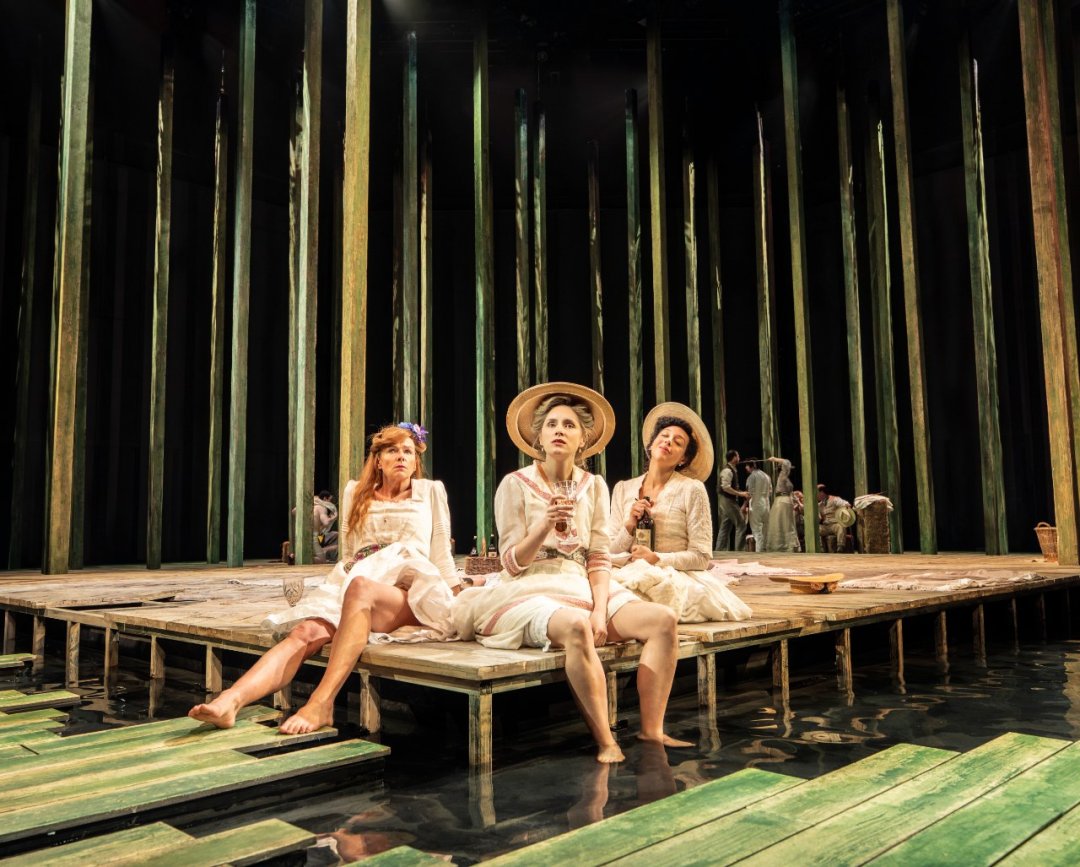
Summer escapes and holiday rentals should be the place for paradise, but aspirations for a peaceful time away quickly erode in this biting satire that sends up pre-Russian Revolution middle classes full of nihilistic hedonism, which feels just as pertinent today in this new version of Maxim Gorky’s play Summerfolk.
It is a play as much about identity and self as it is a criticism of the hollow, self-righteous middle classes. When debuting in Russia in 1904, Gorky’s play caused riots, and while this new version, adapted successfully by Nina Raine and Moses Raine, will not quite incite such chaotic scenes within its audiences, there is much to enjoy and be provoked by throughout this three-hour epic.
Summerfolk thrusts audiences into a ‘dacha’, a second-home of the wealthy in the countryside where those who could afford it could escape from the cities during the summer months, whiling away the hours with food, alcohol, games and very little purpose. It is a directionless existence that thrives on luxury and excess, with Gorky’s original version preceding the revolutions to come in Russia. While this new version will not, presumably, be the prologue to societal revolution in Britain, it does take a swing at the middle classes who thrive on being societal saviours, preaching a better world without actually trying to do anything about it.
Central to the plot is Sophie Rundle’s Varvara, the hostess of the holiday home. Varvara, wife to wealthy lawyer Sergei (a terrifically fierce Paul Ready), struggles throughout the play to reconcile with the banality of her and her friends’ existence. Drifting from chat to chat about art, politics and identity, Varvara pins her hopes for genuinely stimulating conversation upon new arrival, writer Shalimov (Daniel Lapaine), whose freshly bald head is as disappointing for Varvara as his depthless conversation. As the play unfolds, Varvara becomes a female protagonist in the same ilk as Ibsen’s Nora in A Doll’s House, seeking something fresh and new, but that comes at a substantial personal cost. Rundle treads the balance carefully as Varvara, ranging from her exasperation as Shalimov and most other male characters attempt to charm her, through to her anguish and desperation after being berated by jealous, poisonous friend Olga (a neat turn from Gwyneth Keyworth).
One of the biggest conundrums of staging these Russian epics is the enormous cast of characters that they often boast, which is no different here. The programme not only lists the characters, but also their relationship to the others, presumably in an attempt to bring some clarity to the plot, with a very exposition-heavy first 45 minutes, which goes a long way to setting up who everyone is and how they relate. It could be bland, but Robert Hastie’s direction breathes great life into this new adaptation. Characters flutter and flitter in with little urgency, but often with a curt word or, in the case of Doon Mackichan’s very funny poet Kaleria, some dreadful poetry, that moves the piece with ease.
It is the matter-of-fact nature of the script’s humour that propels the play too. A botched suicide attempt is dismissed with an offhand remark (the victim is nowhere near fatally harmed), while the cheek (literally) of a damp bottom emerging from the surrounding river (part of Peter McKintosh’s gorgeous set), asserts that the play is not taking itself too seriously. It is a send-up of the coasting classes, and perhaps not as urgent as it was over a century ago, but its gags and swipes still land. Peter Forbes’s sharp-tongued Semyon is a delight, while Arthur Hughes’s volatile Pyotr provides a contrast to the rest of the characters, grappling with shady business deals that remind audiences of where the money for these hedonistic lifestyles comes from.
An important side-plot to the piece is the burgeoning relationship between clerk Vlass (an excitable and very funny Alex Lawther) and his much older love interest Maria (Justine Mitchell). This particular relationship is played well, with Lawther’s pining and frustrating sighing good fun, but this is tempered with genuinely heartfelt moments between the pair, especially as Maria grapples with the societal perception of their age gap. In a play that has an enormous amount of couples all fighting, it is this one pairing that the play wants you to root for, yet is ultimately doomed by the rigid divides and expectations in this stubborn society.
McKIntosh’s set, full of pale white and green wooden frames, evokes a hollow environment, a clear metaphor for the nihilism of those who holiday there, is a beautiful construction, filling the Olivier space perfectly, especially in the second half, where it expands to the woodland and river areas. The inclusion of a riverbank, full for characters to wade through and splash in, is a neat touch and offers just enough immersion.
Although it will not incite the same level of crowd trouble as it did over a century ago, Summerfolk is a lavish, long, exposé of the flawed middle class, found in that middleground between disliking those higher than them while objectifying those below. It is an expanse where characters like Varvara feel trapped and lacking in purpose, while others simply exist, indulging in a drifting, hollow existence. At this dacha, it is a summer holiday to watch and criticise, but not one you would want to be part of. It is an intriguing production, and one that succeeds in leaning on the various plots and its numerous characters to keep it alive right to the very end. While those who are holidaying might be leading pointless lives, this production of Summerfolk is far from futile.


