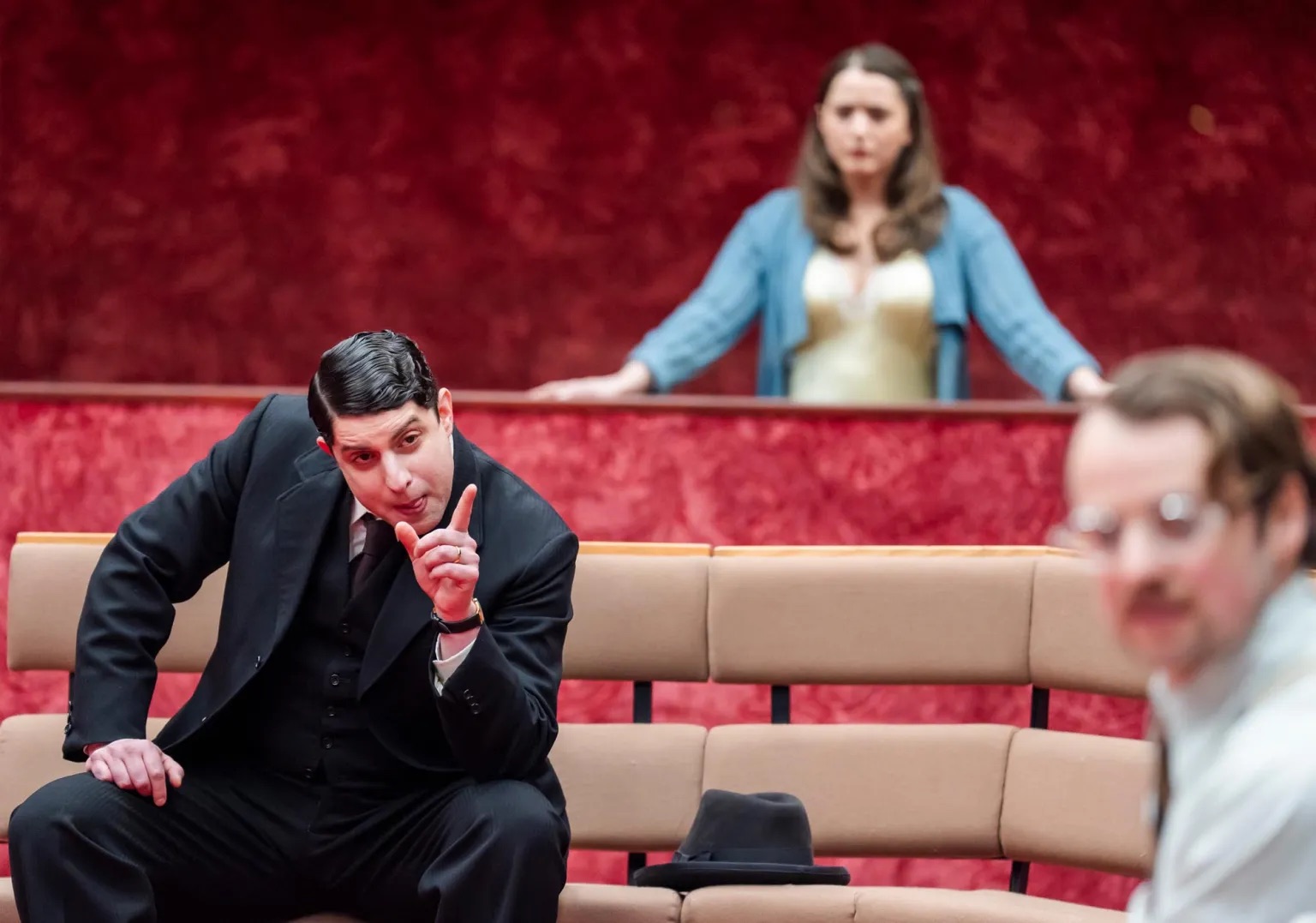
The works of Arthur Miller, or works influenced by his writing, are having a bit of a moment in London right now. From last year’s Shakespeare’s Globe reworking of The Crucible, to the incredible All My Sons and the Miller-esque The Holy Rosenbergs, the playwright’s influence and sharp eye continue to spark debate and reflect the complexities of the world around us. This is no different in this intriguing and boldly styled revival of Broken Glass.
Set in 1938 Brooklyn, a popular haunt for Miller’s work, Broken Glass spotlights the Jewish couple the Gellburgs. It is a disrupted marital setting. Finance worker Philip, (Eli Gelb) wrestling with his Jewish identity and trouble at work, has his misery exacerbated by his wife Sylvia (Pearl Chanda) who is inexplicably, and suddenly, struck down with paralysis below the waist leaving her largely bedridden. The cause of Sylvia’s ailment is unclear, though quickly established as nothing deliberately physical, treated by alluring Dr Hyman (Alex Waldmann), whose obsession with the Gellburgs’ sex life makes up much of Miller’s script and, presumably, his name choice too.
Sylvia’s sudden paralysis also coincides with her reading of, and then complete obsession with, the growing abuses and violence towards vulnerable Jews in Nazi Germany. One image in particular, of two elderly Jewish men scrubbing the pavement with toothbrushes surrounded by a laughing crowd, terrifies Sylvia, fearing similar prejudices making their way across the Atlantic.
As a premise, Miller’s play is a tight one. Sylvia’s sudden disability is infuriating not just for her but for Philip too, and the interweaving of a couple in crisis, emotionally and physically distant, is used as a neat parallel to a global catastrophe that feels poignantly timely today. Yet in its delivery, the piece leans too heavily into slow exchanges, hindered by a lack of interval. At the same time, the obsession with sex and sexuality is not written with particular polish.
That said, this production is propelled by its small but impactful cast. Gelb’s frantic Philip is captivating, full of fury and internalised hatred, capturing the angst of the character with success. Gelb’s performance strikes a clear balance between Philip’s aggression and frustration towards Sylvia, with his self-loathing particularly regarding his sexual inadequacies boiling with rage.
Alongside Gelb, Chanda’s Sylvia brims with paranoia, combined with a devastating vulnerability as Sylvia crawls across the stage eventually to her bed, a representation not just of her helplessness but symbolic of the wider Jewish desperation too. It is when the pair’s relationship erupts that the piece really catches light, building to a terrific climax that is well-telegraphed but still impactful.
Waldmann’s Dr Hyman, urgent in wanting to cure Sylvia, is a bit sleazy, with the discussions about sex and relationships toe-curlingly painful in places. Waldmann captures the character well but it is undone by the dialogue. Hyman’s wife Margaret (performed by a sharp but underused Nancy Carroll) eventually snaps, while Sylvia’s beleaguered sister Harriet is caught between wanting to be supported while also being baffled by her sister’s condition, captured well by Juliet Cowan’s tidy delivery.
Where the piece is also striking is in its design. Reconfiguring the space into almost in-the-round, the stage triples as a medical waiting room, Philip’s workplace and Sylvia’s bedroom. It goes a bit overboard on the symbolism, with a goldfish fizzing around a bowl and four clocks on the wall all feeling a bit superfluous, but the decision to keep the house lights largely on, designed by Adam Silverman) is effective in evoking a similar discomfort to Sylvia in the audience, interrogating each other’s reactions just as much as those on stage.
That said, the piece gets stuck in a bit of a loop that by the end loses too much momentum to fully land. Even though propelled by Gelb and Chanda’s brilliant individual performances, Broken Glass feels more of a small fracture than an urgent shattering by its conclusion.


