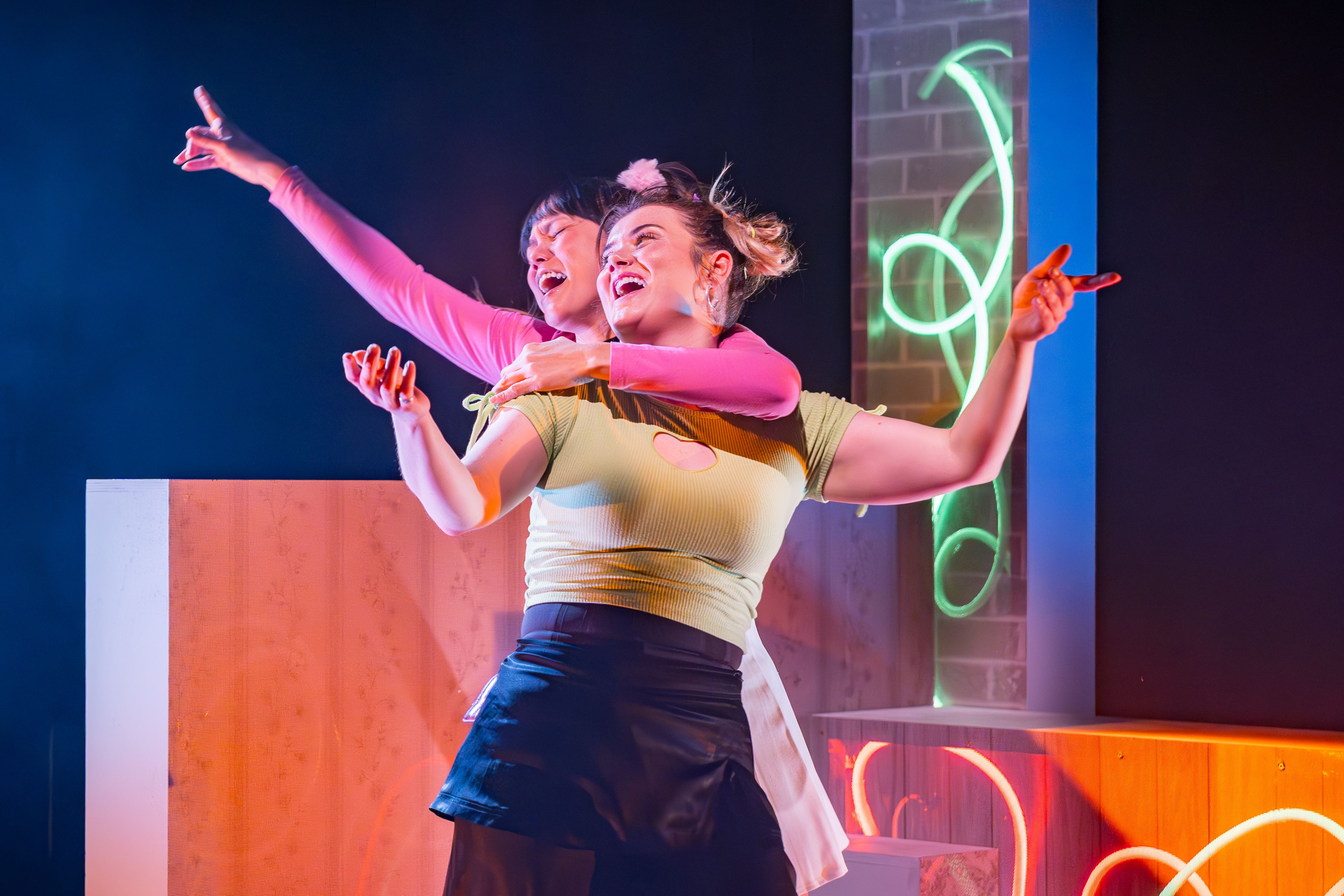
It is the end of the 1990s, and as the threat of Y2K approaches, young Lindsay, a working-class woman from Doncaster, is sitting at a microphone, broadcasting to an unknown audience and reflecting on the chaotic and devastating conclusion to the decade for her in this moving and nostalgia-filled play.
Penned by, and starring, Danielle Phillips, Children of the Night centres upon Lindsay (Phillips), whose passion for nightclubs, drink and sex threatens to derail her life before it has even begun. What starts as a thirst for freedom, backed by an A in A-Level English yet with limited options in front of her, Lindsay throws herself into Doncaster’s clubbing scene, initially intoxicated by the thrill of the music and the beat of the baseline, educated in club music by her father Terry (Gareth Radcliffe), and out-of-work miner, physically and psychologically still grappling with his life lost down in the cloed pit. This is the end of Thatcher’s Britain, and while New Labour races to power, it is not a case that ‘things can only get better’ for Lindsay and her father, with dance-floor euphoria replaced by a localised HIV cluster, fun nights out ending in meaningless hookups and a breakdown between Lindsay, addicted to partying, and her aspirational, excitable best friend Jen (Charlotte Brown).
As Lindsay, Phillips is electric as a woman finding her feet in the clubbing world before being totally lost to the chaos of it all. Lindsay’s erosion from enthusiastic teen through to a woman grappling with alcoholism and regretful sex is brutal in its depiction, with Phillips tireless in bringing Lindsay’s erraticism to the fore. Despite Lindsay’s breakdown, this is not a play that demeans or mocks working-class women; instead, it narrows its attention to the limited opportunities for those like Lindsay in northern working-class towns, seemingly left behind by a Britain uninterested in the North. Lindsay’s complexities are for all to see, and Phillips is commanding in drawing out her vulnerabilities, her fear of losing her ill father and seeing her best friend settle down and move on without her, with her impulses, her casual hookups, and the genuine feelings of self-worth and powerful sense of self clubbing and club life gives her.
Children of the Night is also backed by a superb collection of 90s hits, and a brilliant playlist for partying pre- and post-show too, immediately immersing the play in its time. There is a real sense of freedom, hope and desire about 90s club music, where anything felt possible, yet the stark realisation, which Phillips’ script reflects well, is that for many, spicing up one’s life on a Saturday night with cheap booze, cheap kebabs and cheap sex was all there was to do.
It is a sense of belonging that Lindsay craves against a changing world, but the eruption of an HIV cluster in the town quickly complicates it. It is with this development that Lindsay’s hedonism takes a darker turn, fuelled with desire and fear rolling from one bad decision to another, yet this is tempered with a stark defence of the area, critical instead of the media’s ostracisation of the North and particularly northern women, who were being disproportionately infected. Phillips’ script handles this outbreak sensitively, influenced by the testimonies of 30 local people who helped provide material for the piece. This, in turn, adds authenticity to the piece, blending its genres between kitchen-sink drama and spoken-word styles.
Through Lindsay’s relationship with Terry, the production finds its subtlety. Radcliffe’s depiction of Terry is layered, quietly resigned to being cast aside by a country that moved on from mining, Terry still holds on dearly to his music, with his gift of a tape player, and a self-made mixtape, fuelling Lindsay’s immersion into the dance music scene. Yet when the HIV crisis erupts, his protectiveness takes hold, and it is here that the connection between father and daughter shines through best, including a terrific exchange critiquing Coronation Street. Terry’s relationship with Lindsay provides the play’s most brutal and most moving moments, but also moments of genuine poignancy. Kimberley Sykes’ direction blends well with the script here, with the contrasts between Lindsay’s wild partying and the quietness of her father’s out-of-work life, scratching for cash and struggling with ill health, providing a stark reality which makes Lindsay’s desire to escape it instantly understandable.
Meanwhile, Brown’s Jen is a neat contrast to Lindsay, finding her feet post A-Levels with a university place, a new boyfriend and a life that seems to be so different, and with much more potential, than Lindsay’s. Jen also grappled with racist taunts while partying, which again are dealt with sensitively and authentically by Phillips’ script, with a quiet horror. While not overdone, it is clear that Jen’s background is wealthier than Lindsay’s, and while the pair’s friendship largely holds firm, there is a distinct sense of ending that comes through, as class differences eventually take hold.
While it does get a little repetitive by the end, and the continuous scaling of Hannah Sibai’s multi-level set, decked out with neon lights) feels a bit stuck in a loop, the production ends powerfully and movingly. This is an impacting and unflinching love-letter to 90s culture, that refuses to shy away from its bleakest moments as well as its bold best. It is the baseline that first sweeps Lindsay into the world of clubbing, and this production rarely skips a beat itself.


