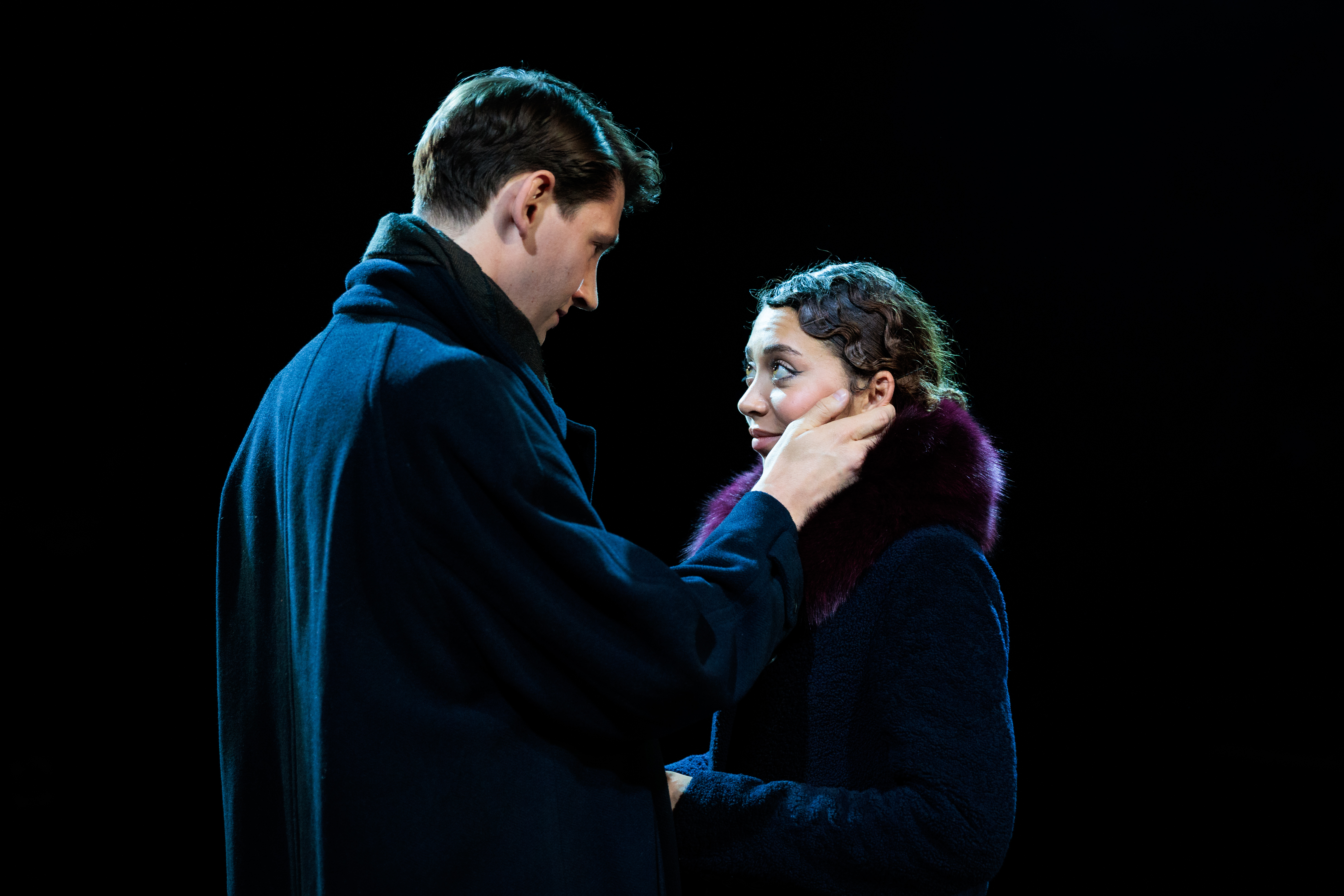
Adapting a novel from the page to the stage is an unenviable task, yet the team behind Twenty Thousand Streets Under The Sky set itself the enormous challenge of adapting Patrick Hamilton’s 1930s trilogy into a two-hour play.
Interestingly, Hamilton’s trilogy is, in some respects, inspired by his own experiences. In the novels, aspiring writer Bob falls for prostitute Jenny, much as Hamilton, and, remarkably, his father, did. Across Hamilton’s trio of books, we are taken through a journey of Bob’s dreams, his volatile love affair with Jenny and her reluctance to leave behind her sex worker lifestyle, fearful of true love, while also delving a little more deeply into how she got into the situation in the first place. It is a story that needs time to organically grow and forge the motives of all its characters, yet in this two-hour whistlestop tour of the book, this stage adaptation, by Simon Reade, struggles to get out of endlessly establishing the plot, rather than letting the characters breathe.
The standout performer here is the energetic yet insecure Jenny (Yanexi Enriquez), whose series of previous poor decisions leads her to a life working the streets. Here, Jenny’s vigour and fiery nature is a deft contrast to the exploitation of women like her in London’s seedier areas, yet where Enriquez also thrives, aided by the in-the-round configuration under Matthew Iliffe’s direction, are the subtle grimaces and eye-rolls as she touts for another customer, which betrays her defiance and is a neat difference to Lucy Gray’s more conventional Prunella.
Jenny’s ability to charm and manipulate Bob makes up much of the early stages of their romance, with her deceptions increasingly more thinly veiled as the piece progresses. Unfortunately, though, in this production Bob is completely gullible, almost to a point beyond belief. Continuously handing money over to Jenny, Jordan Scowen’s hard-working depiction of the play’s protagonist is true to the script, and Scowen does a great job of cutting his continuously forlorn and increasingly more lovestruck figure, but the writing never gets any more than surface level, leaving Bob’s intoxication with Jenny a little baffling.
Nevertheless, this new production from Troupe Theatre Company, who have terrific form for reviving older works, such as their slick The Rat Pack earlier this year at Park Theatre, is full of effort and spirit, and despite the script’s heavy-handedness, is creative in delivery. Alex Musgrave’s lighting choices move the piece quite neatly from the smoky London bar (The Midnight Bell), while Ellie Wintour’s set and costume designs are effective in quickly moving the piece forwards in terms of location while centring it quite firmly in 1930s London. Indeed, the use of set, moving from the rafters to project a wave-like effect of the River Thames is an impressive touch and one which again reiterates the care the design of this production has to bring such an ambitiously large work to the stage.
Meanwhile, the production also includes a subplot which floats between comedy and discomfort. The plain, straight-laced barmaid Ella (Rosalind Lailey) soon attracts the attention of much older bachelor Ernest (Michael Maloney). His desperate courting of her, and her clear desire to escape it, is oddly tuned in this piece, sometimes finding humour in this overly-loving elderly gentleman looking to secure his legacy, and other times finding him lecherous. Maloney is good fun when he is able to lean more into Ernest’s wit, while Lailey works hard to find the complexity in Ella’s character, wrestling with her own desires, but the relationship, like the rest of the piece, struggles to hit tonally.
This is also found in Alex Bhat’s abusive upper-class George, who is instrumental in Jenny’s fall and represents the satirical swipe at the richer Londoners which the novel, and contemporaries such as J B Priestley, were making at the time. Here, though, George swings from gormlessly munching on a boiled egg to a sexual predator in an uneasy sequence that never quite knows what it is trying to convey.
Despite some clumsy storytelling, it is through Enriquez’s Jenny that the love story rises and falls, and it is through her and her final decisions which do evoke some genuine emotion at the end. It is a play which handles the emptiness of these characters, and their desperation to fill it, with some success, although ironically also finding that same sense of hollowness in itself.
That said, it is clear that a lot of work has gone into making this show happen, and it is performed admirably by a great cast and with some strong design choices, but perhaps there is a reason Hamilton needed three books to tell this story.


