Grief is a complicated thing that can manifest in a plethora of ways. In Thomas Carruthers’s dark comedy Are You There, Mother?, it is the cynical exploitation of guilt that takes a sinister yet contradictory turn.
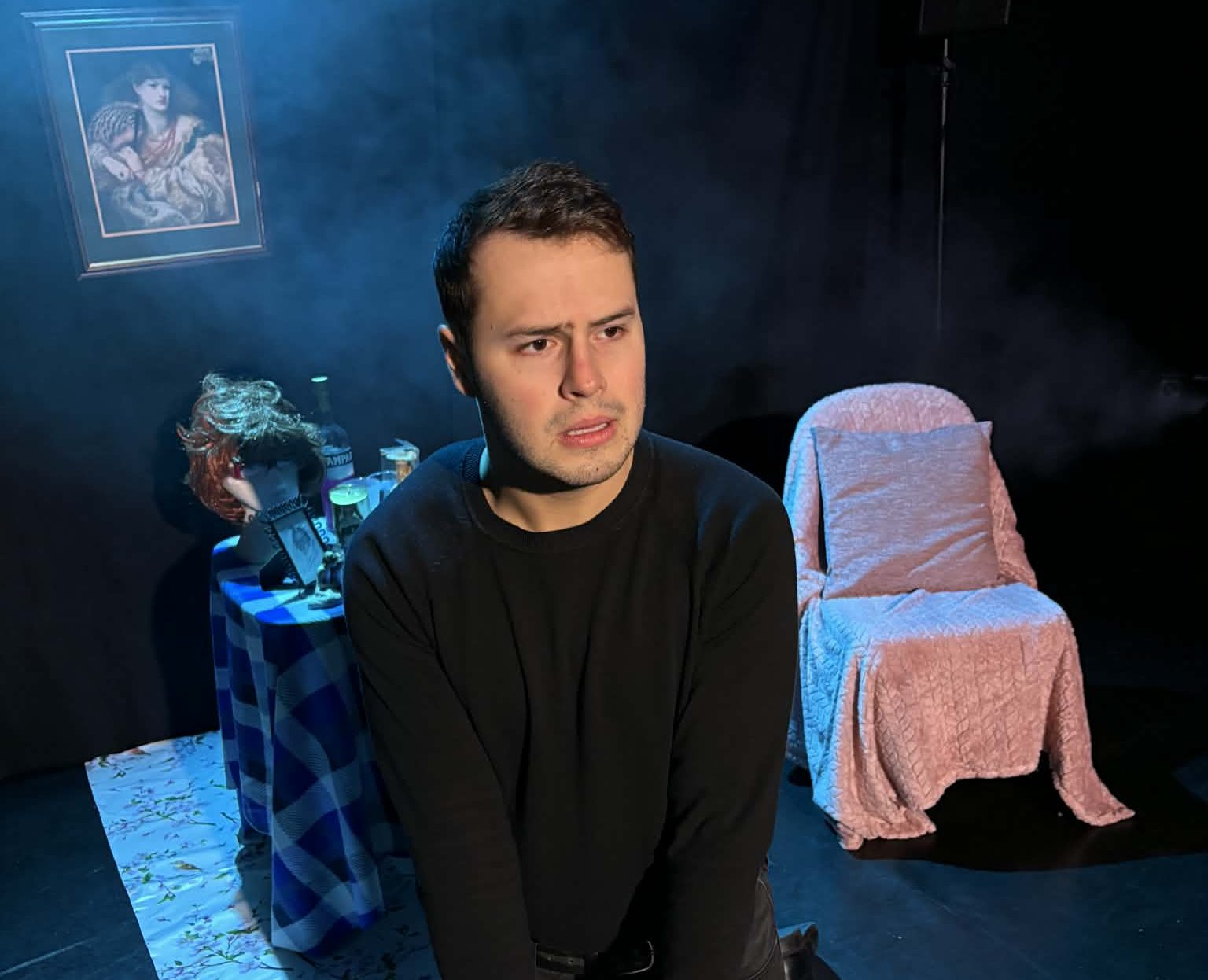
The piece is told through the viewpoint of Vincent (Carruthers, who also writes and directs), an out-of-work actor from Hull who flings acerbic pop-cultural one-liners in a catch-all manner that makes it a little difficult to place the setting of the piece. Nevertheless, Vincent soon establishes that he is reflecting on his experiences with Martha and Prudence, a mother and daughter who, after the former dies, charges Vincent with appearing as a medium to help her oddball daughter grieve.
It is an odd setup. Vincent is accosted by a dying Martha and asked, or rather instructed, to appear to Prudence once Martha has died as a medium who can channel Martha’s spirit from beyond the grave and, therefore, help Prudence to process the loss of her mother. But it is how the warped encounters between Prudence and Vincent soon develop which the piece really focuses upon, and the long-lasting implications of Vincent’s con upon both characters.
As a premise, Are You There, Mother? has an abundance of potential. There is something teasingly engaging about Carruthers’s performance as he swings from the bitter, curious Vincent to the chain-smoking Martha and bizarre Prudence. Carruthers is on fine form here, shifting from character to character to maintain momentum and build towards a genuinely creative and creepy finale. Indeed, when Carruthers dials it back, and we see Vincent reflect upon the morality of his actions, or Prudence’s defiant refusal to accept Martha’s death, the piece thrives in exploring grief and its toxicity.
Yet the production is also hampered by its tired and punching-down sense of humour, with punchlines struggling to land, resulting in a show where it is hard to understand who it is you are supposed to be rooting for. Vincent is manipulative, cruel and crass, while Prudence, the grieving daughter, throws out slurs and outdated phrases that feel entirely at odds with the show. The script, it seems, wants to criticise the conniving Vincent while also meanly skewering a daughter grieving her mother. It is a shame, leaving the production feeling a bit hollow, but not something a remodelling of the script could not fix.
Nevertheless, there is certainly an intriguing idea for a play here. While it does get a bit Norman Bates, Are You There, Mother?, could, with more refinement, linger longer like Martha’s memory rather than, as it risks in its current form, cynically stagnate like Vincent’s con.