The process of growing old is inevitable. Yet, everywhere we turn, we are desperate to stop it. Whether it be anti-ageing creams or a wellness fad, the desire to stop our bodies and minds from eroding over time is something we all fixate on. But, in Care, it is the impact of old age in a desperate, compassionate, yet cash-strapped care system that is so deftly and poignantly brought to the fore in Alexander Zeldin’s new work.
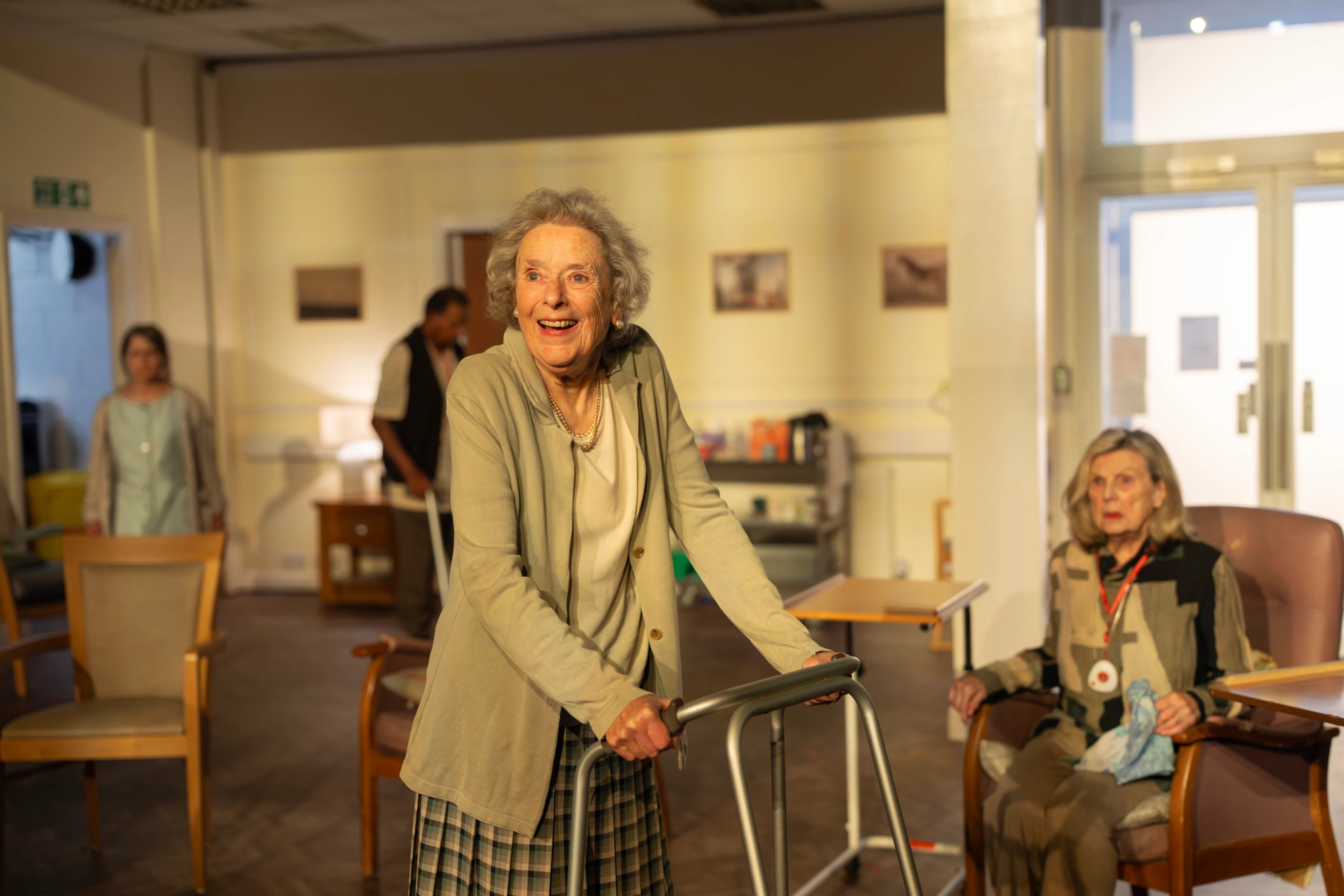
Care is set in a familiar environment: a small, understaffed care home creaking under the pressure and held together only by its remarkable staff. Here, a collection of half a dozen residents sit passively, with their days and time passing over them. At the fore of this is Joan (a remarkable Linda Bassett), a grandmother who finds herself in the home following a fall, put there, in her view, temporarily by her family, seemingly because her body is failing her. Yet, it soon becomes clear that Joan’s fragility is not just physical.
Zeldin’s production largely centres around Joan and her slow, unwilling adaptation to life in the home, where the only way out is bleakly stark. Still, the piece also thrives in the beautiful humanity given to each of the care home’s residents, ranging from the volatile former sex worker Simone (Hayley Carmichael) to the lonely John (Richard Durden), whose memory has long faded and who is fixated upon returning to the beauty of his former marriage.
As Joan, Bassett’s stunning depiction of a proud elderly woman whose pride and independence are ravaged by time is heartbreakingly profound. Joan’s defiant desire to go home will be familiar to anyone who has had relatives go through a similar situation, yet it is the stark decline in her character that is the most provocative. Zeldin’s piece, which is an uninterrupted two hours, is brutal in its depiction of how age grapples with Joan, with her last scenes being ones of great sadness and, in a non-conventional manner, horror too. It is here where Zeldin’s work is the most impactful, leaning on a fear that everyone in the audience shares, which is simply getting old, and Bassett is utterly captivating in fully portraying Joan’s vulnerability.
Meanwhile, Ann Mitchell, Taru Devani, Winston Sookhan, and Diana Payan are all superb in their roles as the home’s other residents, who drift in and out of scenes with a subtlety that mimics the absurdity of a Beckett play. Lines go unfinished, conversations pivot without warning, and characters erupt in stark moments of violence or anguish in a neat representation of the maze of an elderly mind. Durden’s John provides one of the play’s most moving moments in an interaction with Joan, while the shouty Carmichael, noticeably younger than the other residents, is a powerful reminder that there is no minimum age for the ravages of time. As a collective, it is a powerful combination of life in the home, yet as individuals, each performer, especially in how Zeldin’s direction portrays some of their dying moments, is simply stunning.
Although centring upon the residents’ experiences, the piece is equally remarkable in its deft handling of the staff who work there too. Tireless Hazel, superbly performed by Llewella Gideon, remains calm and composed despite the inevitable chaos and strains of her caring role, seen most impactfully during the piece’s final half an hour as Joan’s condition deteriorates. Meanwhile, Aiofe Gaston’s Fanta, a new staff member, learns quickly, leading the residents in daily exercises and dance classes, which offer a rare glimmer of hope and positivity in an otherwise quiet setting.
In addition, Zeldin’s play explores the deep impact of grief upon Joan’s family and the grief of gradually losing a loved one. The family is complex, having already handled the death of Laurie (William Lawlow) and Robbie’s (Charlie Webb) father, and is held together by mother Lynn (Rosie Cavaliero), who struggles to balance her own feelings of grief with the volatility of her two sons. Cavaliero is particularly devastating as a daughter aware of the trauma to come, while the two boys are neat in their fury and compassion, with Webb in particular stealing each of his scenes with unexpected comedy and grace, which is much needed in a piece that is otherwise so emotionally charged.
It is the quietness where the production thrives best. A powerful scene between Gideon and Bassett in Joan’s most vulnerable moments resonates long after the curtain falls in a poignant and raw depiction of empathy. Yet, it is also the silence of the other residents, who have no visitors or family seeing them, which serves as a stark reminder of the absence of compassion for the elderly from wider society, an issue Zeldin’s work clearly leans upon here. It is desperately sad, but it is a story that feels urgent and, despite its gentle dialogue, is brimming with an underlying fury about how the old are left to spend their last days.
Quite simply, under Zeldin’s direction and writing, Care is a sublime piece of theatre that will linger long after it ends. The tenderness of its writing against the brutality of its realism generates an emotional outpouring from characters and audience at the end, uniting both in their sadness and urgent rage for change, as well as a recognition for those who, like the residents, are left to drift their last days away.


