Polarising views on motherhood and the Antarctic climate crisis threaten to freeze over a relationship between mother and daughter in this ambitious but muddled new work.
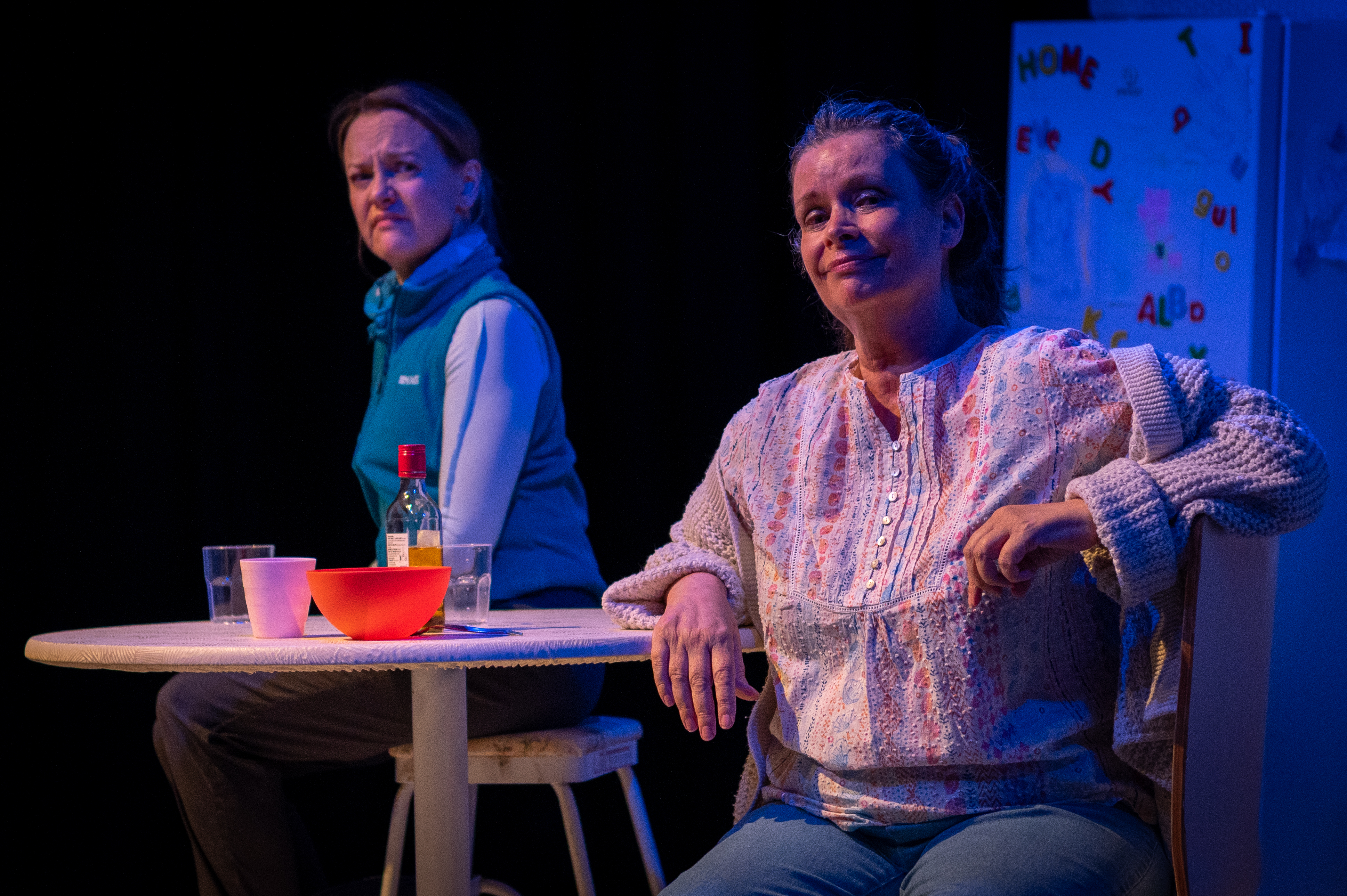
Set in a recently flooded house, Martha Loader’s new play pits Eve (Agnes Lillis) against her daughter Alice (Caroline Rippin), an accomplished climate scientist who has just returned from three months working in Antarctica to find her recently widowed mother in a compromising embrace with a new beau, Martin (Patrick Morris, who also directs).
It is a frosty welcome home for Alice, whose absence from her five-year-old daughter Alba, cared for instead by grandmother Eve, has taken its toll on the family. Yet, matters are complicated further when Eve begins to doubt the significance of the impending climate catastrophe and wants her own life, more specifically, to go on an Antarctic cruise with Martin rather than being her daughter’s permanent childcare support.
As Eve, Lillis is effective as a mother and grandmother who has sacrificed much of her own life for her family. Eve laments lost opportunities as a dancer, and Lillis brings to the fore with good effect the longing of a woman who wants something more than just a flooded kitchen and memories of the past. Eve’s small world is a neat contrast to the big, global problems that her daughter encounters, with Loader’s script lofty in its aims to weave the two. There is also an interesting segue into Eve’s seduction into climate conspiracies, the kind of misinformation one might find on Facebook groups, that provokes conflict, too. Still, her parroting of these views sets her out as oddly ill-informed, given the substantial part of her daughter’s life given to such work, although her desire to visit Antarctica herself, in particular the penguins, from the comfort of the cruise ship that Alice believes is destroying the ice caps, is a wryly funny idea.
Meanwhile, Rippin’s Alice is urgent and defiant, made vulnerable with a clear anxiety about the potential impact of a climate catastrophe, in this case, an enormous ice shelf potentially falling into the sea. Yet, this is combined with anguish about her role as an absent mother to her daughter. Rippin brings Alice’s volatile character out here, but the character itself is a little stunted by Loader’s brief script. Alice swings too violently in attitude and behaviour, with a sense of mania and volatility that makes it harder to understand whom to root for in this piece. Alice’s work is a noble cause, yet the script sets her out with a kind of God complex that makes her harder to resonate with.
Morris’s Martin is a bit of a spare part, awkwardly caught between the warring mother and daughter. There is some sweet humour in his discomfort, heightened by the dining chair embrace Alice catches them in on her arrival, though a daft revelation about his fascination with healing crystals feels a little bizarre. It is Martin who gifts Eve with a stuffed albatross, which sits awkwardly in pride of place in the kitchen, a piece of stage furniture whose imminent extinction haunts Chris Dobrowolski’s set design as a metaphor for the stagnancy of the family life and a sense of doom which morbidly lingers over the three.
Indeed, this is the crack in the piece’s foundations that causes the play to wobble. Albatross has some big ideas, attempting to tackle ideas about working mothers, the lives grandparents sacrifice to provide childcare, middle-aged love, and the climate crisis. Yet, at just 80 minutes, it struggles to land any of these aims with complete precision. As a result, characters make abrupt and rash choices, and the piece meanders, with fleeting moments of bite that contrast with others as sloppy as the ice cream Alice flings across the kitchen in an outlandish attempt to explain the melting ice caps.
Like Martin’s gift, the production is a little over-stuffed and struggles to meet its lofty heights despite the exceptional hard work of the cast and creative team. There is great potential here for a biting piece of theatre, but for Albatross to take flight, it needs to decide just what it wants to say.


