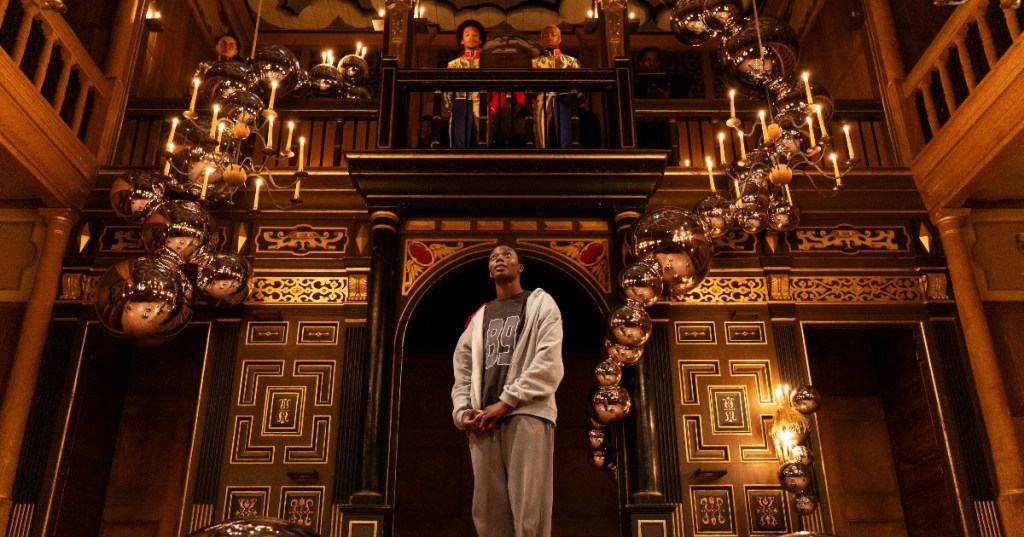
When Chadwick Boseman sadly passed in 2020, the acclaimed actor and playwright left behind several works, but was best known for his exceptional portrayal of T’Challa, Marvel’s Black Panther. However, 11 years before his debut as the superhero, Boseman left a different kind of mark with his beautiful, lyrical work Deep Azure, which finally debuts in this exceptional revival at the Sam Wanamaker Playhouse at Shakespeare’s Globe.
The play is a genre-switching, fluid piece of theatre, mostly rooted though in hip-hop theatre, and centres upon the death of Deep (Jayden Elijah), a victim of police brutality, gunned down by a black police officer, and the horrific aftermath for the characters left behind, especially his devastated girlfriend Azure (an electric Selina Jones). Boseman’s script is inspired by the true story of his friend Prince Jones, also killed by a black police officer, with the focus on black-on-black violence being an enthralling perspective on the reality of American police brutality.
This is a bold, provocative piece of theatre, despite not being one that immediately jumps out as working in a theatre styled as a 17th-century candlelit playhouse, yet under director Tristan Fynn-Aiduenu, Deep Azure feels fresh and dynamic.
What makes this production so unique, however, is the verse hip-hop quality of Boseman’s script. Boseman had studied Shakespeare while at Oxford University, and the influences of the Bard’s writing are clear in Boseman’s own take on lyrical verse, theatre. This is a fresh approach that blends brilliantly with the candlelit intimacy of the Sam Wanamaker Playhouse, with verses and rhymes mostly landing with great impact throughout. The play moves, because of its rhythmic dialogue, at a good speed despite almost totalling three hours, with the performers and dialogue combining effectively to deliver a gripping piece of politically charged, evocative theatre.
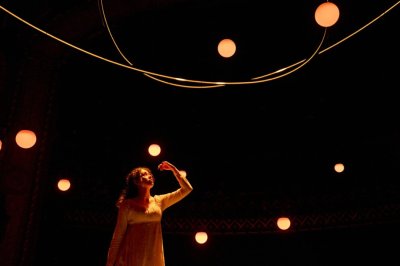
Despite the story being rooted in Deep’s murder, it is through Azure’s grief-stricken reaction that the play is so impactful. Jones’ devastating portrayal is layered and complex, with Azure wrestling with the grief of a life lost, her heartbroken and her eating disorder, which all combine to reflect a woman on the edge. It is a charged portrayal, and Jones’ provocative roars whirl around the space as she grapples with a life without Deep.
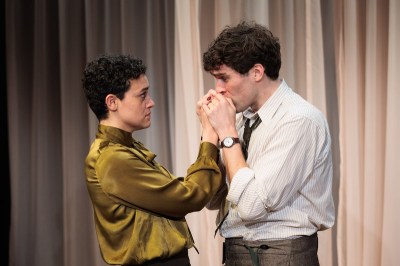
Yet the genre-splicing of the play, which mostly lands, is most effective when Deep initially appears to Azure, a ghost guiding and comforting Azure, with their intimate, tender, embraces, emotionally charged and utterly captivating. Elijah’s portrayal of Deep, his tender, vulnerable character, is a neat contrast to the demonising of his police report, but also an acute juxtaposition to Azure’s fury. Elijah’s role as the ghostly Deep, haunting some characters and comforting others, works well and is particularly successful in using the theatre’s claustrophobic, multi-level space, enabling Deep to observe all reveals and moments in an omnipresent manner.
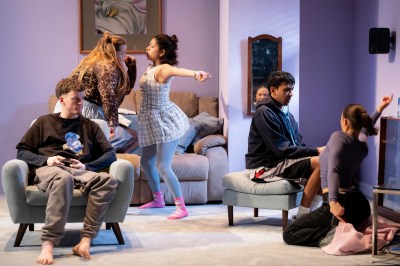
Boseman’s script does, however, deviate a little from the hip-hop theatre in that it also incorporates absurdist comedy and Greek theatre tropes, such as a chorus, spearheaded by the ‘Street Knowledge of Good’ (Aminita Francis) and the ‘Street Knowledge of Evil’ (Imani Yahshua). It is a little on the nose but the pair, alongside a terrific ensemble who beatbox their way through the production, inject a lot of life and energy into the piece. Tonally, though, the involvement of the ensemble can be a little jarring, with the play too quick to leap to absurdist moments and comedy, such as singing the theme tune to ‘Cheers’, or storming the stage as a university marching band, at times stifling the emotionally-charged plot from fully landing.
The decision, too, to put the characters in Ziggy Stardust-esque space outfits feels a little odd, and because it is so different to the story and authentic characters such as Azure, it takes a little while for it all to settle down during the play’s exposition.
While there are some parts that could do with a little trimming and a final twist that is too telegraphed, Deep Azure is at its best when it focuses on what it really wants to communicate: the focus on black-on-black violence and its impact on one terrifically strong and terrifically broken young woman. When it allows Jones to luxuriate in Azure’s grief, the rhymes feel a little less forced, and the result is completely captivating.
This is a tremendous leading performance from Selina Jones, and one that captures the pain of humanity’s violence so poignantly. As one of Boseman’s early works, Deep Azure is a little unpolished, but this production evokes the raw fury of police brutality, black-on-black violence and an urgency for compassion that feels just as timeless as Boseman’s legacy itself.





 Read About Stuff | London Theatre Reviews & Culture