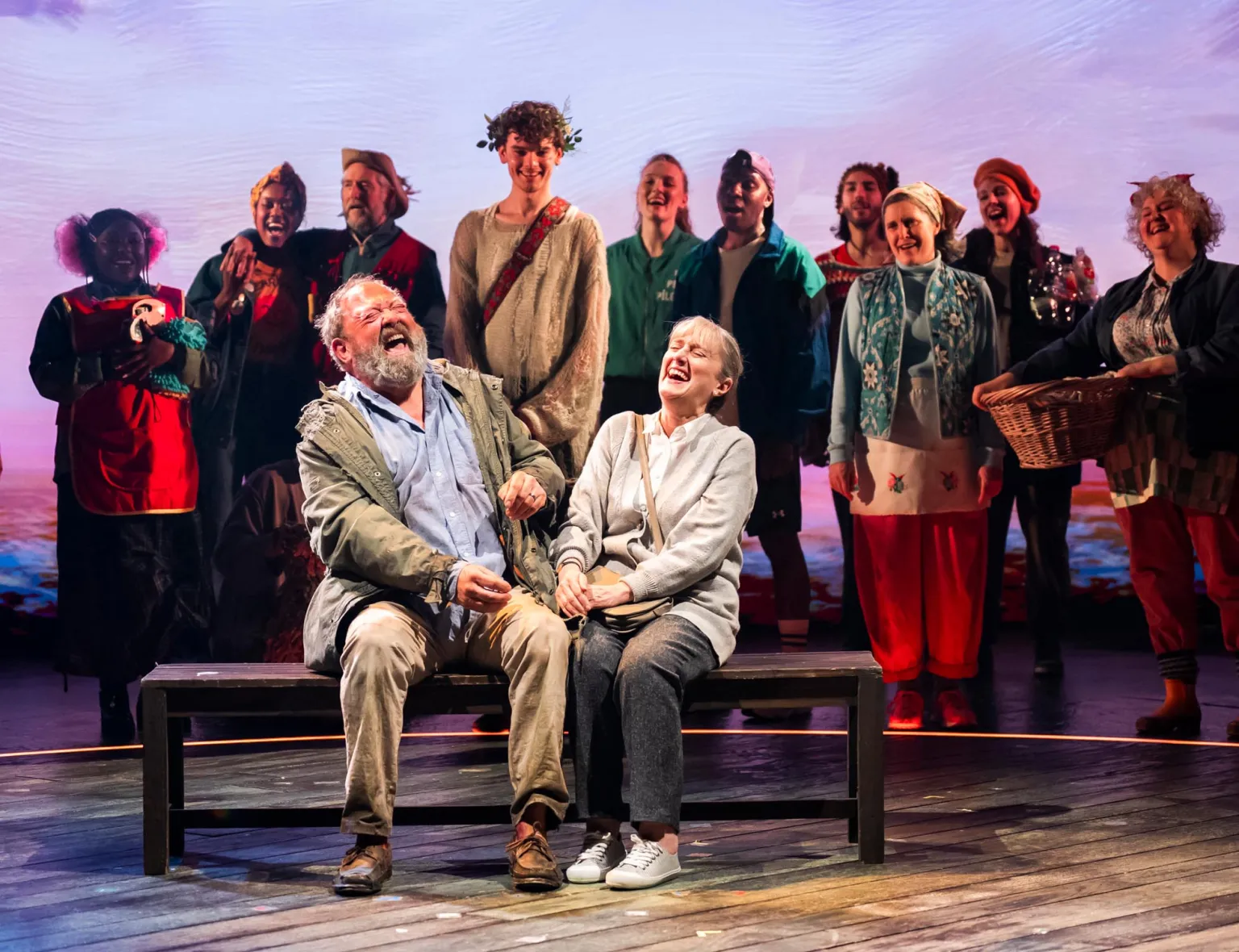
Some musicals just hit you. Sometimes it could be a song, or a choreographed number, or an exchange that simply takes your breath away. With The Unlikely Pilgrimage of Harold Fry, the outcome is not just one stunning moment, but instead a superb two hours of heartfelt musical theatre which culminate with a beautiful yet gut-wrenching finale.
Boasting folk singer Passenger’s exceptional music and lyrics, the production is a terrific adaptation of Rachel Joyce’s best-selling novel, aided by the fact that Joyce writes the book for this piece too. The musical centres upon the eponymous Harold Fry (Mark Addy), who, just like his wife Maureen (Jenna Russell), finds himself stuck in the doldrums of middle-aged life with very little happening. From the get-go, it is clear that all is not well between the pair, especially when their estranged son David is mentioned, and this lifelessness is compounded by the greys of their costumes, deftly designed by Samuel Wyer to further the bland lives the pair lead. This all changes, though, when a letter from dying Queenie, a past associate of Harold, arrives. Initially, Harold sets off to post a typically bland, non-commital reply, but a chance meeting with a motivational garage shop worker (a terrific Nicole Nyarambi) sees Harold change tack, and instead attempt to make the 600-mile journey from Devon to Berwick-upon-Tweed to see Queenie and try to keep her alive.
As Harold, Mark Addy is superb in bringing to the fore Harold’s desperation to make a connection and make an impact in a world that is passing him by. The erosion of his family life clearly takes its toll on Harold’s psyche, with Addy bringing to the fore Harold’s complex combination of fatherhood guilt, professional failures and living in a marriage which has lost its spark. As Harold makes the arduous, absurd journey across Britain, each step feels more painful yet more urgent, with Addy’s depiction of Harold’s desperation stark and authentic.
Alonside Addy, Jenna Russell delivers a stunning display as Maureen, Harold’s long-suffering wife, and a heartbroken mother too. There is a stunning vulnerability in Russell’s characterisation of Maureen, which is enhanced by Russell’s vocal range, which lingers on the higher, softer notes, reflecting Maureen’s anguish. In a musical which is dominated by some larger, more outlandish numbers, it is the quieter ones with Russell which are the most memorable and devastating.
Yet it is not just through the leads where the production shines, but through its talented ensemble too, who all combine to not just depict the cast of misfits and quirky characters Harold meets along the way, but merge as a community, a collective that represents the life-affirming journey Harold goes on. Characters like Madeleine Worrall’s explicit Locum and Ashley Samuels’ Wilf are eager to support Harold’s quest, but harbour their own insecurities that Harold helps them deal with along the way. In a play full of outsiders, a sense of unity and belonging rises to the top.
This is also elevated by the creative changing, such as the use of puppetry to represent a dog who accompanies Harold, as well as the neat inclusion of Noah Mullins’ ‘The Balladeer’, who initially serves as a musical performer to accompany Harold’s quest with folk tales, before mutating into something darker as Harold faces more intimate, personal challenges. These moments are boldly drawn out by Paule Constable’s vivid lighting choices, which capture the psychological breakdown as Harold, as a father, answers questions as to the true motivation of his quest to see Queenie.
By the production’s conclusion, the play focuses on its best parts, the connection between Addy and Russell, to linger on the true central component of this piece, ruminating on how a marriage stays together in the face of unquestionable, unimaginable anguish. It is a painful, moving, final scene that captures the beautiful essence of Joyce’s novel and stages it with a raw, charged emotion that lingers long after the curtain falls. This may only be a short run, but Harold Fry’s pilgrimage is one thay will live long in the memory. A triumph of musical theatre.