Felicity Kendal makes a glorious return to the play that Tom Stoppard wrote for her in this gorgeous revival of Indian Ink.
Stoppard’s script spans from pre-World War Two, the colonial British Raj, through to fifty years later, centring on poet and artistic muse Flora Crewe (Ruby Ashbourne Serkis) and her life in India. The plot threads together two eras: the pre-war focus on Crewe life while unwell in India, and half a century later, focusing on American biographer Eldon Pike’s (Donald Sage Mackay) attempt to piece together Crewe’s forgotten artistic life with help from Kendall’s sharp Mrs Swan, Flora’s sister.
It is an enthralling piece, ruminating on love, identity and artistic beliefs, with a particular poignancy being staged in the immediate aftermath of Stoppard’s death in November 2025. Scenes set in the past, following Crewe’s Indian journey, luxuriate in conversations of artistic merit and emotional and political beliefs. Ashbourne Serkis’ portrayal of the fierce, non-conventional Flora is terrific, showing little restraint, bringing to the fore a woman who enjoys art, male company and entertainment in equal measure. Flora is so modern and energetic, created masterfully by Ashbourne Serkis’ poised delivery, particularly moving, given her later forgetting by the artistic world because of her unique outlook, and despite the play’s age, it is a terrifically modern leading female role.
This becomes even more complex when Crewe sits for the painter, and future revolutionary, Nirad Das (Gavi Singh Chera). The relationship which blooms between the pair mixes personal and professional, with an intimacy that defies conventions but also reiterates Crewe’s power as an Englishwoman in a colonial setting. Das’s obsession with all things English is complexly blended with his fury at British rule, with Stoppard’s writing cleverly fusing the clashes of individual and societal ideologies here.
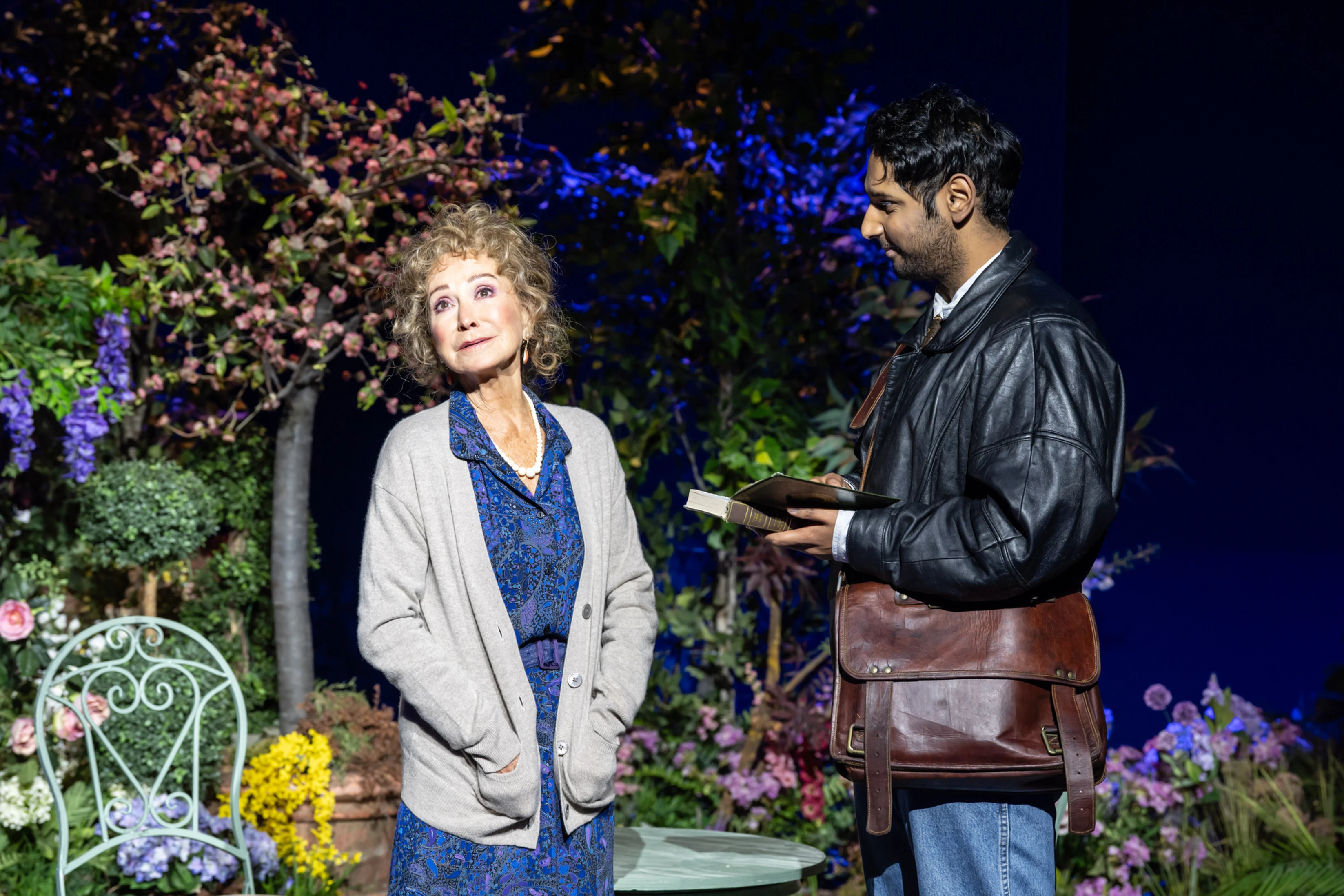
In the play’s present, Kendal is captivating as Mrs Swan. Pestered by Eldon (aided by a brilliant Neil D’Souza as softly spoken Dilip), and later Nirad’s son (Aaron Gill), Mrs Swan gradually, one slice of cake at a time, reveals Flora’s story, scarred by society’s shunning of her dear sister. Mrs Swan’s wit is drawn out by Kendal, furthered by a stunning, final scene that merges the past and present magnificently. Stoppard wrote this play originally for Kendal, who originated the stage role of Flora, and it is clear in this deft portrayal, over thirty years later and now playing the older Mrs Swan, just how dear the work is to her.
The production is also crafted beautifully by Leslie Travers’ stunning set design. It is a set that leans heavily upon flowers with pinks, lilacs, whites and purples surrounding the stage in a floral brilliance that only furthers Flora’s own beauty. This is reinforced by a delightful drifting of blossom in the play’s final moments, where design and acting combine for maximum effect. The split stage design, which mirrors the play’s structure, enables quick switching between eras, but also places the older and younger characters as almost haunting the other narrative, representing the painful passage of time.
Indian Ink, a timely revival that eulogises artistic brilliance at a time following Stoppard’s death, is a gripping, intoxicating production. Its success is in its subtlety, with few crossed words spoken, relying on an authenticity that only a true artist can evoke.