The Camden Fringe is almost upon us, providing one of the best times in the capital to get into Fringe theatre, and the stories it can tell. To get prepared for the festival, Read About Stuff is running a ‘Five From The Fringe’ interview series, where creative teams answer five questions about their upcoming Festival shows.
In this interview, I chat to Sabrina Cierra, Chelsea Dutton, Chiara La Ferla and Pid’or Tampa about their new show Eyes See Song.
Can you tell me a little about your show and what audiences can expect?
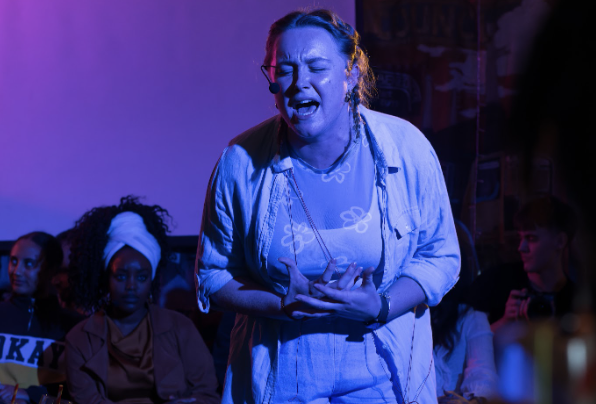
Sabrina: Eyes See Song is an immersive theatre piece that invites you into a world where stories, songs and memories collide. It’s part play, part concert, part ritual, and from the moment you walk in, you’re part of the experience.
It follows a group of women as they navigate friendship, identity, faith, shame, healing and the hidden stories we carry beneath the surface. Through live music, spoken word, movement and audience interaction, we explore what happens when those stories finally demand to be heard.
Audiences can expect laughter, honesty, beautiful music, moments of reflection, and a lot of heart. It’s intimate, energetic and deeply human. You won’t just sit and watch this story unfold, you’ll be invited to travel alongside us!
What drew you to this specific story, and why does it belong at the Camden Fringe?
Sabrina: What drew me to Eyes See Song is how fearless it is. It tackles difficult subjects, but it does so with warmth, humour, music and a real sense of community. At its core, it’s a story about connection. It’s about the parts of ourselves we hide, the things we’re told to be ashamed of, and the healing that can happen when we’re finally seen.
As a performer, I was really moved by the way the piece centres voices and experiences that don’t always get space on stage, while still feeling incredibly universal. Everyone knows what it’s like to feel misunderstood, to search for belonging, or to carry something they don’t know how to say out loud.
Camden Fringe feels like the perfect home for it because it’s a festival that celebrates bold, original work and new voices. Eyes See Song doesn’t fit neatly into one box. Fringe audiences are often looking for something unexpected, and this show offers a genuinely unique experience that stays with you long after you’ve left the theatre.
Chelsea: What drew me to this show was a universal understanding of all these women. Even if you have been lucky enough not to experience these stories first hand, you know someone who has. This is the reality of being a woman that connects us globally, which is why it belongs at CamdenFringe. We must get comfortable in the uncomfortable reality of the female experience. Without it, without facing it, without sharing these stories, woman will continue to face the same reality over and over again. Words alone are often not enough, people must see the effects on these women; their mothers, sisters, cousins, partners, nieces, friends, aunts- for themselves.
What has been the biggest challenge in bringing this production to life?
Chiara: Eyes See Song is a play that really breathes through the ensemble. When one character inhales, the ensemble exhales, never promising solutions but always being there. It’s what the characters need. A community. The biggest challenge for me has been the rehearsals when we haven’t had some cast members present. Rehearsing without each other in the space feels incomplete because each individual character carries so much, It’s feels wrong to do it without them. We’ve worked really hard to do their stories justice, and part of the reason why it feels right isn’t because there’s a resolution, but because they aren’t alone. It really puts life into perspective. Going through things, good and bad, without your sisters and your people… We need community.
How does the design of your show (set, sound, or lighting) impact the presentation of your story?
Pid’or: There’s a striking tension between the set and every other technical element in this show. The set is intentionally bare. We perform in thrust to heighten intimacy, to collapse the distance between performer and audience. From the moment people walk in, they’re not “watching a show” — they’re stepping straight into a house party. That’s the point. We want you with us, not observing us. We want you to feel claimed, welcomed, folded in from the very first beat.
For most of the piece, our bodies and voices become the set, the props, the architecture of the world. Beyond six stools, there’s almost nothing onstage. But the sound design is the opposite: lush, layered, visceral. Music is the spine of the show. Whether we’re dancing through a shared playlist, releasing tension through choral harmony, or letting a single heartbreakingly beautiful melody carry the narrative forward, sound becomes the primary theatrical medium. Ro. Morrison’s underscoring and soundbites are extraordinary — they transport us from 90s nostalgia to the present day, from Congo to a London club, from a hospital waiting room to a church pew. In Eyes See Song, sound isn’t background. Sound is a character.
You’ll also notice the near‑rainbow palette of the costume design. Each character is colour‑blocked, their emotional temperature and personality distilled into a single hue. We instinctively lean toward or pull away from them based on colour alone — that’s colour psychology at work. At first, the palette seems to simplify our reading of each character, but as the story deepens, those colours complicate. They reveal the masks we wear, the assumptions we make, and the truths we hide.
The design also nods to Ntozake Shange’s For Colored Girls. Like Eyes See Song, Shange’s work is interdisciplinary — poetry, music, movement — a form built to hold the unspoken stories of women. I first encountered her play during my training in Drama and Theatre Studies, and I had never read anything like it. Her audacity — to present herself as multifaceted, contradictory, beautiful, wounded, powerful — was a revelation. Our costume design honours that legacy. It honours her insistence that women, especially women of colour, deserve to be seen in all their tones, all their contradictions, all their brilliance.
The colours are loud because our experiences can be. They are bright because we refuse to dim. They are complex because we are complex. This is our right — to be seen, fully, unapologetically, and in every shade we carry.
If you could sum up the show in one word or phrase, what would it be and why?
Chiara: Honest is the first word that comes to mind. Honest because no character is perfectly placed on a pedestal. Neither are they put down as evil. It is so common for women and femme presenting people to be described as one of the two extremes, but that’s not what we are. Maybe it’s because of survival. Surviving patriarchy means you have to be one or the other, but it’s not a sustainable mask to wear and, in this friendship group- we have a matriarchy without ranks. So, the characters are not afraid to cuss each other and call each other out; to gas each other up and to hold each other strong. I love the play for its fluidity because that’s what feel most honest and refreshing. The fluidity beautifully written in it’s structure, found in it’s music and seamed into movement connect everything and everyone together.
Eyes See Song runs at The Cockpit on 29 – 30 August. Tickets are available here: https://camdenfringe.com/events/eyes-see-song/


