You are never too far from an Oscar Wilde play in London’s theatreland. Whether it be the wonderfully colourful The Importance of Being Earnest, which dazzled the National Theatre and the West End, or the creatively reimagined An Ideal Husband at the Lyric Hammersmith, Wilde’s work continues to flourish over a century since the playwright’s premature death. Yet it is the writer’s own storied life, his flamboyancy and his conviction which are put under the spotlight in this engrossing one-man biographical piece.
The Importance of Being Oscar was penned by Irish writer Micheál Mac Liammóir over 60 years ago, and uses Wilde’s own writings, as well as Mac Liammóir’s research, to chart the unsteady waters of the playwright’s adult life from Victorian Dandy to bankrupt convict, treated severely and cruelly by a criminal justice system which imprisoned Wilde for his relationships with young men, convicting him of gross indecency. Over 90 minutes, Mac Liammóir’s work is split evenly between Wilde’s rise to stardom and his bitter fall, interspersed with extended passages from works such as The Importance of Being Earnest, ‘The Picture of Dorian Gray’ and Wilde’s remarkable ‘De Profundis’, a letter written to friend, and lover, Lord Alfred ‘Bosie’ Douglas, the relationship which, thanks to Alfred’s furious father, catalyzed Wilde’s trial.
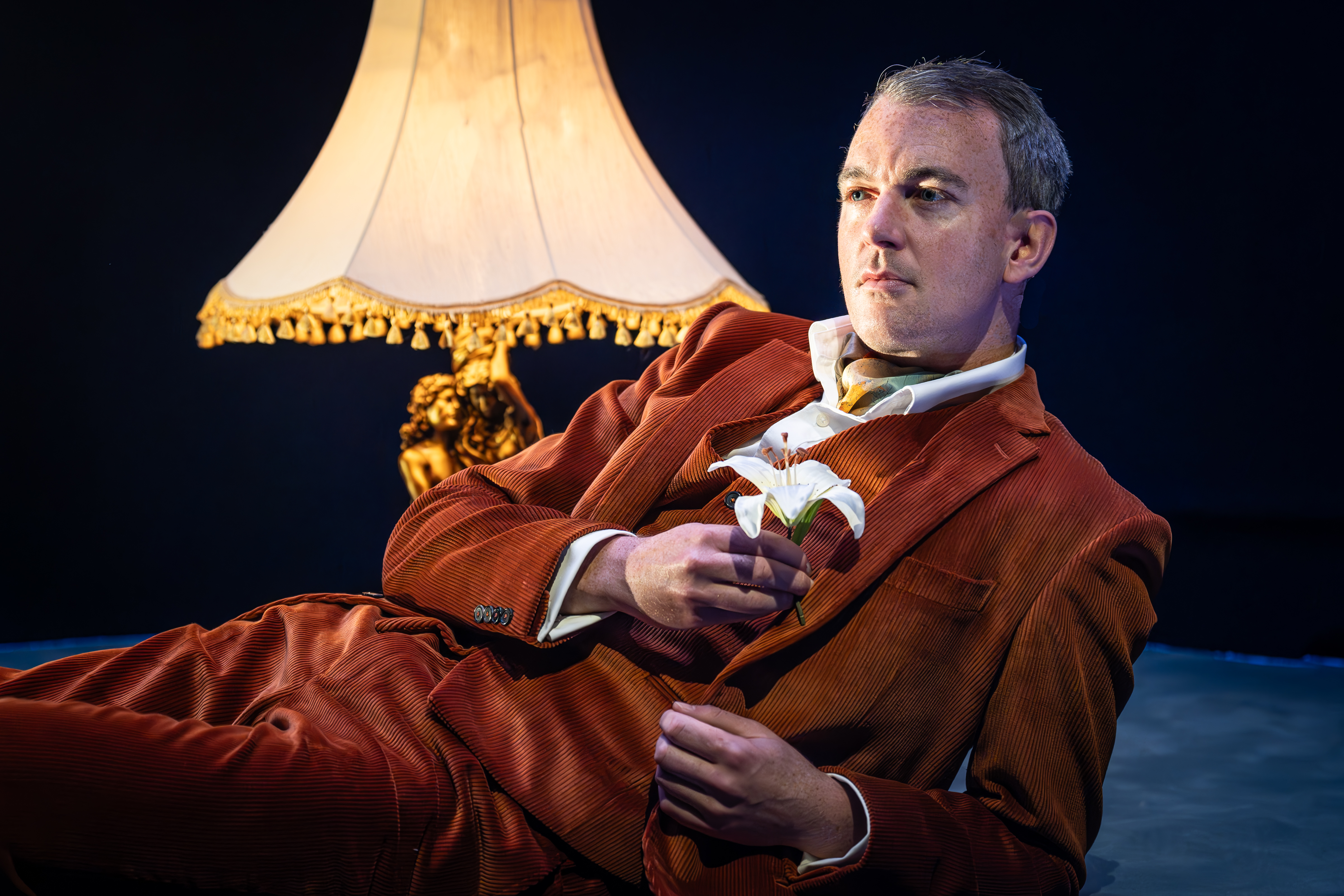
As Wilde, Alastair Whatley works hard to capture the man’s magnitude, offering a measured and poised depiction of one of Victorian Britain’s most exuberant characters. Under Michael Fentiman’s direction, Whatley splits his performance between serving as a narrator, weaving the narrative of Wilde’s life together, with performances of Wilde’s work, either multi-roling as characters from his plays or reading excerpts from the writer’s novels and letters.
The piece is staged in minimalist fashion, reliant upon Whatley’s impressive performance skills, yet Madeleine Girling’s oval set design serves as neat symbolism for the portrait of Dorian Gray, which in turn feels a metaphor for Wilde’s complex personality. All of it illuminated beautifully by Ben Jacobs’s lighting designs, transitioning from the colour and vigour of Wilde’s freedom to the starkly dim spotlights of his trial.
Whatley succeeds in portraying the numerous characters from Wilde’s work, such as Earnest’s iconic Lady Bracknell, yet it is when performing as Wilde that the performance really thrives. During the second half, where the piece’s structure wobbles a little under the weight of two lengthy excerpt choices, Whatley superbly delivers Wilde’s ‘De Profundis’ letter, sat upright and angry, pained by a life irreversibly damaged by imprisonment and still lamenting the loss of his relationship with ‘Bosie’. Indeed, it is here where the piece, and Whatley, is most captivating, when the production moves away from Wilde’s ‘greatest hits’ and instead digs down further into the torment of the man himself.
Yet, and perhaps because the piece is over sixty years old, Mac Liammóir’s writing does shy away a little from Wilde’s problems. His latter years, his ill health and his bankruptcy, are all skimmed over, leaving the resolution feeling a little unfinished. Whatley’s cradling of a green carnation, Wilde’s symbolic buttonhole decoration which meant more than just floral beauty, is a neat place to end on, but the play too neatly wraps up the life of a very complex and complicated individual, with a slight sense of self-indulgence that the playwright himself would be proud of.
Nevertheless, despite some deflections that Dorian Gray would be proud of, The Importance of Being Oscar is a poignant reminder of the voices silenced by prejudicial justice systems, with Whatley’s delivery a charming tribute to the iconic writer.


