Academy Award and Golden Globe winner Christine Lahti brings her and her family’s powerful trauma to the fore in this cathartic, intimate and deeply personal autobiographical show, The Smile of Her.
It is a production which starts in a rather typical, disarmingly sweet manner, with Lahti projecting a seemingly normal family photograph, introducing us to her parents and siblings all posing for a neatly choreographed snap. Yet as The Smile of Her unfolds, Lahti reveals the deep-rooted and long-lasting traumatic experiences which have impacted her and her family, influenced by society’s patriarchal construction and treatment of mental health sufferers, in what is largely an affecting and striking piece.
Mêlisa Annis’s direction guides Lahti through her own backstory, with the piece mostly following a chronological order, though with lop-sided division between the various stages of Lahti’s life and career. Large amounts of time are given over to her experiences at college, while her acting success is skimmed through briefly, though with a slight self-indulgence as the production includes Lahti’s Golden Globes win and victory speech.
That said, it is the focus on Lahti’s unconventional family life which is the most stark aspect of the play. Lahti’s picture-perfect acting life disguises a lot of family pain, be it the harrowing experiences of her sisters, her perfectionist father’s mistreatment of them and their mother, her mother’s empty grin, reflecting her subordinate familial role, or the horrifying consequences of patriarchal and societal manipulation upon her older brother. Lahti herself voices her own haunting experiences, but these are only glanced over, choosing instead to spotlight her siblings and mother, perhaps modestly recognising her career in the spotlight. Lahti’s family have seemingly suffered much more than most, which the script puts down mostly to society’s patriarchal constructs, yet the horror of it all is almost overwhelming, with Lahti brought to tears on more than one occasion as she recalls what happened to her loved ones.
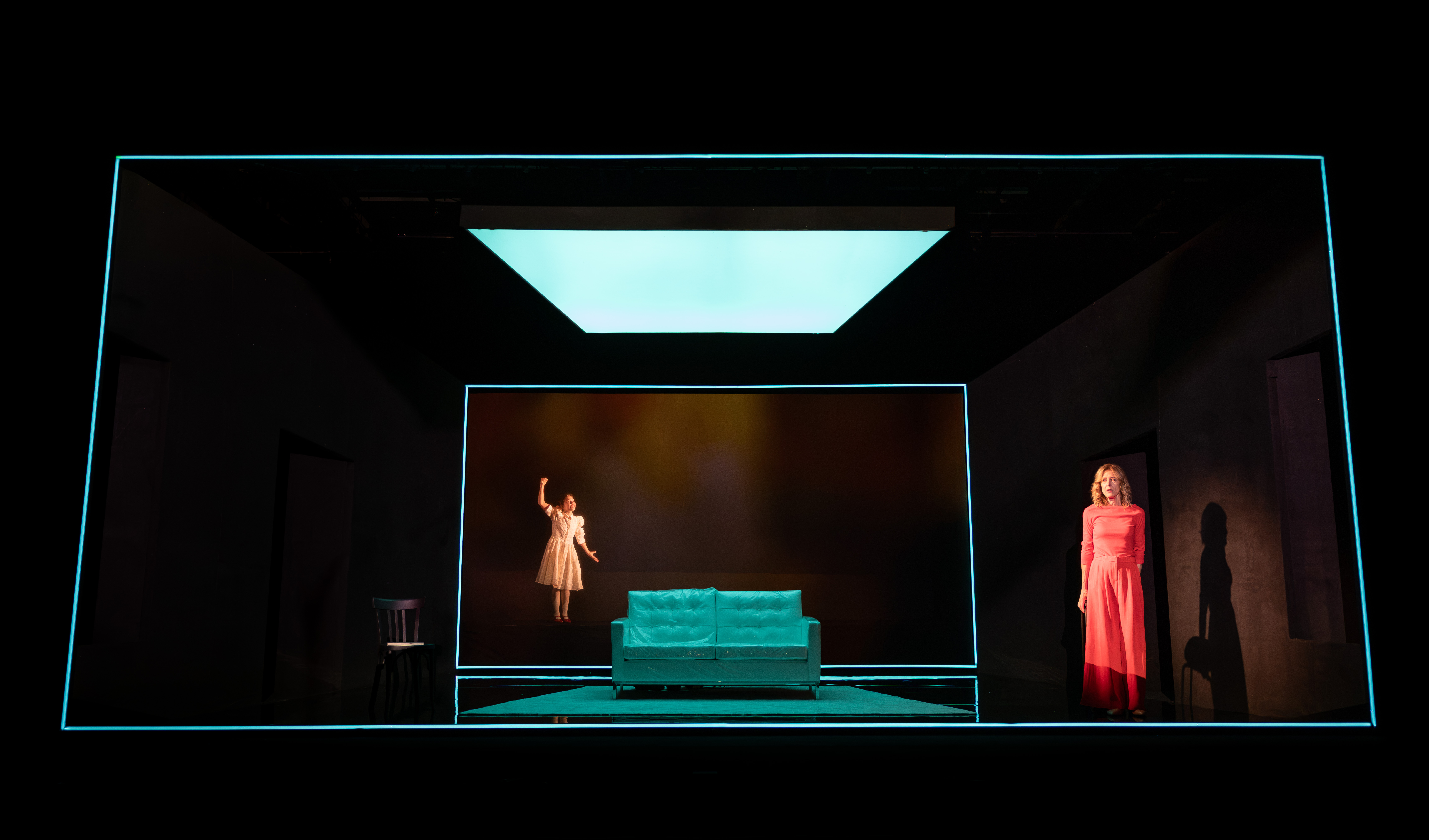
In this sense, Annis’s direction works neatly here. The production is constrained, mostly, to a rectangular box, a design choice by Sarah Beaton which Annis allowed Lahti to escape when retelling moments that are too shocking to comprehend. Indeed, the confining of the set is reflective of Lahti’s sense of confinement in her familial home, symbolised by the permanent plastic covering on a spotless white sofa, desperate to escape her parents’ stifling relationship, which comes through her acting career.
The piece is seen mostly through Lahti’s delivery, yet the inclusion of her younger self, in this performance played by Isabella Ford, is a nod to the innocence and naivety of her youth, and representative of the young girl trapped in a patriarchal world which Lahti wants to dismantle. It is as much an angry performance as it is reflective, and perhaps here the introspective nature of it becomes a little too heavy, making it harder, particularly during Lahti’s college years, to really engage with the piece.
Nevertheless, The Smile of Her becomes a poignant piece about resilience, courage and defiance, all things which Lahti’s career has come to embrace. Her personal experiences, and those of her family, are bleak and awful, almost too much to bear, which the production is unflinching in its handling of, and so, if nothing else, it is a show which enables a courageous Lahti to give a deserving voice to her silenced relatives.


