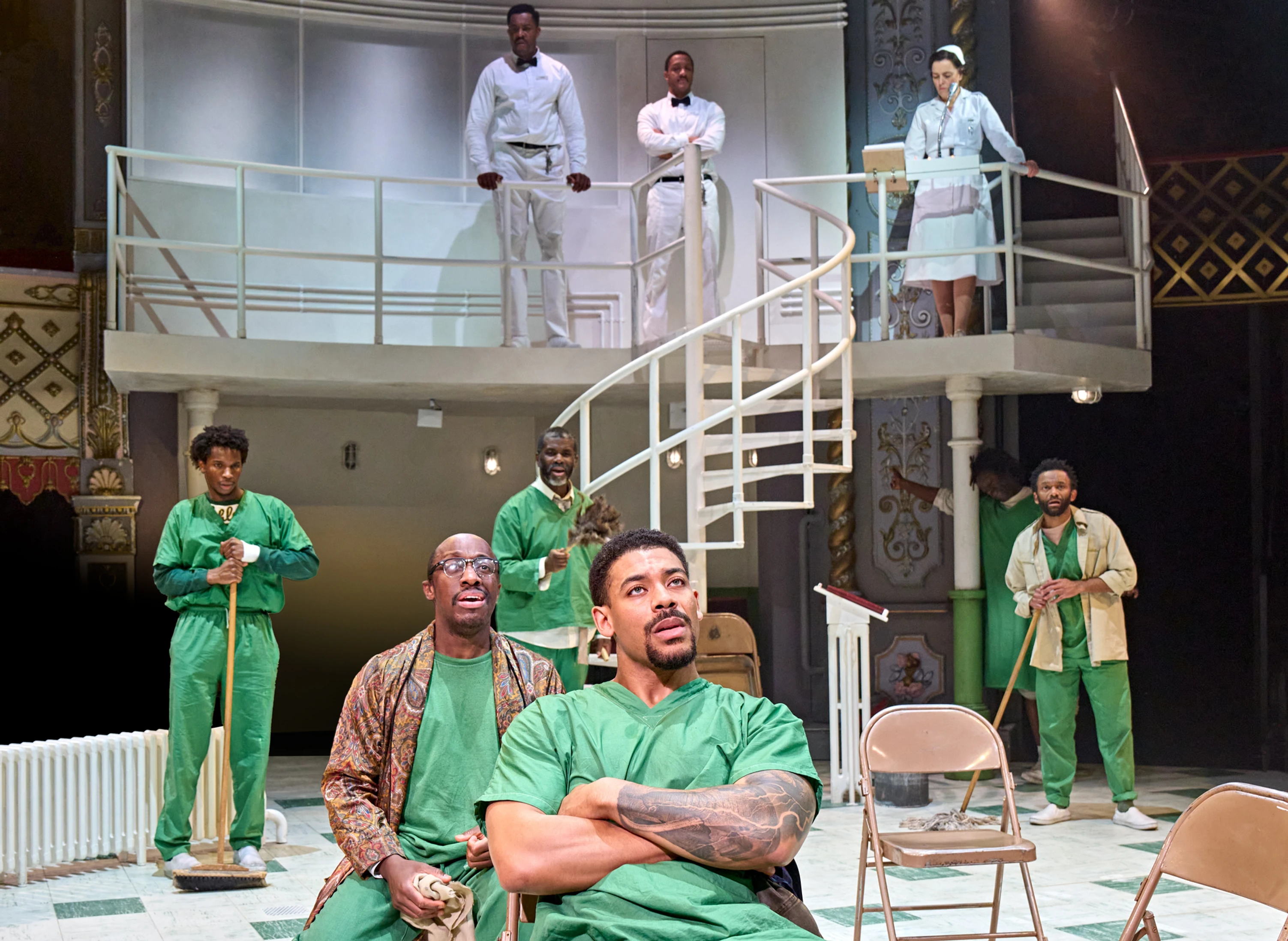
Clint Dyer’s reimagining of Ken Kesey’s 1962 novel ‘One Flew Over the Cuckoo’s Nest’ maintains its focus on colonialism but with subtle racial undertones in this stark new production.
Dyer’s play, which uses Dale Wasserman’s 1963 stage adaptation as its base, centres upon the rebellious and charismatic Randle P. McMurphy (Aaron Pierre), who, incarcerated in a psychiatric institution, attempts to rally the other patients in acts of protest against the cruel Nurse Ratched (Olivia Williams). While the basis of the story, and its plot, remains largely faithful to the source material, Dyer leans more heavily into the colonial themes, using the all black male cast for the psychiatric patients, contrasting the white medical professionals, to make a profound comment on 1960s American race relations, and the subjugation of African-Americans, complicated by the willingness of some of these patients to be locked away. This is furthered by Dyer’s decision to bookend the piece with more stylised, frenetic sequences in ‘Congo Square’, a site of protest and resilience for Black and indigenous Americans in New Orleans, making a broader comment on oppression and subjugation than Kesey’s novel originally does.
As McMurphy, Pierre is captivating in bringing to the fore a sense of normality and reality to a character so starkly at times detached from it. It is an individual performance played with terrific energy, whether McMurphy is rallying the inmates against Ratched, consoling and motivating the seemingly catatonic Chief Bromden (Arthur Boan) or deftly portraying McMurphy’s desperate fate at the play’s conclusion, though with one excellent twist. It is a superb leading portrayal, and one that helps to spearhead this production’s successful highs.
Meanwhile, Olivia Williams’s Nurse Ratched is just as severe as in the novel, and here the contrast between Ratched and McMurphy, not just in their behaviours but also in their ethnicities, works to reiterate Dyer’s central interpretation. Williams brings to the fore Ratched’s callous coldness, but in a way that is much subtler than in some other depictions, quickly establishing a poise and unease about the character that feels instantly threatening.
It is a production buoyed by its ensemble, with each performer succeeding in building a cohesive picture of the institution’s volatile and vulnerable patients. Giles Terera’s sexually frustrated, prudish Dale Harding is a neat contrast to McMurphy. Terera feels frustratingly a little underused given his talents, though the payoff, in a beautiful final scene, is worth the wait. Kedar Williams-Stirling’s stammering Billy Bibbit is played with great sensitivity, leaning heavily on the young man’s desperation to please his mother, which catalyses much of McMurphy’s downfall, while Ene Frost’s remarkable physical characterisation of the trembling Ruckley shines.
Although the production shifts some of its cultural ideas, it still focuses greatly on the oppression of indigenous Americans through Bromden’s character. Positioned, just as in the book, as a narrator/observer, Boan’s delivery is effective as Bromden casts a comment on the actions in the institution. This culminates in a bold and evocative set destroying sequence, designed by Ben Stones, which complements the devastating plot beats well. Indeed, Stones’ design is effective in the Old Vic’s current ‘in-the-round’ configuration, with the sterile whites and greens making audiences feel just as part of the 60s institution as the men trapped in it.
Some of the novel’s stark and more problematic inclusions remain, though. The men’s misogyny persists, while the traumatising presentation of electric shock therapy reiterates the troubling treatment for men like these only half a century ago. Yet Dyer’s direction here, accepting that these are vital components of the story and of the men, manages to still focus the piece on the male bond that grows more than anything else.
What is truly remarkable about this version of One Flew Over The Cuckoo’s Nest, though, is that despite its length (2 hours 45 minutes), the play never drags. Each scene, and each interaction, feels purposeful, building to the brutal and poignant conclusion.
Funny and painful in equal measure, the staging keeps hold of the novel’s big question: who are the mad ones, those in the institution, or those outside it?


