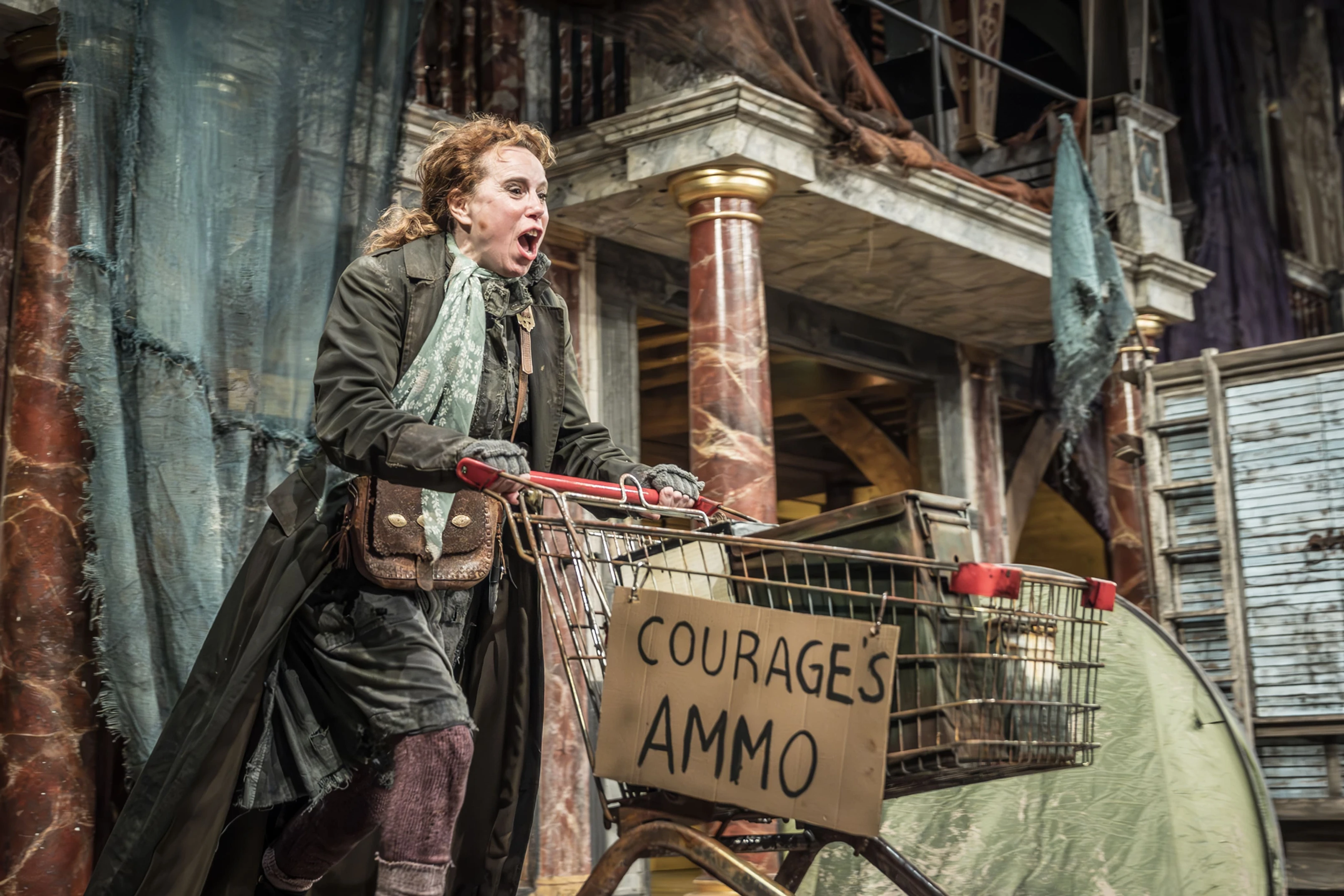
What is the price for survival? This question is at the heart of this scorching new staging of Bertolt Brecht’s anti-war play Mother Courage and Her Children, spearheaded by an exceptional Michelle Terry.
Originally set against the backdrop of the Thirty Years’ War, this new adaptation, translated from Brecht’s work by Anna Jordan, places the piece in a nuclear apocalyptic dystopia, where individuals are grouped into warring factions and Courage (Terry), supported by her three children, drags her cart, full of wares for sale, looking to cash in on war to stay afloat. Yet war is brutal, and for Courage, the sacrifices of herself and of her children, Eilif (Vinnie Heaven), Swiss Cheese (Rawaed Asde) and Kattrin (Rachelle Diedericks), gradually take their toll upon the formidable matriarch.
As Courage, Terry is sublime is holding the attention across the production. It is a complete performance, ranging from sweary bravado, saleswoman showmanship right through to the devastated isolation, slowly, and bitterly, dragging her cart around the expanded Globe stage. It is an individual performance that captures a woman ravaged by time and situation, yet also a woman with remarkable resilience and determination to survive at all costs. Brecht’s original piece skewers capitalism and the cashing in on immorality, and while Courage certainly does do that, especially in her pimping out of addict prostitute Yvette (a terrific and underused Nadine Higgin), Anna Jordan’s new translation of Brecht’s work, alongside Elle While’s direction, pulls this back ever so slightly to look at a woman caught in the crosshairs of war, in a piece that certainly feels pertinent.
As her children, Heaven, Asde and Diedericks all shine in their respective moments, each with dedicated episodes which co-exist within the play, with this new version maintaining Brecht’s hallmarked episodic structure. Heaven’s arrogant Eilif is cocky and devastating, while the naivety of the upstanding Swiss Cheesenis is brought to the fore with care and brutality in equal measure. But it is Diedericks exceptional portrayal of Kattrin, left mute after a horrendous assault, which is the play’s most striking aspect. Kattrin, a symbol of the good and pure that Courage is trying to protect, suffers unimaginably in this piece, with Diedericks doing a remarkable job of crafting the pain, anger and anguish of the character without a single word uttered.
Despite this, it is a production which, given the nature of the characters and the manner in which Brecht wrote, is not exactly subtle. The presentation of the ruling classes, especially religious figures, is scathing, deftly presented by Ferdy Roberts’ flawed Minister who, enhanced with the eroding of his costume, designed by takis, cuts a sorry sight towards the play’s end. His berating of war and life’s meaning takes on a new form in the Globe’s environment, standing downstage and calling to the masses for action, in a moment that would probably make both Brecht and Shakespeare proud.
It is a production, though, that could still be trimmed a little more. The inclusion of songs is expected for a Brecht play, but some of these versions drag on a little, and the piece suffers from a muddying opening that takes a while to kick in. The play is then thankfully sparked into life with Terry’s arrival, but her sweary, sex-filled jokes and slang are not for the easily offended.
Even so, the full-throttle nature of this production largely lands. The second half in particular arrests some of the momentum issues of the first, building to a quietly devastating finale, which is a bittersweet contrast to the chaos that has come before.
Courage faces terrific and terrible choices across the piece, but thankfully, in this production, the team behind the play have made the right ones.
An exciting, fresh take on a century-old play.


