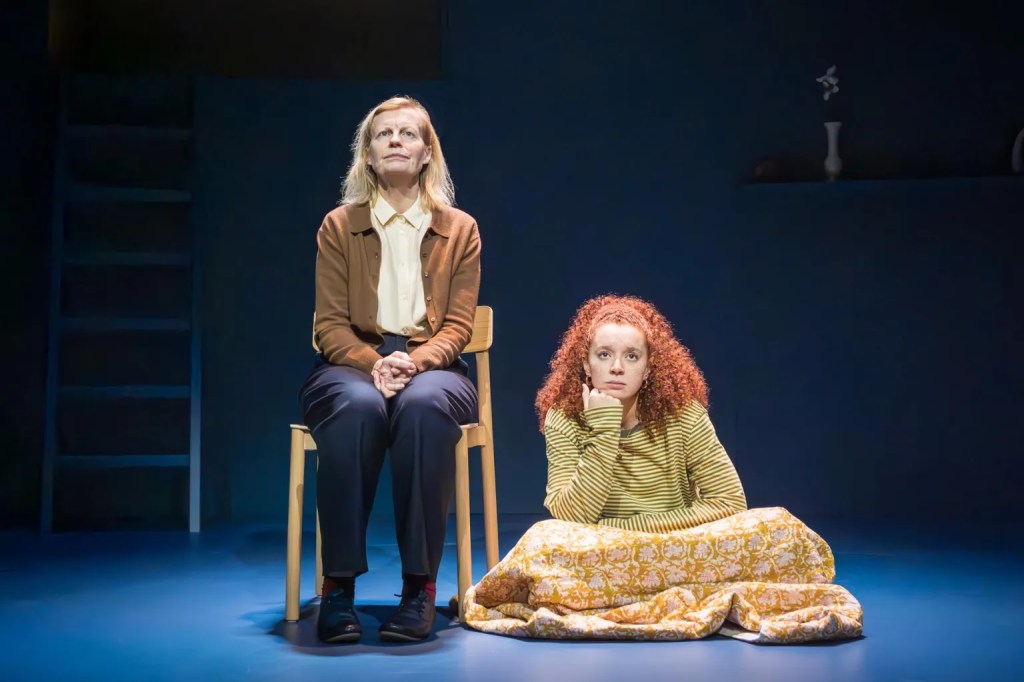
What does one grieve for? Is it a death, a permanent change in a relationship, a loss of freedom or a loss of self? It is all of these questions, and much more, that are posed in this gripping two-hander, centred on a bitter clash between stepmother and stepdaughter.
As a pair, Jennifer and Delilah could not be more dissimilar. Anatasia Hille’s middle-aged Jennifer is a meek and mild medical administrator, newly married to the never-seen John, having spent the majority of her life caring for her elderly, domineering mother. Meanwhile, bolshy student Delilah, Erin Kellyman, is terribly angry at everything; her mother has died, her father has remarried, her university course has taken a sinister turn, taking it all out on her new step-mother, Jennifer. As a concept, Anna Ziegler’s script is a well-trodden path, where the age-old clash between stepmother and stepdaughter hinges around fraught conversations and torrid insults. Yet where Ziegler’s script does stand out is how relentlessly both characters hold their nerve; Jennifer’s kindhearted nature never relents, while Delilah’s fury with the world burns throughout.
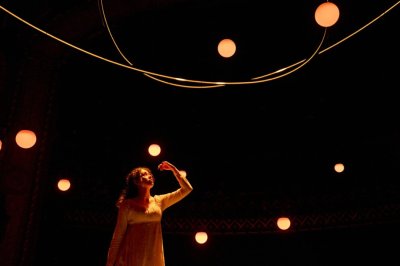
As a result, the piece is largely trapped in a spin where the pair find themselves at loggerheads, which is well-nodded to by the revolve central to Basia Bińkowska’s design, enabling the pair to circle each other during their many confrontations, mirroring the wild animal dynamics strongly explored during an exchange that, unusually out of context, tackles the poaching of the Northern White Rhinos. Bińkowska’s design enables the conflict and fleeting relationship burgeoning between them to be the centre of attention in an otherwise sparse space, with only a few objects, all tokens of Jennifer’s relationship with her deceased mother, and a couple of chairs on stage.
Indeed, the concept of motherhood is one of the most burning points of this increasingly compelling piece. While both women have their stark differences, they are both, in their own way, reconciling with the passing of their mothers and their lives in the aftermath of this. Jennifer feels a sense of relief, but also a sense of loss at her own place in the world following her mother’s death, which Hille draws out acutely, most poignantly explored in Diyan Zora’s gentle direction of Jennifer’s cradling of her mother’s objects, enhanced by the fraility of Hille’s portrayal. In contrast, Delilah’s anger at having her mother stolen from her at a young age burns ferociously, and this rage is ever-present during much of Kellyman’s depiction. It is a loud and furious delivery, yet one that also finds great tenderness when Delilah’s mother returns to her with increasingly more unsettling visions. The psychological impact of grief is on display here, and beautifully captured in its multi-faceted sense by the two leads.
Ziegler’s script is also unexpectedly funny in places. Jennifer’s bumbling approach to the world is sweet, especially in her inquisitive googling of ‘FOMO’, and it is hard not be swept in by her charm and her complete harmlessness. There are some wicked one-liners from Jennifer, who feels to be written by Zielger with more complexity than Delilah’s simplistic rage. That, in part, is also one of the production’s drawbacks. While it feels as though we are supposed to root for either Jennifer or Delilah, it is much harder to side with Delilah here, who is a little too one-dimensional in writing during the first half of the production, as her constant blocking of Jennifer stifles the play a little. Kellyman does a terrific job with the material here to try to refine Delilah, but the character’s abrupt stubbornness is a little too intense, which makes Jennifer’s scenes more palatable.
Given its runtime of less than 90 minutes, there probably is ever-so-slightly too much going on here to really fully land the piece. Coercive control, inappropriate relationships, race, women’s rights, bereavement, mental illness and parental loss are all thrown into the mix, which is perhaps why, despite their differences, Jennifer and Delilah are so well-suited in the end, because of their individual complexities. That said, the sudden sharp twists and turns, especially in a more chaotic final twenty minutes, are a little too tonally whiplashing to full work. It is though a brilliant opportunity for Kellyman to explore Delilah with greater layering, which she rises to with great effect. In these moments, Delilah’s vulnerable erraticism comes to the fore, in a hyperventilating display that is both terrifying and devastating in equal measure.
That said, Evening All Afternoon is a poignant exploration of two women on the edge for very different reasons. Eventually thrust together because of the pandemic, the collision of the pair is expectantly explosive, yet it is in the tender, quieter moments where the play is at its most memorable. While Hille’s Jennifer is completely endearing, it is in Kellyman’s desperation to find her sense of self amid the chaos around her, at such a young age, that the differences between the pair become each of their salvation. A short, but impactful, two-hander.




 Read About Stuff | London Theatre Reviews & Culture