Have you ever wondered what the person next to you is thinking? It is this intriguing premise that takes a sinister turn in this creative dark comedy that tackles deep-rooted trauma, single motherhood and an awful lot of exploding balloons.
Written by Chiara Fumanti, who also stars, The Extraordinary Life of a Rat Racer focuses on Eva, a struggling single mother, supported by her disapproving Italian mother, who is also grappling with a tormented mind, personified by Arthur (Andrea Guerini), succumbing to darker and darker thoughts triggered by reactions and flashbacks to a violent childhood trauma.
It is an intriguing premise, and one which Fumanti’s writing and Guerini’s (who also directs) flamboyant portrayal of Eva’s cruel brain ambitiously explore during its hour’s runtime. The piece is simple in its execution, primarily focusing on Eva’s tube journey to a job interview; she quickly succumbs to the dark fantasies her mind plays out, longing to indulge in increasingly warped and sadistic acts of violence against her oblivious fellow passengers, goaded by Arthur, who takes great glee in drawing Eva back into the darkness of her traumatised mind.
Marketed as a dark comedy, the piece actually thrives much better when it fixates upon Eva’s traumatised childhood, a witness to a terrible accident, and its long-term implications. The piece’s lighting design, put together by Guerini and Francesco Angeloni, is effective in using small torches and strobe lights to intensify the psychological suffering which lingers in Eva, while the red washes are cued neatly to differentiate reality from Eva’s disturbing fictional desires.
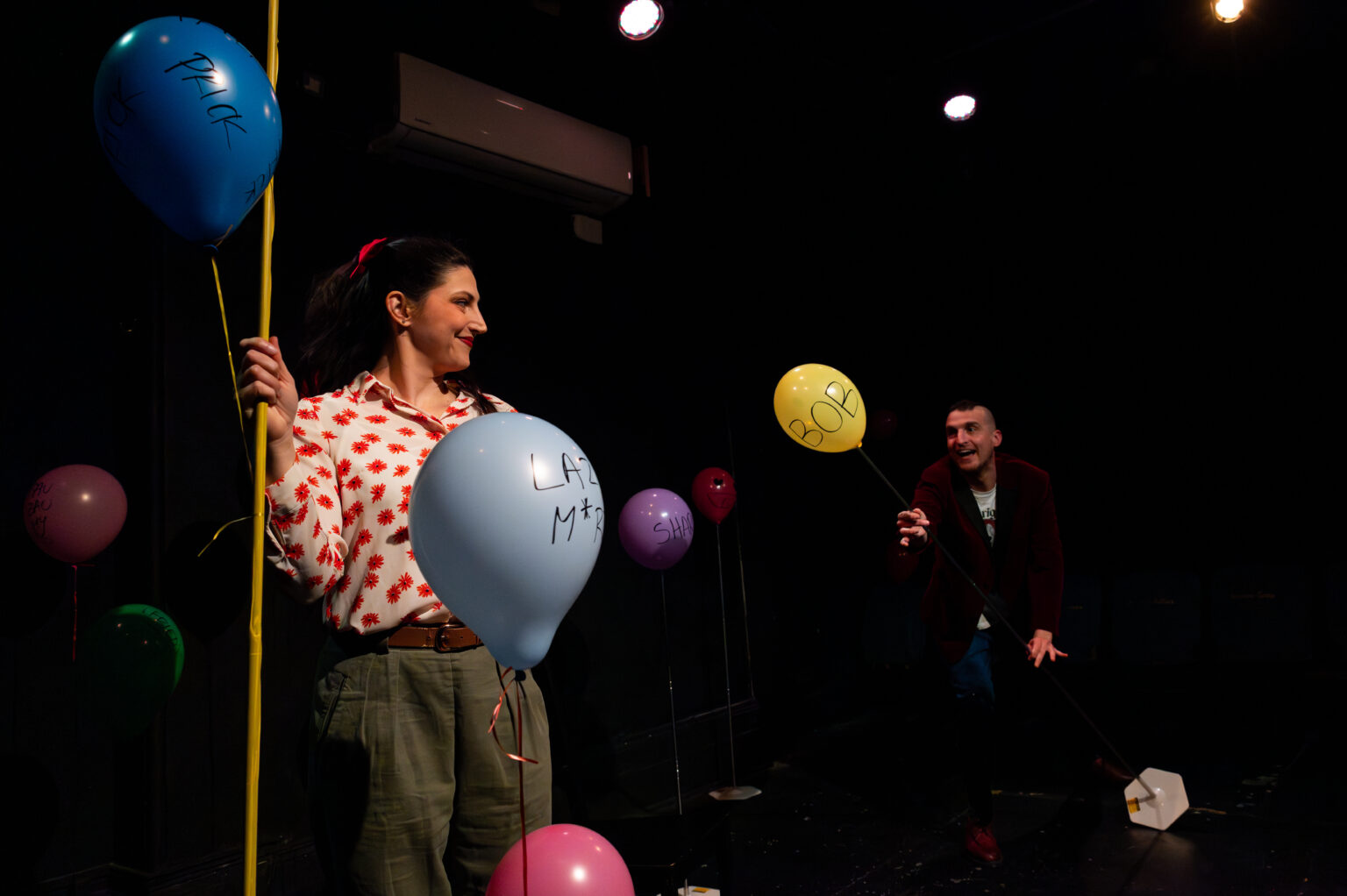
Moreover, perhaps the most inventive inclusion in this short piece is the use of balloons. A dozen balloons, some hanging from the wall and some attached to poles, are scattered among the intimate stage, and are used to reflect the other individuals who cross Eva’s path. Interestingly, the visions from her past do not make it to balloon form, but those from her fictional fantasies do, with the decision to burst many of these violently jolting both Eva and the audience back to their senses.
The production does, too, target the audience throughout. There are attempts at call and response, which work to varying degrees, while one direct moment of interaction detracts a little, disrupting the pace and focus on Eva’s state of mind.
Indeed, there is a great nucleus of an idea here, with Fumanti in particular shining as the struggling Eva. Still, the piece would benefit a little from leaning more into the darkness, excavating the comedy and instead pushing what the production really succeeds in, which is tackling Eva’s suffocating past.
It is a creative attempt to explore trauma, and despite being such a small production, it makes a big impact. With a little trimming, this balloon drama could stop suffering from over-inflation. Nevertheless, there is a lot to get excited about regarding the potential of this inventive show, and of this creative team, which both burst with possibility.


