Capitalism, the pursuit of money, and the toll it takes on morality have always been a source of great fascination for the stage. When you think of plays which ruminate on the topic, thoughts often drift to Arthur Miller’s Willy Loman in Death of a Salesman, a male figure at the forefront of the business world’s cutthroat, morally redundant world.
On paper, it is no different in David Mamet’s play Glengarry Glen Ross, a series of episodic scenes which all eventually coexist, capturing the conniving and underhanded tactics of real estate agent men looking to make a quick sale or drive a flashy car. It is the sense of male bravado and ego, which booms more than anything else in Mamet’s script, and it is the retention of this, alongside an all-female cast here, directed by Patrick Marber, that makes the production such an intriguing prospect.
Indira Varma leads the all-female cast as Levene, a washed-up seller desperate to make a name for himself as time and money are passing him by. Marber’s direction and the show’s casting deliberately maintain the play’s male characters and pronouns, and so immediately Varma brings this out in his posture and strides, balancing the male ego with the fragility of a man whose life and livelihood are on the line. Varma is strong here, yet it takes a little while to buy into Levene’s character, which is hindered by Mamet’s episodic style, where Varma disappears for large chunks of the middle part of the piece.
Rosa Salazar’s brash and arrogant Roma is willing to con anyone to get himself a new Cadillac, in an energetic and enthusiastic delivery. Roma, like Levene, is under pressure to sell, and both take their frustrations out on office manager Williamson (Dorothea Myer-Bennett), who is underplayed until the piece’s final moments in a reasonable if not slightly too obvious moral-making twist for Mamet’s message about the business world and trust.
Bubbling underneath Levene and Roma’s stories is the melodramatic heist that is being plotted in the office, and their leads, by Niky Wardley’s Moss. It is a frantic and frenetic portrayal, but one that feels a little too melodramatic in contrast to the rest of the piece. Wardley works hard here to draw out Moss’s desperation, but it borders on the comedic, enhanced by Nancy Crane’s Aaronow’s horror at being made an accomplice, in a duologue that feels five minutes too long.
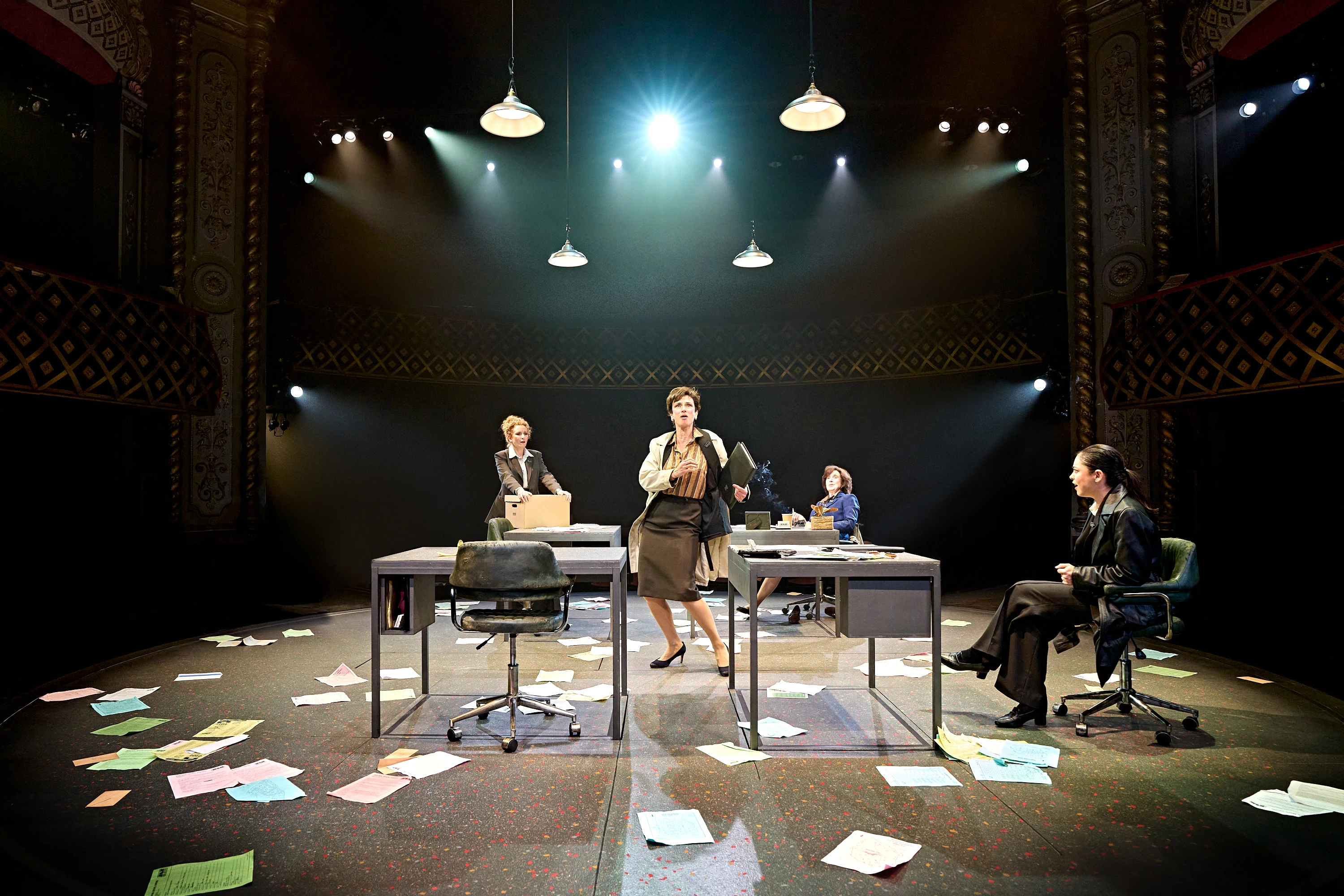
Still configured into the round, the Old Vic’s 360-degree spotlight of the seven women works well, and all seven performers are great in their pacing and movement to evoke the tense office environment. Rob Howell’s design, seeing hundreds of documents fall from the rafters to mimic a robbery, feels a little on the nose but also a necessity given the circular configuration. Scene changes, too, are handled in awkward silence, presumably to force the audience to ponder events on stage, but this remains uncertain.
There is absolutely potential to explore this play through a female lens, but this new production has not leaned into it enough. This is no doubt an excellent cast and creative team, but the threads do not pull tightly together enough here, leaving it as loose as one of Levene’s slack business deals.