When looking at a photograph we are often drawn to what is going on outside of the frame, a form of intrigue and mystery that never gets revealed. But what about the photographer? It is the relationship between a photographer and his art, belonging and legacy that are all neatly framed in this ambitious, tidy two-hander.
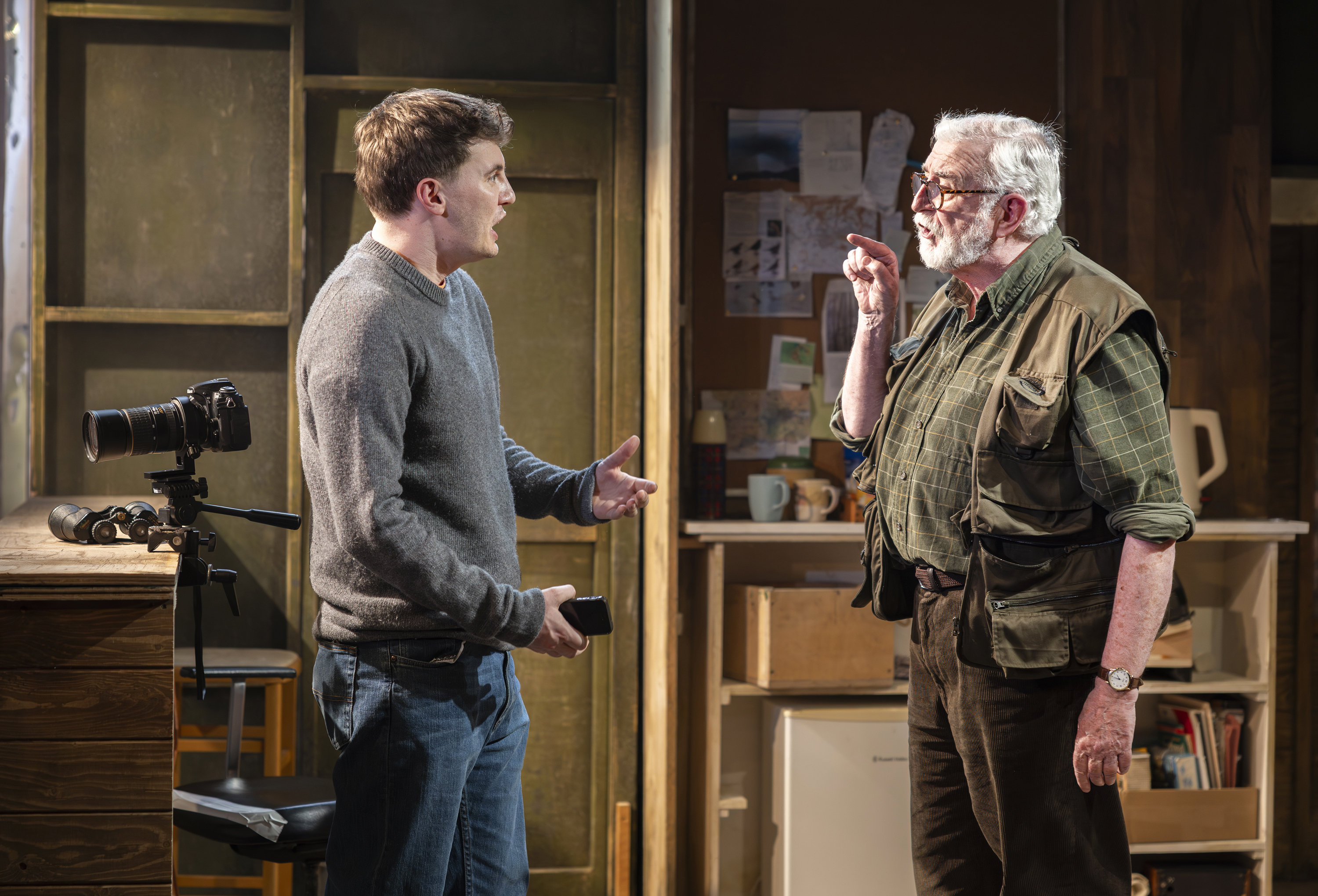
The first staging of his debut play, writer David Pearson’s script places the piece in a small, isolated, wooden hut in the woods where acclaimed, reclusive, wildlife photographer Tim (Gerard Horan) has begrudgingly invited aspiring snapshotter, the young Marcus (Charlie Beck), for a weekend of teaching and mentoring. Pearson’s dialogue, stretching over just 85 minutes, wastes no time in establishing the dynamics, with Tim’s curmudgeonly personality abrupt and abrasive towards seemingly nice but naive Marcus, yet it is when both parties reveal their true motives that the piece gains greater intrigue. Extremely well-performed by Horan and Beck, Pearson’s script combines the pair’s oddball nature with a tinge of cruelty to keep the play moving with engaging momentum.
Horan’s depiction of Tim, under Alice Hamilton’s direction, initially feels a little stifling. An aged wildlife photographer, Tim seems bogged down by modern technology, preferring his secluded existence slowly waiting for the perfect shot, yet his sweary, grouchy exterior is a deft deflection for his troubles and for his desire to see, and snap, the elusive Siberian ‘Firewing’ one last time. Tim’s focus on not getting involved in what he photographs (part of a thought-provoking take on the intersection between photography and morality) becomes a metaphor for the stagnancy that it becomes apparent he is in, and it is why young Marcus becomes such an urgent potential prodigy.
It is an effective contrast to Beck’s fresh-faced Marcus, arriving at the hut having snapped a picture of a bird at the beach, garnering Tim’s interest. His youthful energy and eagerness are an early point of conflict, which Beck projects well, yet like Tim Marcus’ character garners more interest once his intentions become clear. Beck takes time to let us see what Marcus could be, or is truly like, with a coy mischievousness threatening to be overtaken by a dark desperation that lingers for much of the piece.
While their exchanges get a bit repetitive on occasion, there is a lot to be swept up in. Tim’s grumpy takes and acerbic putdowns, as well as a taste for cold beans, create humour while the exploration of Marcus’s home life, and in particular his difficult parental relationships, trigger conversations about intergenerational trauma and identity, with the pair oblivious to their similarities. Pearson’s script balances the curt with the tender, with the final five minutes a heartwarming yet painful new existence for one of the pair, supported by the other.
The production is also enhanced by the claustrophobic depiction of Tim’s understated hideaway. Surrounded by a shallow pool of water, the small set works well to put isolated focus on the awkward exchanges between the pair, quickly changing for an ambitious time jump in the play’s penultimate scene. There is little horror or violence threatened here, yet the design works well to evoke a strong sense of tension and unease, especially once both parties reveal their inner tensions. It is an ironic design, giving the audience as much of an opportunity to peer into what the characters allow us to see as the photographs they ruminate on do. The use of projections, though, to showcase some of Tim’s finest photos, is a bit too skewed, which pulls you out of his teaching moments depending on where you are sitting.
Part of Tim’s teaching revolves around the rule of thirds and using straight lines to guide the viewer to the photograph’s focus. Like Tim’s wisdom, Firewing splits nicely into three central moments, yet the conclusion offers a little uncertainty about what lies ahead for the pair. An absorbing watch.


