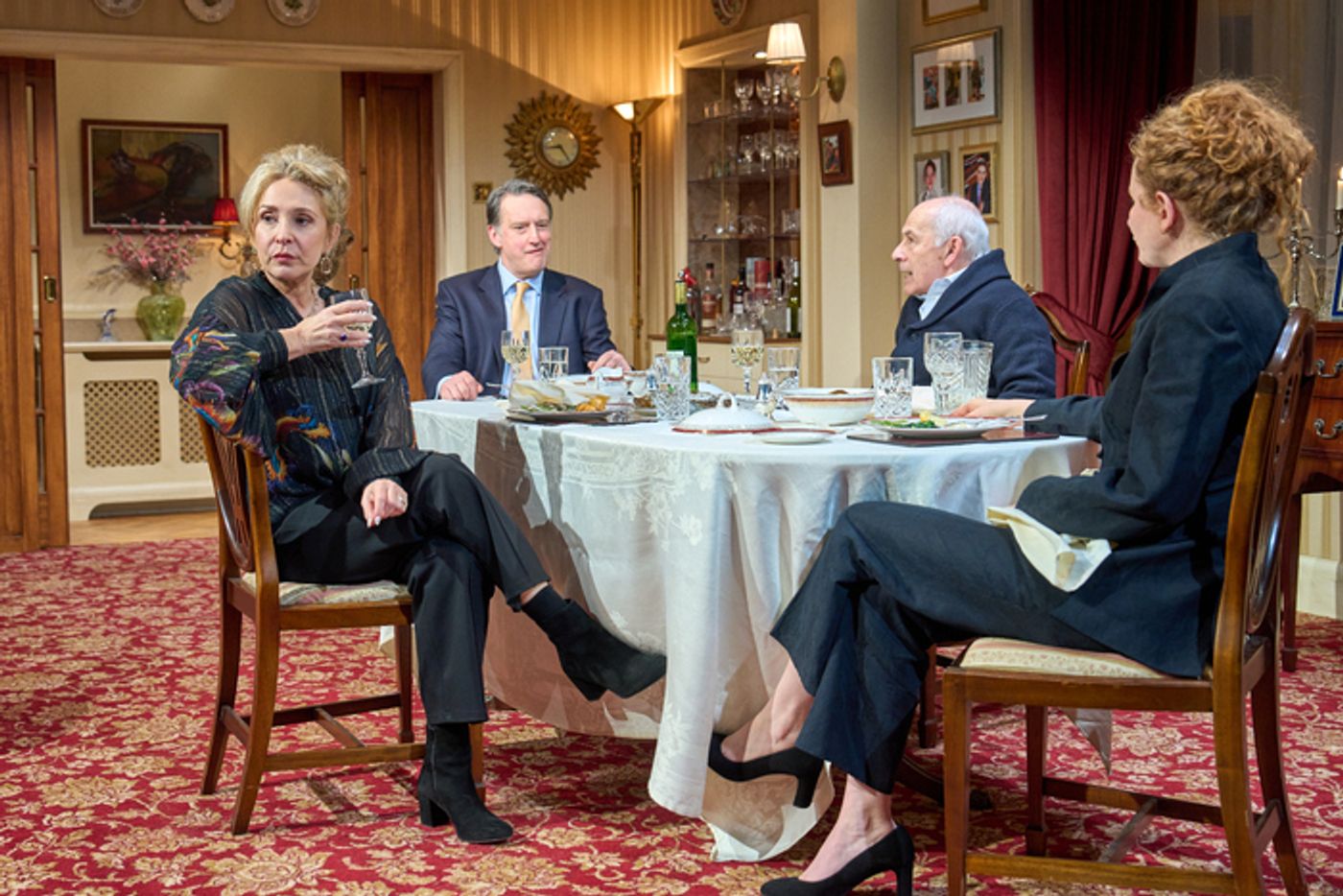
Where is the line between family values and individual principles? It is this complex conversation that is the central focus of this incredibly timely revival of The Holy Rosenbergs.
There is, not unsurprisingly, a flourish of plays about the Middle East at the moment, with plays exploring the lives of those in Palestine and in Israel, with this play, written by Ryan Craig, throwing us into the front room of the Rosenbergs, a small Jewish family living in Edgware facing a crisis of ideas following the death, and upcoming memorial, of son Danny, killed in action for the Israeli Air Force, while defiant daughter Ruth (Dorothea Myer-Bennett) is investigating Israel for war crimes. Amid this, elderly patriarch David (Nicholas Woodeson) is trying to keep his catering business afloat, propped up by his determined, desperate wife Lesley (Tracy-Ann Oberman).
It is a lot to take in, and while there are several different conflicts at play in this piece, Lindsay Posner’s direction straightens them out with great clarity. Craig’s script is not too dissimilar to some of Arthur Miller’s great works, such as Death of a Salesman or All My Sons, where flawed patriarchal figures attempt to keep their homes together even in the face of unfathomable decisions, and this is on display here as David wrestles with his own conscience, his Jewish family’s standings in the community and his fractured relationship with Ruth and lay-about son Jonny (Nitai Levi).
Woodeson’s fragile David mumbles and bumbles across the stage to good success, with the portrayal helping to hide some of David’s fragility and vulnerability. Woodeson’s deft vocal delivery helps make the dialogue feel raw and authentic, especially when discussing faith and values with Rabbi Simon (Alex Zur). Yet it is in the second half, as David’s family and professional life crumble around him, that the depiction of the ageing patriarch shines, more impactful in the quieter moments of reflection, particularly during one brutal exchange between David and an imposing Ruth.
Alongside Woodeson, Oberman’s Lesley is determined to get the Rosenbergs back on their feet despite the tragedies that have befallen them. Lesley’s continual lighting of the Yahrzeit candle, in memory of Danny, is moving, with Oberman balancing this quieter mourning for her son well with the outlandish nature of Lesley’s other traits, seen more boldly during an amusingly urgent thrusting of a macaroon into prospective customer Saul’s (Dan Fredenburgh) mouth. While the production is not a laugh-a-minute, there is a fair amount of humour at play here, most of which comes through Oberman’s well-timed delivery.
Yet it is through Ruth’s character that the play becomes its most complex. Ruth, a UN investigator, places the Rosenbergs in an impossible situation. Initially, their failing catering business is put down to a suspected case of poisoning, yet it quickly becomes clear that Ruth’s investigation into the homeland places the Rosenbergs at odds with their Jewish neighbours. Myer-Bennett’s portrayal of the stubborn Ruth is well-crafted, and it is her continual clashing with David, who cannot reconcile with his daughter’s actions, his son’s death and his own role as a failing father that is so evocative of comparisons to Miller’s work.
This is complicated by the arrival of Sir Stephen Crossley (Adrian Lukis), who is leading the investigation, and Saul, who goes head-to-head in an intriguing conversation about the rights and wrongs of the Israel/Palestine conflict. It is a conversation where there, like in war, are perhaps no winners, and instead goes some way to spotlighting the plight of victims on both sides. Lukis’ Crossley only appears here, but his character’s charm and poise are a neat contrast to the frantic nature of all those around him, perhaps a result of his distance from the conflict itself.
Set in a neat, but not lavish, home (designed by Tim Shortall), the initial suggestion that all is well for the Rosenbergs is quickly dismissed. It is a play that uses a family’s internal conflict as a mirror to one on a global scale, and while the ending is a little abrupt, it is in the poignant final lowering of the lights where the tension, but not the troubles for the Rosenbergs, finally subsides.


