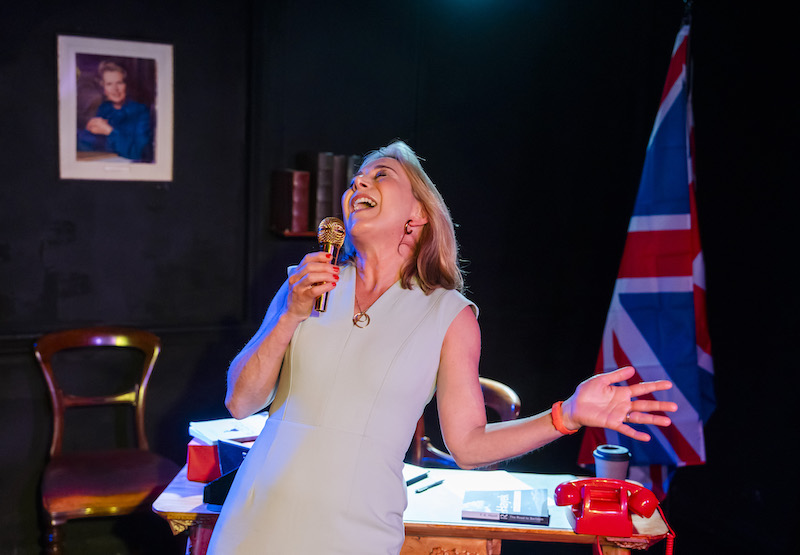
49 days. It was just 49 desperate, chaotic days that Liz Truss was Prime Minister in 2022. Yet in that time, Truss led the nation in mourning, tanked the economy and was trolled by a lettuce, finally finished off by Tory infighting and financial ruin. It is Truss’s time in office, as well as her rise to Number 10, that is the focus of this energetic solo show.
The piece opens on Truss’s last day in office. Surrounded by prime ministerial paraphernalia, books on Ronald Reagan and a looming portrait of Margaret Thatcher on the wall, she cuts a forlorn figure, and one well-crafted over the two-hour runtime by Emma Wilkinson Wright.
Before we get to Truss’s dismal tenure, Greg Wilkinson’s script takes us back to her humble beginnings, from forming her ‘Elizabethan’ identity at primary school, her politicking to get into Parliament and a penchant for karaoke. It is a neat setup, but crucially not one that is totally mean-spirited. There are some reasonable swipes, absolutely, but there is also exploration of Truss’s ideologies that does not feel too cynically portrayed either.
That said, Wilkinson Wright’s portrayal certainly sends Truss up. It is an enthusiastic portrayal, not falling into direct parody but with enough recognisable open-palmed gestures and rising intonation that resembles the beleaguered PM with success. The spotlighting of Truss’s formative years, her precocious childhood marred by bullying and her Oxford success as a northern woman, is a nice touch and again helps to humanise, while never taking the piece too seriously either.
It is only when, however, the piece moves to Truss’s disastrous time in office that the play unravels a little. The focus on her failed economic policies is well-pitched, with Wilkinson Wright’s portrayal of Truss’s naivety representing her urgent panic at the situation well, though this is combined with a subtle arrogance too, gradually eroded away by the nation and its media’s pressure.
Yet as the tables turn on Truss, the play descends into an elongated pro-Trump love-in as she looks to establish a new future for her politics. Wilkinson Wright captures the growing paranoia and slight mania of Truss well here, but it is the length of this section that detracts, plodding through while the rest of the production maintains a healthy, unlike Truss’s reign, momentum. A quieter moment about the importance of growth is neatly lit by Tom Younger, but the attempt at a serious take while Truss grapples with a lettuce contradicts a bit too much for impact.
Steve Nallon lends his voice to a number of characters, most notably the ghost of Thatcher, who amusingly berates Truss as things start to crumble. Others, like Kwasi Kwarteng, are skewered too by the script, with these pre-recordings giving Wilkinson Wright helpful material to react to, but these do feel a little meaner in places.
Unlike Truss, this production goes on a little too long and could use, ironically, a few cuts to fully land. Wilkinson Wright’s performance is terrific, though, and it has some fun moments, especially through Truss’s karaoke obsession, and nods to some of her more barmy speeches, which do work. It is a far more interesting legacy for Liz than her premiership.
This review was originally written for The Reviews Hub: https://www.thereviewshub.com/the-last-days-of-liz-truss-the-other-palace-london/


