The literary successes of George Eliot are well known, but it is her formative years, as the oppressed daughter Mary Ann Evans, which are spotlighted in this intimate new play.
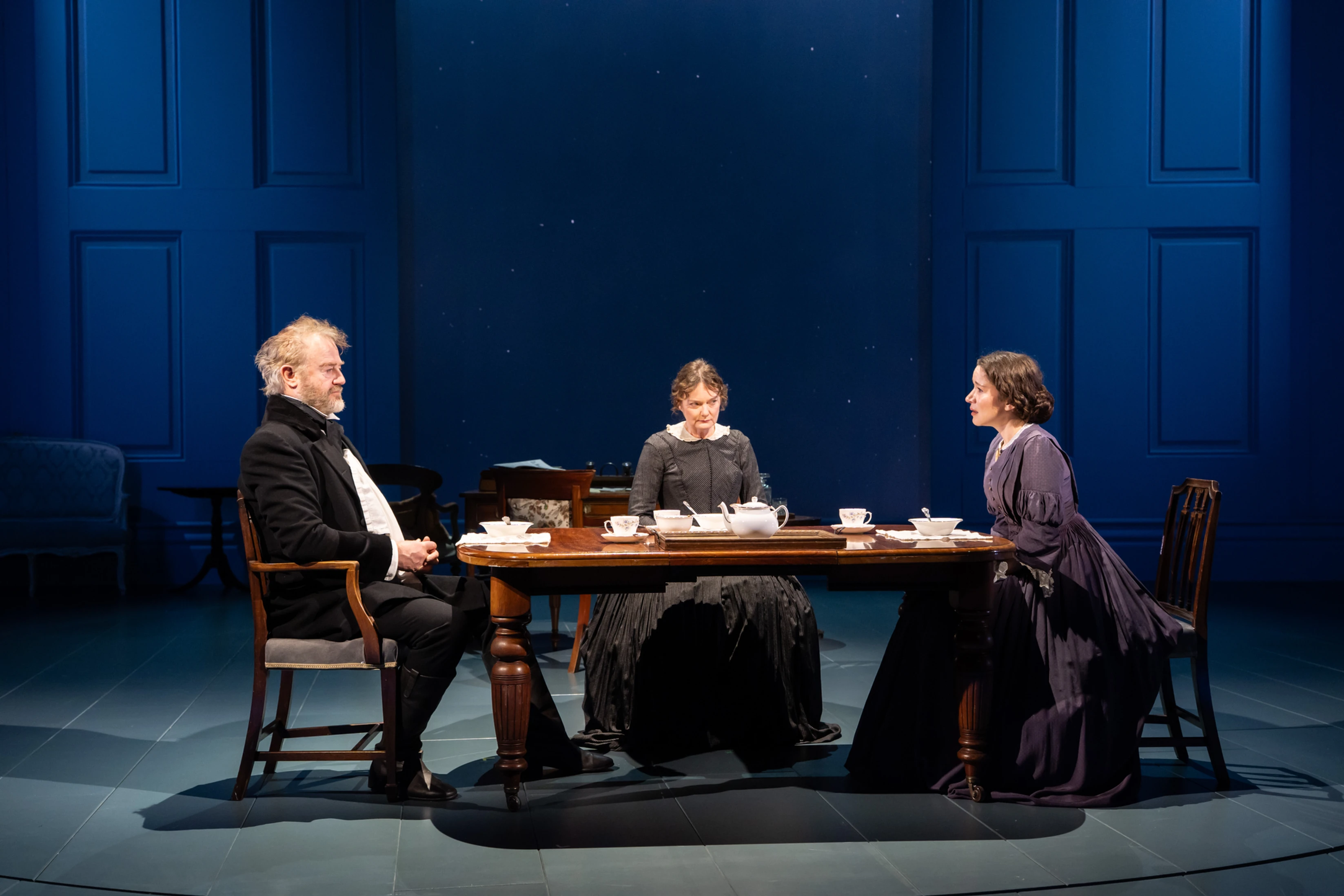
Alexi Kaye Campbell’s new work takes us away from Middlemarch and instead to Bird Grove House, the lavish estate of the Evans family, where Mary Ann (a fantastic Elizabeth Dulau) cares for her ageing father Robert (Owen Teale), while reconciling with her changing beliefs on the world, the growing influence of the radical couple, the Brays, on her world and a life-changing decision that throws her situation into turmoil.
It is an interesting premise, and one executed with some precision by Kaye Campbell’s script and Anna Ledwich’s design, though it also gets a little bogged down in lengthy exchanges and is undermined by an ending that pays lip service to Eliot fans hoping for more on her literary classics.
Nevertheless, it is Dulau’s performance that is the highlight of this production. Mary Ann’s formidable personality and her constant questioning of the world and its workings ultimately drive her to become the great writer she becomes, and it is this thirst for knowledge and its contradiction of expectations for a woman, particularly one of marriageable age, that forms the basis of Dulau’s precise characterisation. Dulau captures Mary Ann’s urgency to achieve more, to read widely and to express her own views, yet expressing her mind, particularly on the role of religion and religious faith in society, leaves Mary Ann ostracised, even from her devoted father, and it is this clash which is spotlighted throughout. While much is made of Mary Ann’s strength and confidence, it is in the quieter moments, screaming into a pillow with frustrated fury, or a gentle sob at the loss of her father, where Dulau truly excels.
Alongside Dulau, Owen Teale’s restrained yet bitter Robert is a nice contradiction to Mary’s open-mindedness. Initially, Robert allows Mary Ann to indulge in her conversations with radical thinkers, and even subtly encourages her self-determination, yet Robert becomes far more interesting once his own religious beliefs and habits are called into question by his daughter. Teale’s depiction of Robert’s quiet, yet desperate, rage is impactful here, though the character’s resolution is rushed in an odd twist to the second half that leaves the piece feeling a little hollow.
Indeed, it is a script that does succeed in what it sets out to do, which is to explore Mary Ann’s formative years, yet it is also one that luxuriates a bit too much and a bit too awkwardly in this respect, too. At 160 minutes, there are a few too many elongated discussions and not-so-subtle conversations that contradict the eloquence of Mary Ann. The inclusion of the Brays, Charles (Tom Espiner) and Cara (Rebecca Scroggs) are necessary, depicted as the progressive, modern thinkers leading Mary Ann astray, especially in the eyes of her conservative brother Isaac (Jolyon Coy), but they also get reduced at times to caricatures, or soundbites without much substance.
Furthermore, the programme offers great insight into Mary Ann’s complicated later life as a writer, juggling relationships with literary success, and one cannot help but wonder whether this is the more interesting part of her life to have explored. At face value, her inner conflict with her faith is an intriguing idea, especially complicated by the presence of pious teacher Maria (Sarah Woodward), but it all explodes and resolves twenty minutes either side of the interval, feeling a little underdeveloped.
That aside, Sarah Beaton’s design helps to throw us into the grand country home, and this is coupled by a deft use of snow which slowly infiltrates the home space, mirroring the growing entrapment of Mary Ann with success. This is also compounded by the costume design, with the extroverted Brays much more colourfully kitted out than the blacks and browns of the sensible Evanses.
By the end, Kaye Campbell’s script finishes by teasing Mary Ann with what was to come. It is a poignant conclusion and a reminder of the hardships women like Mary Ann underwent in order to succeed. It is the story of the foundation of one of England’s greatest writers, yet unfortunately feels a slightly underpolished first draft rather than the final publication.


