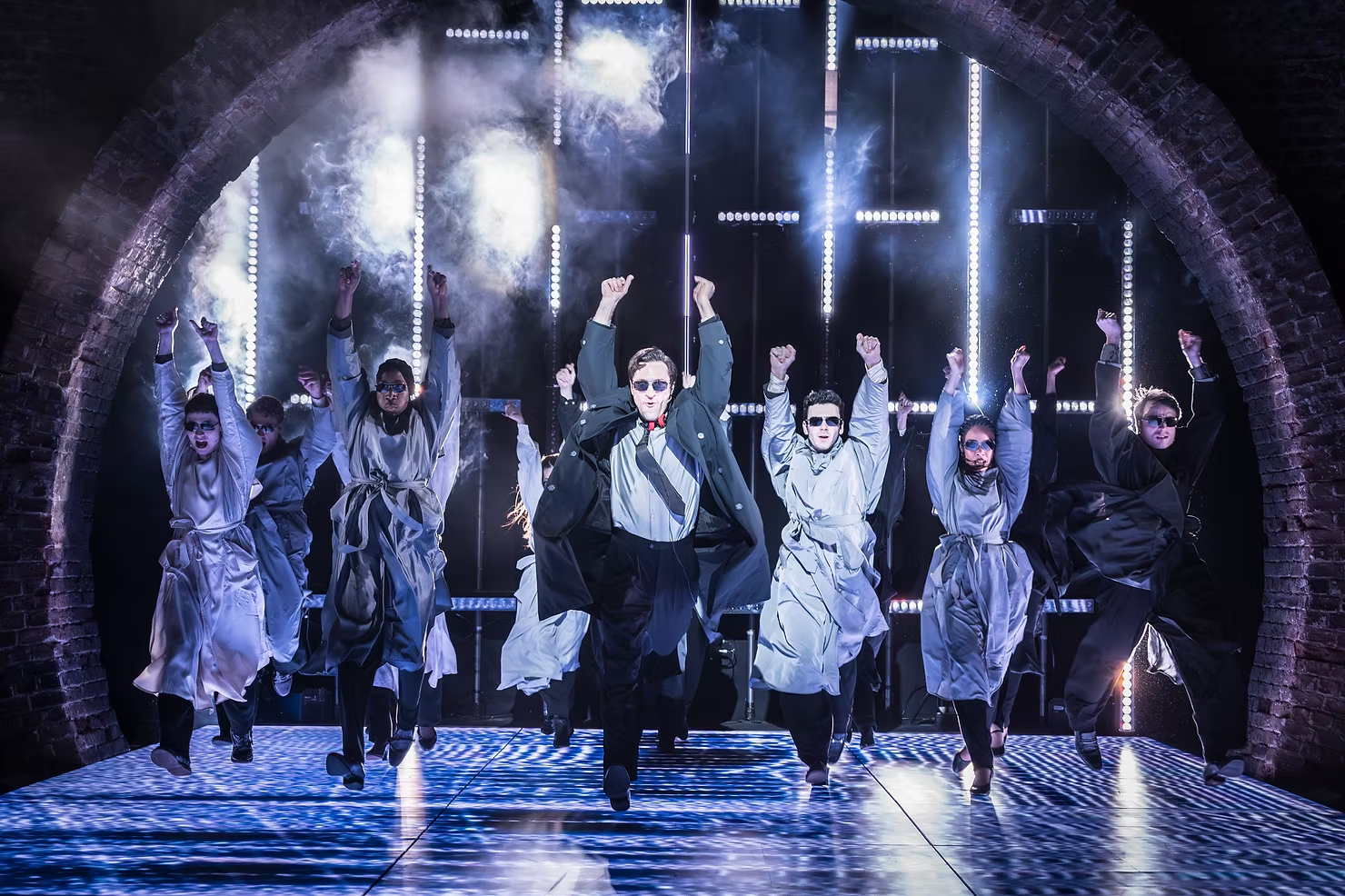
Hedonism, the 1980s and the quest for individual success by any means necessary are all in play in this lavish, bloody and terrifically stylised musical revival.
The story of Patrick Bateman, a man consumed by 1980s materialism, striving to be the best and the determination to be the pinnacle of masculinity by any means necessary, seems all the more timely given the rise of discussions on toxic masculinity and poisonous influencer-culture. Yet in this devilishly entertaining musical adaptation of American Psycho, a revival of the 2013 production also directed by Rupert Goold, the piece leans heavily into the absurdity of such ideologies, to great success.
Where the piece stands out also is that it does not take itself too seriously, even in its most violent moments. Goold’s direction does not attempt to dismember any bodies on stage, utilising screams, blackouts and an awful lot of fake blood to replicate the deranged scenes from its film and book predecessors, and as a result, this fills the musical with a frenetic energy that never lets up, even over its near three-hour run time. It is Patrick’s mania that is in focus here, and we are all just horrified, mesmerised, spectators.
Arty Froushan’s portrayal of Bateman, slowly eroding into an insanity driven by his desire for financial, material and sexual success, is utterly intoxicating. Froushan stalks the stage, a continuous, eerie presence as Bateman eyes up the competition before, literally and metaphorically, chopping them down. Goold’s direction of Froushan has Bateman is slick, with his arrival on stage, in a steamy perspex cubicle setting the tone for the hedonistic indulgences that are the come. Yet it is not just in the dialogue and staging where Froushan shines, but in the delivery of Duncan Sheik’s music too, striking the right balance between murderous rage and deft vulnerability that makes this presentation of Bateman so utterly compelling.
Yet it is not just Froushan’s leading role that enables this production to thrive, but its terrifically talented ensemble cast too. Emily Barber’s Evelyn, Patrick’s indulgent fiancée, is typically vacuous and serves as a neat contradiction to the quietly sweet Jean (Anastasia Martin), Patrick’s assistant, who seems a far more suitable match for Bateman, albeit not matching his financial and societal aspirations. Although a bit on the nose in showing the differences in classes, these two leading women are excellent contrasts in helping Roberto Aguirre-Sacasa and Goold’s respective book and direction regarding their social commentaries on material wealth and identity. In a play about a deranged serial killer, there is no place for subtlety.
Oli Higginson’s Price, Bateman’s friend, is never fully trustworthy, while Tanisha Spring’s Courtney, Patrick’s lover while also engaged to Bateman’s other friend, the closeted Luis (Zheng Xi Yong) are nice nods to the ever-present corruption within this high-flying, money-making society, with the strength of the wider ensemble cast meaning that the production never falters, even in the rare moments Patrick is offstage. Daniel Bravo, meanwhile, as Paul Owen, Patrick’s first on-stage victim, is a lot of fun, confusing Patrick for another banker infurating Bateman, and is chopped up for his mistake.
Despite its 80s setting, the production is anything but retro. Es Devlin’s set is stylised and purposeful, combining successfully with Lynne Page’s exceptional choreography, full of right angles and sharp turns, which are completely relentlessly energetic and engrossing. This is supported by Jon Clark’s bold, bright lighting design and Finn Ross’ video, covering the stage in powerful projections, blasting slogans, pixelated images and brand names across the production to evoke the inescapable capitalism that consumes anyone and everyone in sight.
It also boasts a brilliant set of songs, which, like the rest of the musical, are tongue-in-cheek and reflect the musical’s tone effectively. An early number about business cards (‘Cards’) during Act One exposes the trivial nature of male identity and status in this world, while the rest of the book does not often fall into typical musical theatre tropes, such as luxuriating in a typically slow lead-up to the play’s climax.
Indeed, although the piece is played at breakneck speed, this is exactly the urgency it needs to make Bateman’s collapse so utterly compelling. Patrick strives for perfection, and while the production does not need to get its hands dirty to do this in the same way that its protagonist does, the result is a bloody masterpiece. A thrilling revival.


