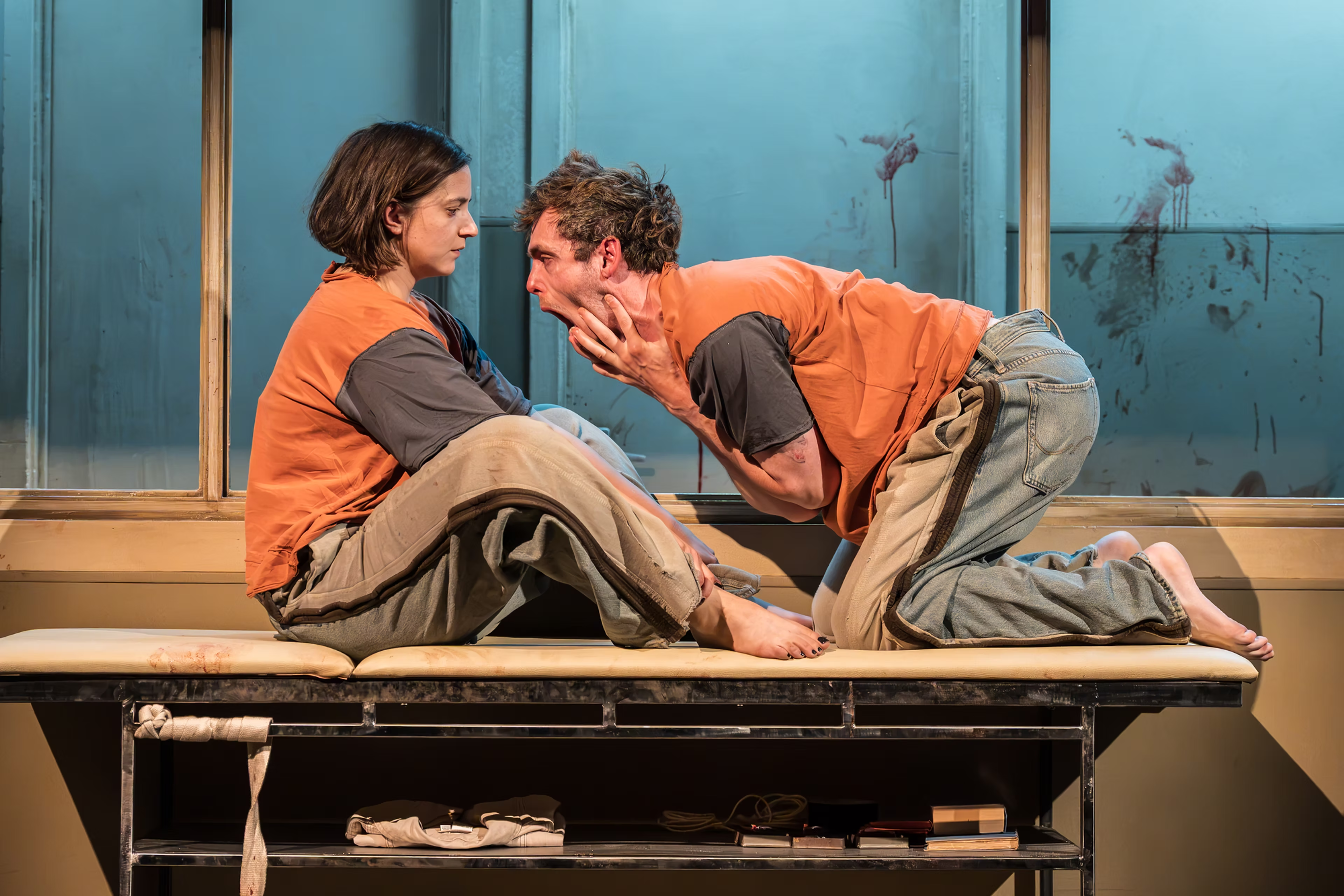
There is nothing quite like taking a seat for a Sarah Kane play, even if you know what is to come. With Cleansed, its visceral violence, unsettling relationships and remarkable attempts at both hope and nightmare, there is a great deal to anticipate, and under Rebecca Frecknall’s bold and unrelenting direction, this revival of the acclaimed and derided work largely succeeds.
What is striking about the play as it opens is the blend of clarity and vagueness, which immediately forces audiences into a state of interpretation. The piece is set in a university, but one hell-bent on removing ‘undesirables’ from society, under the actions of the barbaric Tinker (Leo Bill), who appears to take great strength from his cruel and brutal treatment of those incarcerated. Locked up away from society are two men, Rod (Parth Thakerar) and Carl (Luke Cinque-White), seemingly for their homosexuality; another young man, Robin (Stuart Thompson), whose reasons for being there are initially unclear, and the heartbroken Grace (Pearl Chanda), seeking answers and warped closure about her dead brother, Graham (Jack Riddiford).
It is a tightly knit production, and one which refused, from the play’s opening, to pull back from the immense violence in Kane’s work. The trigger warnings for this play are endless, and the violence opens with an unimaginable injection that sets the standard for the horror to come. The torture the characters go through with increasing intensity. Being moved by this violence is impossible to avoid, but there is something that feels a little restrained in 2026, perhaps representative of a society where such extreme violence is more accessible and prevalent now on screen, that reduces some of Cleansed’s original impact.
That said, where Frecknall’s staging of this work shines is in exposing the raw intimacy of the characters. Chanda’s Grace and her incestuous fantasies about brother Graham are disturbing and fiercely passionate, yet there remains something tender and vulnerable about this character, devastated by the eradication of her sibling. Rod and Carl, increasingly tortured and violated by Tinker, are still, amid the blood and screaming, given gentler moments of affection, drawn out by their resilience to the violence they endure. Meanwhile, Thompson’s Robin, sweet and seemingly naive, has one of the play’s most shocking and awful moments, in an act of violence that is predictable yet still just as disturbing.
Bill’s Tinker is vicious and relentless, but the direction of Bill here sharpens the character’s warped personality, with slower, meticulous movements and a brutal control of those around him, especially Robin, reiterating the innate violence of the man who represents society’s intolerance to individuality. While the common interpretation of this play being the characters’ dreams remains firmly in the spotlight, it is Tinker who haunts their nightmares through increasingly more horrifying spectacles of abuse, which the character clearly enjoys.
There are a few moments, however, which undo some of the piece’s hard work. The play has some incredibly difficult stage directions to pull off (such as rats running off with severed limbs), but the decision to pull the boxed stage back to reveal a meadow of sunflowers, while being a neat touch and a nod to the hope amid the desperation of the characters, pulls the action too far from the audience, removing the intimate closeness which had until then maximised the violent effects. Moreover, the keenness to demonstrate the violence on stage hits and misses too. The terrific fight choreography by Sam Lyon-Behan is superb in blending the ideas of what is real and what is not in this play, but the lengthy and clumsy execution of onstage amputations takes too long for the moments to have much impact, and has been done better in other, similarly violent productions (such as Shakespeare’s Globe’s Titus Andronicus).
Much of the pre-show hype, and post-show horror, has fixated upon the ultra-violence of the work, and this still largely remains. But what Frecknall succeeds in here is reiterating the human quality of this work, and the strength and danger of human connection, and tolerance. A revival that will linger in the memory.


